The Grateful Dead’s First Bassist Lasted Only 4 Shows
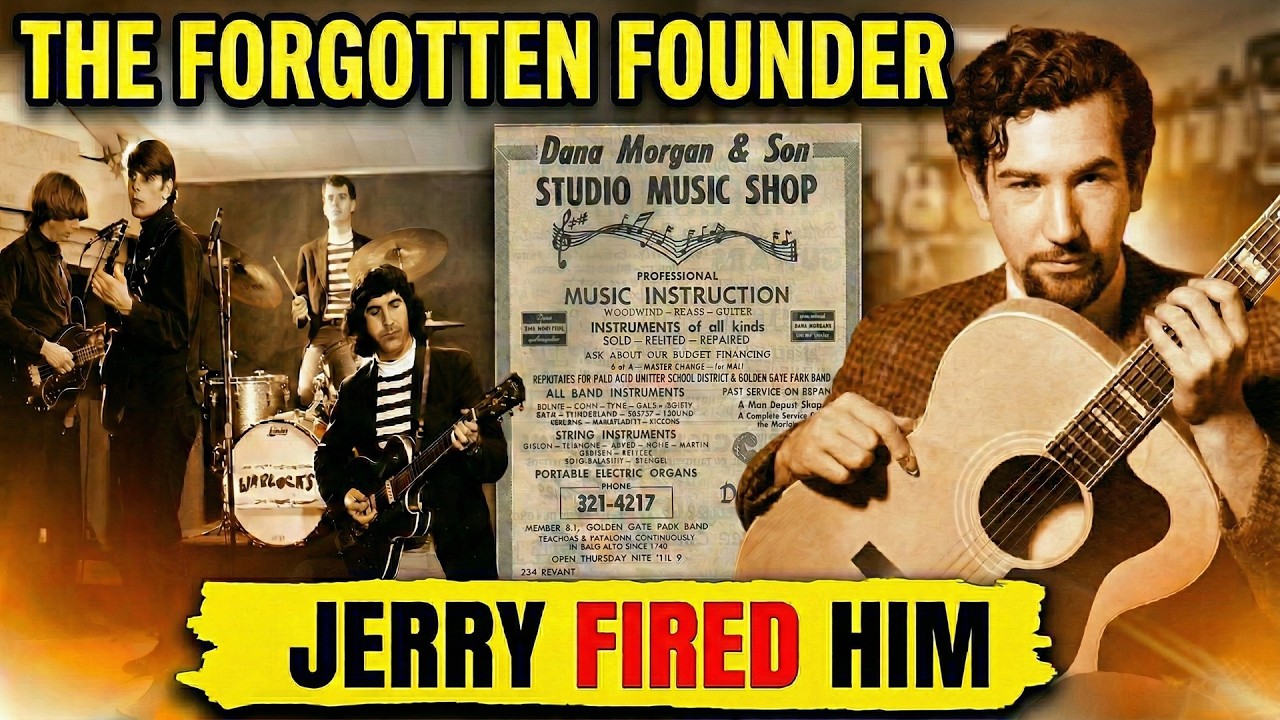
Most people think the Grateful Dead started at an Acid Test. They didn’t. They started in the back of a music store — playing for a guy named Dana Morgan Jr., who they fired after 4 shows.
Dana Morgan’s Music Store
Before they were the Grateful Dead, before they were even the Warlocks, Jerry Garcia, Bob Weir, and Ron “Pigpen” McKernan were hanging around Dana Morgan’s music store in Palo Alto, California. Dana Morgan Sr. ran the shop; his son, Dana Morgan Jr., played bass — or at least he tried to. Morgan Sr. offered the band free rehearsal space in the back of the store, and the implicit deal was clear: his son would be part of whatever group they formed.
The arrangement started in late 1964. Garcia was already the focal point — a magnetic fingerpicker who’d been working the folk scene around Palo Alto and Menlo Park. Weir was the kid of the group, barely seventeen, who showed up at a New Year’s Eve party where Garcia was playing and essentially refused to leave. Pigpen brought the blues — the real, gritty, howling Chicago stuff he’d absorbed from his father, a rhythm and blues DJ.
The Problem With Dana Jr.
The problem with Dana Morgan Jr. wasn’t that he was a bad person. It was that he couldn’t keep up. The music these guys were making in the back of his father’s store was evolving fast — from jug band folk to electrified rock and roll to something that didn’t have a name yet. Morgan was a competent enough player for simple chord progressions, but the jams were already starting to stretch. Garcia and Weir were pushing into uncharted territory, and Morgan couldn’t follow them there.
The band played their first gig as the Warlocks on May 5, 1965, at Magoo’s Pizza Parlor in Menlo Park. Morgan was on bass. They played a handful of shows — accounts vary, but most sources place it at three to five gigs total. The music was raw, basic rock and roll covers with some original material mixed in. But even at this embryonic stage, the other musicians could tell something wasn’t working.
Phil Lesh Changes Everything
The solution arrived in the form of Phil Lesh, a classically trained musician and electronic music composer who had been working at KPFA radio in Berkeley. Garcia knew Lesh from the folk scene and invited him to see the Warlocks play. Lesh had never played bass guitar in his life, but Garcia saw something in him — a musical mind sophisticated enough to keep up with wherever the music was going.
Lesh agreed to join, and Morgan was out. There was no dramatic confrontation, no ugly scene. The band simply told him it wasn’t working and moved on. Morgan continued working at his father’s store, and the Warlocks continued their rapid evolution — adding Bill Kreutzmann on drums, renaming themselves the Grateful Dead, and stumbling into the Acid Tests that would define their identity.
The irony of Dana Morgan Jr.’s brief tenure is that his father’s generosity — free rehearsal space, free equipment access — was essential to the Grateful Dead’s formation. Without that back room at Morgan’s music store, the band might never have come together. Morgan Sr. essentially subsidized the birth of one of America’s most important bands. His son just wasn’t meant to be part of what emerged from it.
The Live Experience
The Grateful Dead’s live performances were fundamentally different from those of any other major rock band. While most acts rehearsed and repeated a fixed setlist, the Dead approached each show as a unique event. Setlists were chosen shortly before the performance, and the transitions between songs — the spaces where improvisation lived — were entirely spontaneous. A concert might last three hours or more, moving through structured songs, extended jams, and passages of pure collective improvisation that could be transcendent or chaotic, sometimes both simultaneously.
This approach demanded extraordinary musical communication. Each member of the band had to listen constantly to every other member, responding in real time to melodic suggestions, rhythmic shifts, and dynamic changes. Garcia often described it as a conversation — not a performance, but a dialogue between musicians who had developed, over years of playing together, an almost telepathic understanding of each other’s musical instincts. When it worked, the result was music that felt inevitable and surprising at the same time.
The Chemical Reality
Drugs were inseparable from the Grateful Dead’s story, but the relationship was more complex than the caricature suggests. LSD was foundational — the Acid Tests were the crucible in which the Dead’s improvisational approach was forged, and psychedelics informed the expansive, boundary-dissolving quality of their music throughout their career. But the drug culture that surrounded the Dead evolved over the decades, and not always in positive directions.
By the 1980s, harder drugs — particularly cocaine and heroin — had infiltrated both the band and their community. Garcia’s well-documented struggles with heroin addiction took a devastating toll on his health and his playing. The parking lot scene, once dominated by psychedelics, increasingly included dealers selling substances that were addictive and dangerous. The Dead’s open, tolerant culture — which had been a strength in the 1960s and 1970s — became a liability when that openness was exploited by people whose relationship with drugs was destructive rather than exploratory.
What Came After
The transition from Dana Morgan Jr. to Phil Lesh was more than a personnel change — it was the moment the Grateful Dead became the Grateful Dead. Lesh brought a musical vocabulary that no rock bassist of his era possessed. His training in classical composition and electronic music meant that he approached the bass not as a rhythm instrument but as a melodic voice equal to Garcia’s guitar. The interplay between Garcia and Lesh — two musicians listening to each other with extraordinary attention, weaving melodic lines that complemented and challenged each other — became the foundation of the Dead’s improvisational language.
Morgan Jr.’s brief tenure is worth remembering not as a failure but as a necessary step. The Dead needed to discover what they weren’t before they could become what they were. Morgan represented the conventional — a competent musician playing conventional rock bass in a conventional way. The Dead needed something unconventional, and they found it in a man who had never held a bass guitar before Garcia put one in his hands.
Related Articles
- How Ken Kesey’s “Suicide” Changed The Grateful Dead Forever
- From Jug Bands to Grateful Dead: The Folk and Bluegrass Roots of American Rock
- How LSD and the Acid Tests Created the Grateful Dead’s Iconic Sound and Performance Philosophy
The Shakedown Archives publishes new research on Grateful Dead history each week. If you enjoyed this essay, you can subscribe to the companion YouTube channel below.
Subscribe on YouTube