The Mistake That Killed Jimi Hendrix — and Saved the Grateful Dead
Two Bands, Two Philosophies, One Festival That Changed Everything
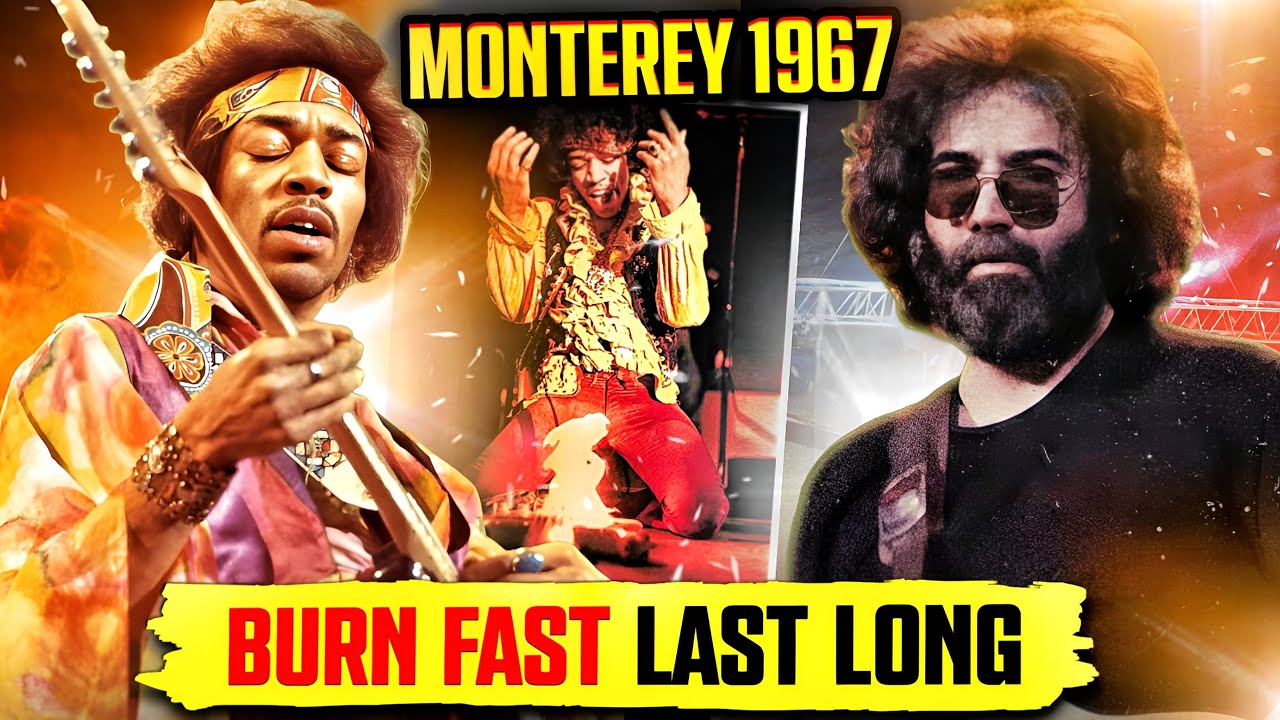
Monterey Pop Festival, June 1967. The Grateful Dead took the stage right after The Who destroyed their instruments, and just before Jimi Hendrix set his own guitar on fire. Phil Lesh later called their set terrible. Jerry Garcia said they got erased. What most people don’t know is that the film crew literally ran out of footage during the Dead’s performance—the result of long, wandering improvisations with no clear beginning or end. When D.A. Pennebaker’s documentary was released, there was no visual proof the Dead were even there. Meanwhile, Hendrix closed the festival with an image so powerful it would define him forever.
This single moment at Monterey Pop illuminates two fundamentally different approaches to building a band. One system optimized for maximum brilliance and spectacle. The other designed for longevity and collective survival. Both would prove lethal, just on completely different timelines.
The Spectacle vs. The Collective Conversation
The Dead refused to be filmed that day—a deliberate choice that reflected their distrust of how they’d be presented. What Pennebaker’s crew captured anyway were long, exploratory improvisations: a fifteen-to-twenty-minute version of “Viola Lee Blues” with no clear structure, no hits, no climax to wait for. All six musicians were having a conversation through their instruments, and the film crew couldn’t figure out when to stop rolling, so they simply ran out of film. The Dead vanished from the official record of one of rock history’s most important weekends.
Hendrix’s team, meanwhile, understood spectacle. His management—Chas Chandler and Mike Jeffrey—carefully orchestrated the guitar sacrifice. It wasn’t spontaneous. It was planned and rehearsed: douse the Stratocaster in lighter fluid, set it on fire, smash it, and let the crowd lose their minds. Jerry Garcia, watching from the wings, would later say it was one of the best performances he’d ever seen. Hendrix had a visual quality that was simply untouchable.
But here’s what that image cost: once you’ve burned your guitar at Monterey, what do you do next weekend? Hendrix’s management started pushing him to repeat the formula. Documentation shows that Jeffrey and Chandler actively discouraged the long free-form jams Hendrix actually wanted to play. “Hit records sell tickets,” they told him. “Experimental jams don’t lock it down. Be repeatable.” This was a genius who wanted to push music into uncharted territory, forced to recreate explosive moments every single night. That’s not a path to sustainability—that’s a burnout machine.
The Missed Session That Revealed Everything
October 1968. Promoter Chet Helms arranged a jam session between Garcia and Hendrix after a Hell’s Angels party in San Francisco. Everyone was excited. Two of the best guitarists on the planet were finally going to see what happened when their styles collided. Hendrix didn’t show up. He was on an acid trip somewhere in the city and just missed it.
A few nights later, Hendrix appeared at the Avalon Ballroom asking if he could sit in with the Dead. The Dead stalled him. They kept playing their set, stretching things out. Eventually, curfew arrived, the venue closed, and Hendrix never got on stage.
Why would they do that? There’s no clean answer, but what was likely happening is that the Dead system was protecting itself—maybe not even consciously. Hendrix represented everything they’d chosen not to be: a singular genius who redefined the ceiling of what’s possible on a guitar. If you let that energy into the middle of your collective improvisational conversation, what happens? Does the whole thing bend around him? Does it stop being a conversation and become a showcase?
The Dead spent three years building a band where no one person is the center. Garcia was the lead guitarist, but Phil Lesh was playing melodic bass runs that were practically lead parts. Mickey Hart and Bill Kreutzmann created a polyrhythmic engine underneath everything. Pig Pen anchored the blues foundation. It was designed as six people talking, not one person soloing while five people accompanied.
Woodstock: Where Both Systems Cracked
August 1969. The Dead played Saturday night in pouring rain with technical problems—shocks from microphones, amps cutting out, the usual festival nightmare. But the real issue was psychological. Mickey Hart later admitted they were terrified not of the music, but of the crowd. Half a million people. The Dead were used to playing the Fillmore, the Avalon, places where they could see faces and feel the room. This was too big. The system couldn’t process it. Hart said flat out they played badly, and the tapes confirm it: tentative, scared, disconnected.
But here’s what mattered: the Dead survived it. Next weekend, they were playing another show. The system absorbed the failure, adjusted, and kept going. That’s what it was designed to do.
Hendrix closed the festival Sunday morning with the Star Spangled Banner—a howling, feedback-drenched meditation on Vietnam and chaos and everything the country was tearing itself apart over. It was brilliant and completely unrepeatable. When you’re operating at that level, every performance resets the baseline. Hendrix couldn’t just play a good show—he had to play a transcendent show. And the human body can’t sustain that, especially when you’re touring constantly, using substances to manage the pressure, and your management is telling you to keep being the guy who burned his guitar at Monterey.
The Final Collapse and the Band That Kept Going
By 1970, Hendrix was trying to escape. He recorded “Band of Gypsies” with Buddy Miles and Billy Cox—funk, jazz fusion, an attempt to move past the spectacle template. You can hear him stretching out, experimenting, finding new spaces. He was trying to build something different, but the pressure was relentless. The touring schedule was brutal. “Play the hits. Be the spectacle. Come back to what works,” his management demanded.
September 18, 1970. Hendrix died in London at 27 in a flat in Notting Hill with his girlfriend Monika Dannemann. The system overheated and collapsed.
The Dead responded differently. That same year, they released “Workingman’s Dead” in June—songs like “Uncle John’s Band” and “Casey Jones”—and “American Beauty” in November. No twenty-minute Dark Star jams. Tight, song-oriented Americana material. It was shocking for a band known for extended improvisations. Bob Weir later explained they needed to prove they could actually write songs, not just improvise forever. It was a recalibration. The system recognizing that pure improvisation has limits.
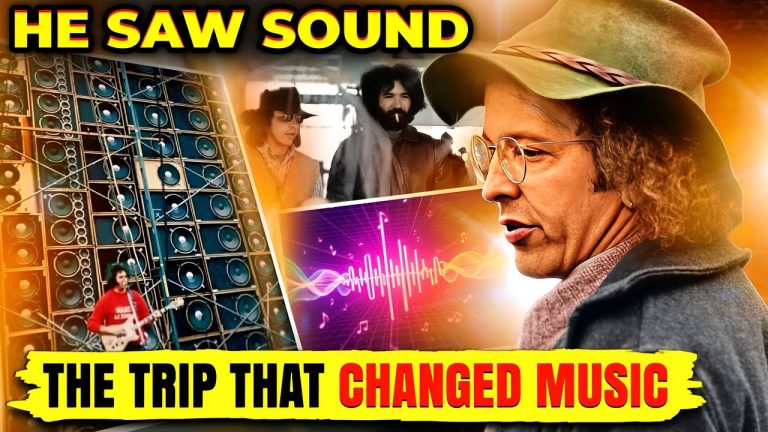
They built the Wall of Sound in 1974—an insane experimental sound system designed to solve every technical problem they’d ever had. It nearly bankrupted them, requiring multiple trucks and a massive crew. They took a hiatus in 1975 partly because they couldn’t sustain the expense. They came back in 1976 with a more manageable setup. They adjusted. They kept going.
The Mythologies We Create
Neither model was sustainable in the long run. One burned hot and fast. The other burned slow. Both ended up in the ground. But we mythologize them completely differently.
Hendrix gets frozen at 27—forever young, forever brilliant, forever the guy setting his guitar on fire at Monterey. We don’t have to watch him age or compromise or put out a mediocre album or fail to live up to his own legend. The mythology stays clean, pure, tragic, but perfect.
The Dead get mythologized as survivors—a communal experiment that somehow made it work against all odds. But anyone who actually followed the band knows the reality was messier. Shows were uneven, sometimes transcendent, sometimes just okay, sometimes bad. The scene got complicated. Jerry got sick. People died. Three keyboardists passed away—Pig Pen in 1973, Keith Godchaux in 1980, Brent Mydland in 1990.
Jerry Garcia died on August 9, 1995, at a rehab facility in Marin County. Heart failure. He was 53 years old. Not 27, but 53. The system lasted 30 years longer than Hendrix’s did, but it still killed him.
Both systems failed. They just failed at different speeds and for different reasons. If you’re Hendrix, the cost is everything immediately—three years of redefining what’s possible and then you’re gone. If you’re the Dead, the cost is everything eventually—thirty years of keeping the machine running, absorbing shocks, touring through deaths and addictions and financial disasters until finally the engine can’t turn over anymore. Either way, the bill comes due. You just get to choose how you pay.
Subscribe to The Shakedown Archives for more Grateful Dead documentaries, and explore more stories at TheShakedownArchives.com.
The Shakedown Archives publishes new research on Grateful Dead history each week. If you enjoyed this essay, you can subscribe to the companion YouTube channel below.
Subscribe on YouTube