How Owsley ‘Bear’ Stanley’s LSD Shaped the Grateful Dead’s Sound
The Moment Acid Met Technology
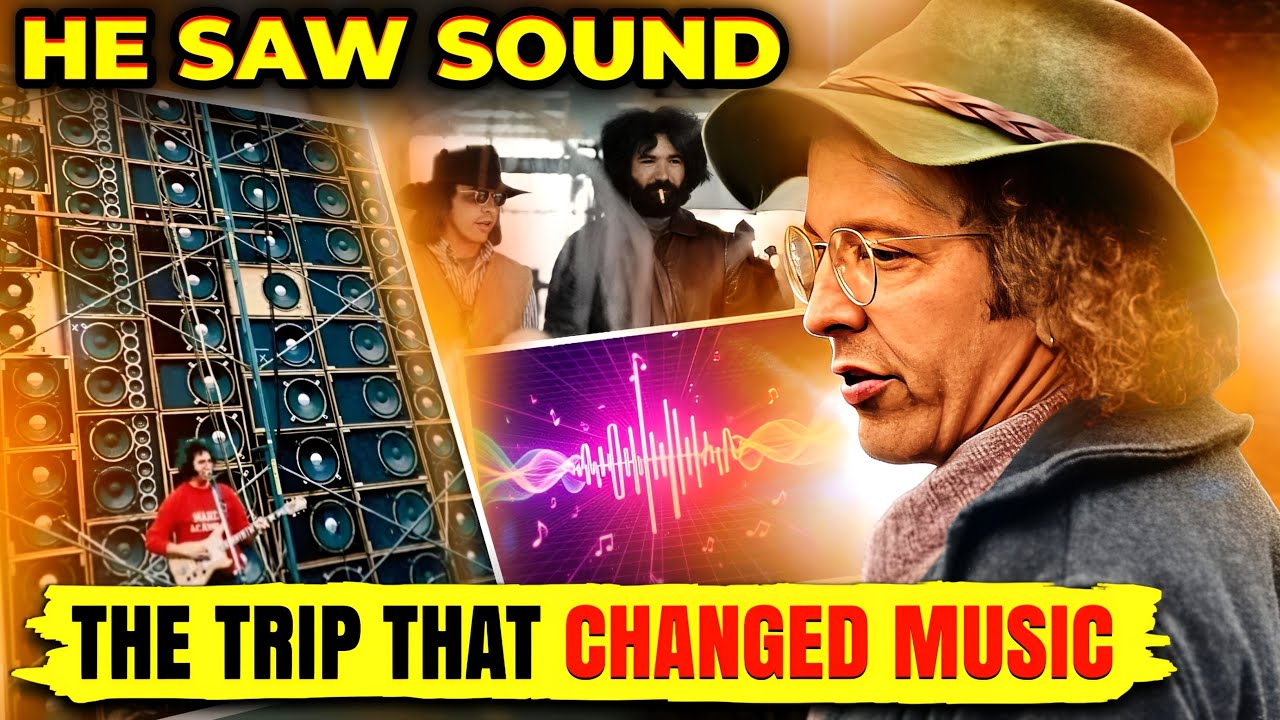
Before Owsley “Bear” Stanley became synonymous with the Wall of Sound—the most ambitious and technologically sophisticated sound system ever deployed in rock music history—and before he became the Dead’s legendary soundman, there was a single moment in 1965 that set everything in motion and defined his entire approach to audio engineering. Augustus Owsley Stanley III, a brilliant but unconventional engineer obsessed with technical perfection and acoustic purity, took LSD and experienced something that would haunt and inspire him for the rest of his life: he literally saw sound coming out of speakers. Not metaphorically, not as poetic description, but as visible waves of acoustic energy moving through space. He watched the air itself seem to shimmer and move in response to sound, as though audio frequency had been translated into visible light and energy. That experience, and the obsessive mission it created, would reshape rock and roll forever and define decades of his work.
The Engineer’s Epiphany
What Owsley experienced wasn’t a hallucination or a malfunction of consciousness, but a perceptual shift common to certain LSD experiences where sensory boundaries blur and synaesthetic perception—the crossing of sensory modalities—becomes real and vivid. For an engineer obsessed with the technical challenges of sound reproduction and the physics of audio, this experience posed an impossible challenge that would consume the rest of his life: How do you make sound visible? How do you engineer an amplification system so powerful and precise that the physical impact of the sound is literally felt by the audience, creating a synesthetic experience where the boundary between hearing and feeling collapses? Owsley set himself the obsessive task of turning his acid vision into reality, of engineering the music itself into tangible presence.
The Wall Emerges
The Wall of Sound wasn’t simply bigger than other sound systems—it represented a fundamental paradigm shift in how rock amplification could be conceived and executed. Where most bands used a single amplification point somewhere on or near the stage, the Wall created a comprehensive acoustic space where sound surrounded the audience from all sides, above and below, creating three-dimensional immersion. Owsley’s system didn’t just play music louder; it created an environment of sound, achieving a kind of three-dimensional sonic presence that matched his acid vision of sound as a visible, tangible force. The system required unprecedented technical sophistication, thousands of watts of amplification carefully distributed across the space, and a completely reimagined approach to speaker placement, phase coherence, and frequency management that pushed the boundaries of what was technically possible.
LSD as Technical Inspiration
Owsley’s story challenges the popular narrative that LSD and rock and roll were connected purely at the level of psychedelic aesthetics, visual imagery, and trippy lyrical content about consciousness and spirituality. For Owsley, acid was a technical inspiration, a doorway into new ways of thinking about sound as a physical phenomenon rather than an abstract artistic gesture. His LSD experience didn’t lead him to make prettier or more psychedelic music; it led him to ask fundamentally new questions about what sound could do to human consciousness and perception when reproduced with enough precision and power. In this sense, the Wall of Sound was acid’s truest technical legacy to rock and roll, not a visual or aesthetic statement but a physical and acoustic one.
The Soundman as Artist
Before Owsley, the person mixing the sound was invisible, a technical functionary serving the band and the audience, working from a behind-the-scenes position with little recognition or artistic agency. Owsley transformed the soundman into an artist whose creative decisions were as important as those of the musicians themselves. His choices about frequency response, speaker placement, dynamic balance, and real-time mixing were as important to the Dead’s artistic output as the musicians playing instruments. The audience wasn’t just hearing the Dead’s music; they were experiencing Owsley’s vision of what that music could become when translated into the most powerful, sophisticated sound reproduction possible. His one LSD trip in 1965, and the obsessive mission it launched, proved that sometimes the most important contributions to rock and roll come not from those who play instruments but from those who figure out new ways to transmit and transform sound through space and into consciousness.
Subscribe to The Shakedown Archives for more Grateful Dead documentaries, and explore more stories at TheShakedownArchives.com.
The Shakedown Archives publishes new research on Grateful Dead history each week. If you enjoyed this essay, you can subscribe to the companion YouTube channel below.
Subscribe on YouTube