The Night the Grateful Dead Played a Lunar Eclipse in Egypt
September 1978: A Date with Destiny
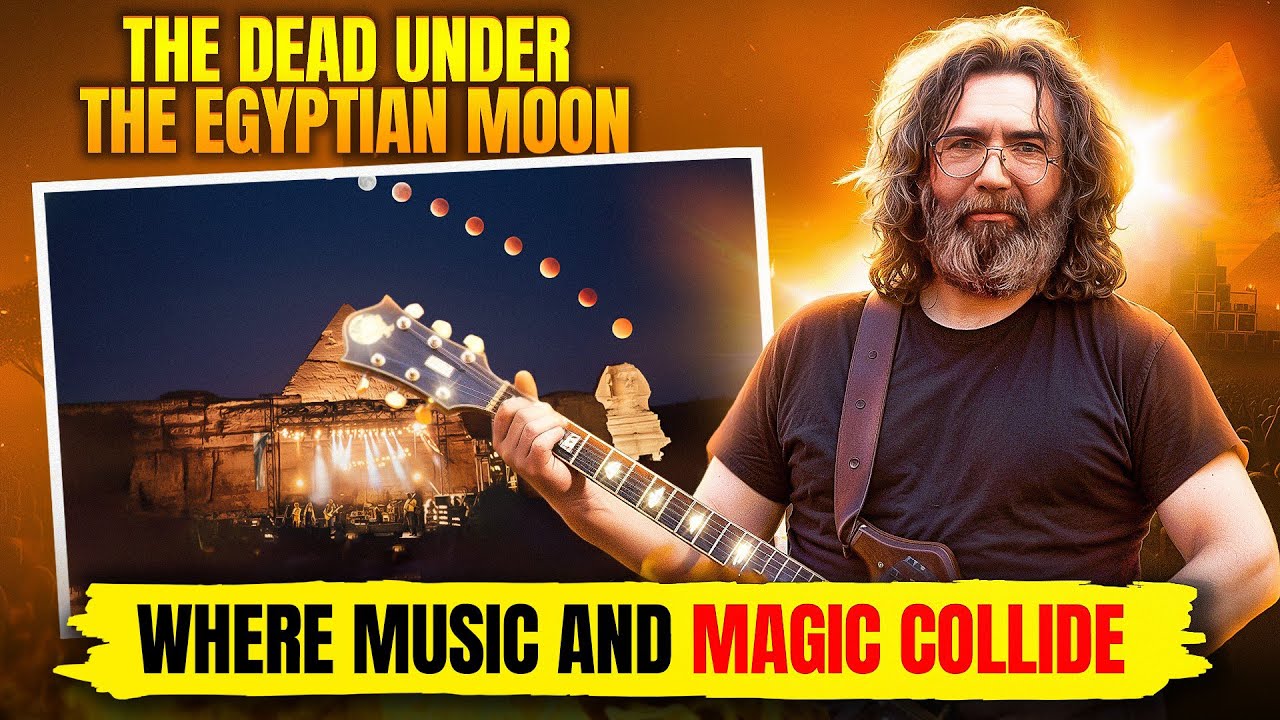
September 16th, 1978. The Grateful Dead found themselves on one of the world’s most iconic stages—the Great Pyramid of Giza—performing for an audience that stretched across the Egyptian desert. It was an extraordinary achievement, a moment that seemed almost impossible just years earlier. The band was mid-performance of “Fire on the Mountain,” and the crowd was fully engaged in the music, lost in the hypnotic groove that only the Dead could create.
Then something unexpected began to unfold in the sky above them. The moon didn’t disappear behind clouds. There was no technical glitch or equipment failure. Instead, the moon itself started to vanish—slowly at first, then completely. A total lunar eclipse was unfolding in real time, visible from the pyramid to anyone looking up from the stage or the crowd.
Cosmic Synchronicity
Jerry Garcia and the band continued playing, aware of what was happening but not stopping to acknowledge it directly. For the Grateful Dead, cosmic coincidences were part of the mystical fabric of their existence. They believed in synchronicity, in the alignment of earthly events with celestial patterns. The universe occasionally confirmed their artistic mission by orchestrating moments that seemed almost impossibly perfect.
The convergence of elements was staggering: a legendary rock and roll band performing at one of humanity’s most ancient monuments, under the light of an eclipsing moon. For those present, it created a moment that transcended typical concert experience. The music, the setting, the astronomical event—all combined to create something that existed outside normal reality, in the realm of pure experience.
When Music Meets the Heavens
Playing at Giza was already an extraordinary achievement. The logistics alone were monumentally complex. Getting equipment, crew, and band members to Egypt, setting up on sacred ground, managing the technical aspects of a major concert at such a location—these were feats that required months of planning and thousands of decisions. Yet the Grateful Dead had always sought out these kinds of boundary-pushing moments.
The lunar eclipse elevated the night from remarkable to transcendent. In the worldview the Dead occupied—one informed by rock and roll mysticism, spiritual exploration, and a belief that the universe operated according to patterns and synchronicities—the eclipse wasn’t random chance. It was confirmation. The cosmos was validating what they were doing, blessing this moment with celestial participation.
The Ancient and the Modern
Standing before the Great Pyramid, one of humanity’s most enduring structures, while performing music that pushed the boundaries of what rock and roll could be, the Grateful Dead occupied a unique cultural space. They were simultaneously deeply rooted in ancient human traditions of gathering, music-making, and spiritual practice, while being completely modern and experimental in their approach.
The pyramid had stood for thousands of years, constructed by ancient peoples who also understood the power of gathering, of creating monuments, of marking cosmic events. Now, in 1978, the Dead were adding their own chapter to that long human story—musicians performing under an eclipsing moon, continuing traditions of music and ceremony that stretched back beyond written history.
Witness to the Extraordinary
For everyone present that night, the experience created a permanent mark. The music from those performances circulated through the Dead community, carrying with them the story of what had happened—not just what was played, but what was witnessed. The lunar eclipse became inseparable from the music, part of the permanent record of that moment.
This was characteristic of how the Dead’s greatest moments often unfolded. They didn’t always happen in the most obvious venues or under the most controlled circumstances. Sometimes they happened when cosmic forces aligned, when the band was in the right place at exactly the right moment, when the universe seemed to collaborate with their artistic vision. The pyramid, the eclipse, the music, and the crowd all converged into something that existed beyond the ability of mere words to fully capture.
A Moment Beyond Explanation
Years later, those who were present would struggle to adequately describe what they’d experienced. How do you explain the convergence of seeing the Great Pyramid, hearing the Grateful Dead, and watching a total lunar eclipse all at once? It transcends the realm of mere concert experience and enters something closer to spiritual event. It becomes the kind of moment that people speak about in hushed tones, the kind of thing that defined a lifetime of Dead fandom, the kind of memory that never quite fades regardless of how many decades pass.
Subscribe to The Shakedown Archives for more Grateful Dead documentaries, and explore more stories at TheShakedownArchives.com.
The Shakedown Archives publishes new research on Grateful Dead history each week. If you enjoyed this essay, you can subscribe to the companion YouTube channel below.
Subscribe on YouTube