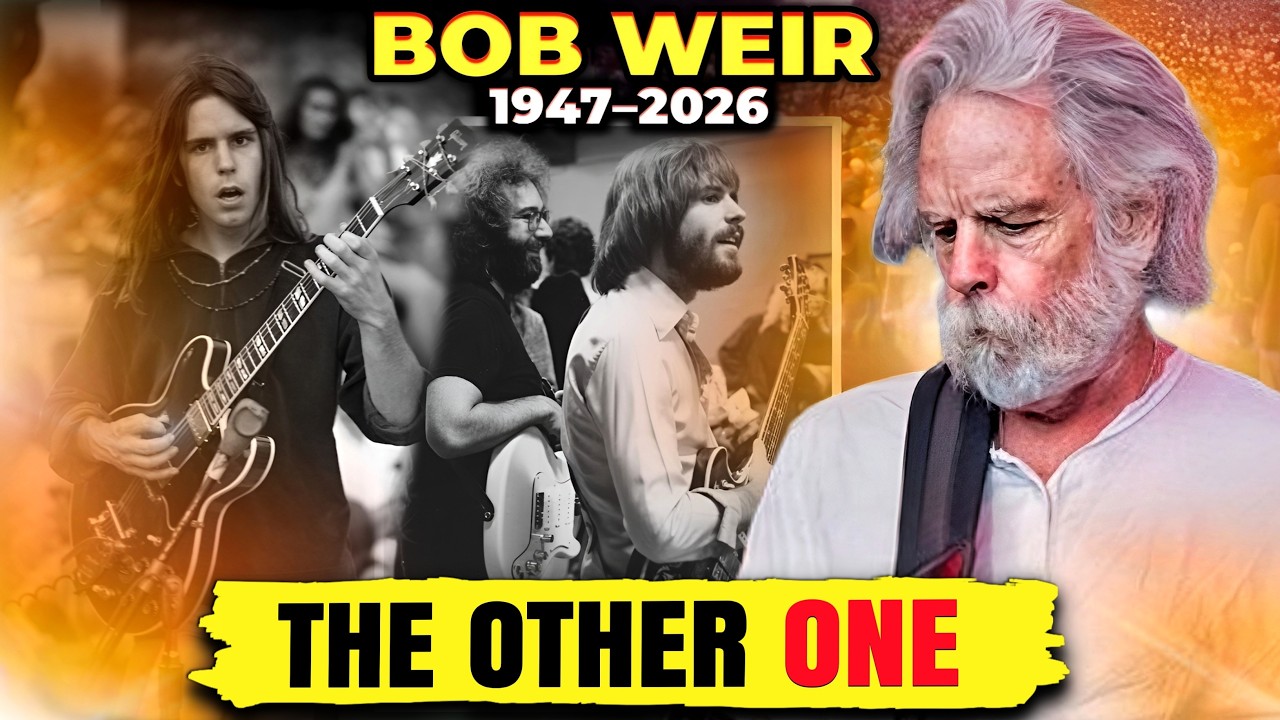
Bob Weir’s Legacy: The Role That Made the Grateful Dead Possible
The Architecture of the Grateful Dead
Most bands fall apart because nobody can agree who’s in charge. The Grateful Dead survived because no one was—not entirely. Jerry Garcia led, but his idea of leadership was different from what people expected. Garcia led by creating space for others to lead within. He held the center without claiming authority. For that to work, someone had to understand how to hold a system together without controlling it. That someone was Bob Weir, not the frontman, not the visionary, but the stabilizing force inside a band built to fly apart.
The easiest way to misunderstand Bob Weir is to call him the rhythm guitarist. That phrase implies support, background, following. But Weir’s role was fundamentally structural. He managed space in a band where space was constantly under threat. Garcia pushed outward. Phil Lesh pulled the harmony apart. Two drummers created motion without anchors. If nobody controlled the negative space, the music collapsed. Weir was the one who didn’t let that happen.
The Language of Space and Silence
Listen to Weir’s playing closely and you’ll notice something most casual listeners miss. He doesn’t lock into obvious patterns. He doesn’t strum continuously. He avoids predictable chord shapes. His chords land late or early. They break apart instead of filling in. They leave room instead of resolving tension. To untrained ears, it sounds wrong. To trained musicians, it sounds intentional.
Garcia understood what Weir was doing better than anyone. He explained it plainly: “We feel Bob’s the finest rhythm guitarist on wheels right now. He’s like my left hand. We have a long serious conversation going on musically and the whole thing is of a complimentary nature. His playing in a way really puts my playing in the only kind of meaningful context it could enjoy.”
That was the actual role—managing the negative space, creating room for Garcia’s lines to breathe, giving Phil somewhere to land when he pulled the harmony sideways, holding the structure when the drummers wanted to dissolve time itself. If Bob Weir had played like a traditional rhythm guitarist, the Grateful Dead wouldn’t have existed.
The Firing That Revealed the System
The band figured out Weir’s function the hard way. In fall 1968, Garcia and Lesh fired both Weir and Pig Pen. They thought the music was being held back by their playing abilities. They wanted to go somewhere more experimental, more jazz fusion, more self-consciously weird.
Weir took it seriously. He went off and practiced hours every day. His guitar work evolved from adequate to distinctive—that strange pianistic approach to chording, those unexpected voicings that seemed wrong until you heard them in context. He came back a different player. Garcia later admitted they’d been wrong. “We were off on a false note. We were doing something that wasn’t really natural. We were doing music that was self-consciously weird. If we had paid more attention to Pig Pen, it probably would have saved us a couple of years of [nonsense].”
But Weir’s return wasn’t just about better technical chops. It was about understanding his function in the system. Bob Matthews, who mixed their sound, put it clearly: “As a rhythm guitar player playing between Phil and Billy in the rhythm section, he did some phenomenal things. He’s got an incredibly creative mind. Playing music, you’ve got to be right there that moment. It doesn’t matter what you did two beats ago. It’s what you are going to do the next beat.” That was the skill that mattered—not technical proficiency but presence and attention, the ability to hear where Garcia was taking the music and make space for it to get there.
Songs as Architecture
When Pig Pen’s health deteriorated in the early 1970s, Weir stepped into the showman role. He took on more vocals, brought more songs, and became the second focal point on stage when Garcia was the only focal point they’d ever had. The songs he wrote with John Barlow became as fundamental to the Dead’s repertoire as anything Garcia sang. “Sugar Magnolia” gave them sunshine when the jams got dark. “Playing in the Band” became a vehicle for the most expansive improvisations they’d attempt. “Trucking” told the story of the life they were living. “Jack Straw” brought cinematic storytelling to the catalog.
But more than that, these songs provided the structural variety the band needed to build sets that could breathe. Garcia would take them out into space. Weir would bring them back to Earth. This alternation wasn’t just about giving Jerry a break. It was about creating rhythm in the show itself—tension and release at the macro level, not just within songs.
Keith Olsen, who produced “Terrapin Station,” saw how the entire system depended on Weir’s understanding of his role. “Phil is a very inventive bass player. It allows Weir to do a more inventive guitar part where he doesn’t have to be down there at the bottom. That’s the key.”
Continuity Through Collapse
Through the 1980s and early 1990s, things started breaking. Keyboardists came and went. Personalities clashed. Energy levels dropped. The music got heavier, then looser, then strained. Garcia’s health deteriorated. Through all of it, Weir stayed in the same role—not as a savior, not as a replacement, but as continuity. Someone had to keep showing up when the band stopped having fun. Someone had to keep the music playable when it stopped being easy. Someone had to honor what Garcia had built even when Garcia couldn’t build it anymore. That’s not romance. That’s responsibility. That’s love.
After Garcia died in August 1995, the question wasn’t whether the Grateful Dead could continue. It was whether the structure could. Weir didn’t try to recreate Garcia. Nobody could. He didn’t freeze the music in amber. He didn’t turn it into nostalgia theater. He kept the framework intact and let the sound change inside it.
The System Survives
He honored what Garcia had created by allowing it to evolve. Rat Dog in the late 1990s—a band of all rhythm players, no lead instrumentalist, forcing Weir to reimagine how the songs worked without Garcia’s melodic lines floating above everything. “The Other Ones,” then “Simply the Dead,” reuniting former members for tours that proved the music could still breathe. “Dead & Company” starting in 2015, finding a new generation of players who understood the approach even if they hadn’t lived the history. Bobby Weir and Wolf Brothers, taking the songs acoustic, stripping them down to their skeletal structures, proving they could survive without the electric architecture they’d been built around.
Different lineups, different approaches, but the same understanding: preserve the system Garcia created, not just the songs. Honor the idea, not the execution. That distinction matters. A lot of bands preserve songs. Very few preserve systems.
In July 2025, Weir was diagnosed with cancer and started treatment. Three weeks later in August, he stood on stage at Golden Gate Park in San Francisco with Dead & Company for three nights celebrating the Grateful Dead’s 60th anniversary. Those August shows were his final performances—emotional, full of light, played through whatever he was feeling in his body. Because that’s what you do when Garcia taught you what music means. You show up. You play. You hold the system together one more time.
Weir never claimed authority. Garcia led. That was clear to everyone. But Weir understood that Garcia’s kind of leading required a different kind of supporting—not following, but supporting. Holding the structure so Garcia could do what only Garcia could do. Never acting like the center. Never turning himself into the point.
That restraint is why the music survived as long as it did. The Grateful Dead didn’t need another genius. They had Garcia for that. They needed someone who understood balance, someone who knew when not to play, when not to fill, when not to resolve. Someone who understood that the most important notes are the ones you don’t play, that silence is part of the structure, that space is what allows motion to happen. That was Bob Weir. This is what appreciation looks like without sentimentality—not praise, not mythology, just function and love.
Watch the full documentary on YouTube →
Subscribe to The Shakedown Archives for more Grateful Dead documentaries, and explore more stories at TheShakedownArchives.com.