How Ken Kesey’s “Suicide” Changed The Grateful Dead Forever
▶ Watch the full documentary on YouTube
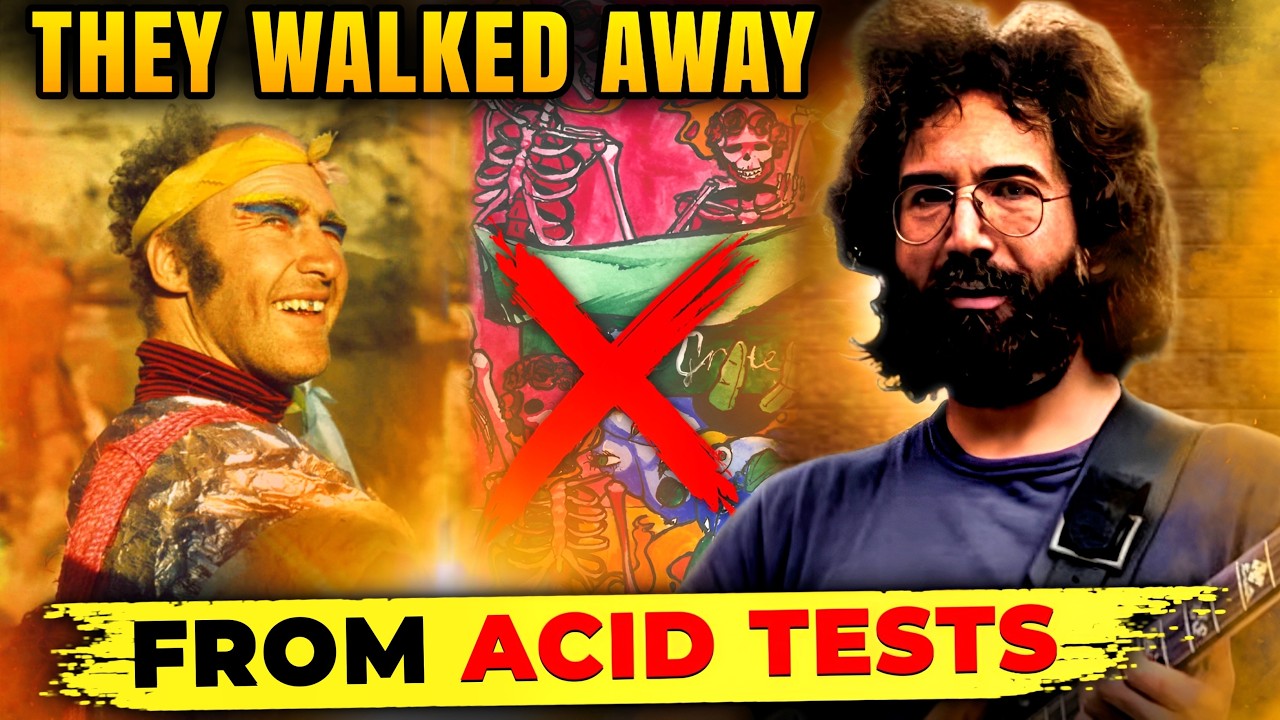
SUBSCRIBE TO THE SHAKEDOWN ARCHIVESThe Grateful Dead walked away from Ken Kesey and the Acid Tests in 1966. From the Watts double-dosing to the Halloween Graduation, this is why they left.
In late January 1966, Ken Kesey faked his own death to avoid drug charges — staging a “suicide” note at the edge of a cliff and fleeing to Mexico. The move forced the Grateful Dead to choose between following the Pranksters deeper into chaos or building something sustainable on their own. They chose the latter, and the split reshaped everything that followed — the band’s relationship with psychedelics, their approach to live performance, and the boundaries they would draw around their own autonomy for the next three decades.
This documentary traces the full arc of the Dead’s entanglement with Kesey’s Merry Pranksters — from the early Acid Tests at the Fillmore and Longshoreman’s Hall, through the dangerous escalation at Watts, to the Halloween Graduation that marked the official end of the psychedelic testing ground. What emerges is a story about a band learning to separate artistic freedom from someone else’s experiment.
The Watts Acid Test
To understand why the Grateful Dead left Ken Kesey, you have to understand what happened at the Watts Acid Test in February 1966. Kesey and the Merry Pranksters organized an event in the Watts neighborhood of Los Angeles — a predominantly Black community still reeling from the devastating riots of August 1965. The idea was to bring the psychedelic experience to Watts as an act of cultural bridge-building. In practice, it was a disaster of cultural insensitivity that left the Dead increasingly uncomfortable with Kesey’s judgment.
The event was chaotic even by Acid Test standards. The Pranksters double-dosed the punch, meaning people who thought they were getting a mild psychedelic experience received something far more intense. In a community that had just lived through violent civil unrest, subjecting unsuspecting people to overwhelming psychedelic doses was reckless at best. The Dead played, but the experience left a mark on the band’s thinking about where Kesey’s experiments were heading.
The Fake Suicide
By late January 1966, Kesey was facing serious legal trouble. He had been arrested twice for marijuana possession — charges that carried real prison time in 1960s California. Rather than face trial, Kesey staged an elaborate fake suicide. He left a note on the dashboard of his truck parked near a cliff overlooking the Pacific Ocean. The note read, in part, “Ocean, ocean, I’ll beat you in the end.” He then fled to Mexico, where he lived as a fugitive for several months.
The stunt was vintage Kesey — theatrical, audacious, and deeply self-centered. But for the Grateful Dead, it crystallized a growing realization. They had been Kesey’s house band at the Acid Tests, providing the soundtrack for his psychedelic experiments. But Kesey’s vision was becoming increasingly erratic, and his legal problems were creating risks that extended to everyone in his orbit. The Dead had their own ambitions — they wanted to be a band, not props in someone else’s theater.
The Halloween Graduation
The break became official at the Halloween Acid Test Graduation in October 1966. Kesey had returned from Mexico and surrendered to authorities. He organized one final Acid Test at a warehouse in San Francisco, billing it as a “graduation” from LSD — a statement that the psychedelic movement should move beyond the drug itself. The Dead played, but the event felt like an ending rather than a beginning. The Dead’s relationship with Kesey would remain cordial for the rest of their careers, but the creative partnership was over.
What the Dead took from the Acid Tests was invaluable: the concept of music as a communal, improvisational, boundary-dissolving experience. What they left behind was Kesey’s need to control the narrative. The Grateful Dead would never again be anyone’s house band. They would build their own world, on their own terms, and the thirty-year journey that followed — from the Haight-Ashbury to stadiums to the birth of jam band culture — began with the decision to walk away from the man who had given them their first stage.
The Live Experience
The Grateful Dead’s live performances were fundamentally different from those of any other major rock band. While most acts rehearsed and repeated a fixed setlist, the Dead approached each show as a unique event. Setlists were chosen shortly before the performance, and the transitions between songs — the spaces where improvisation lived — were entirely spontaneous. A concert might last three hours or more, moving through structured songs, extended jams, and passages of pure collective improvisation that could be transcendent or chaotic, sometimes both simultaneously.
This approach demanded extraordinary musical communication. Each member of the band had to listen constantly to every other member, responding in real time to melodic suggestions, rhythmic shifts, and dynamic changes. Garcia often described it as a conversation — not a performance, but a dialogue between musicians who had developed, over years of playing together, an almost telepathic understanding of each other’s musical instincts. When it worked, the result was music that felt inevitable and surprising at the same time.
The Deadhead Phenomenon
The community that formed around the Grateful Dead was unprecedented in popular music. Deadheads didn’t just attend concerts — they built a culture. Tape trading networks distributed live recordings across the country before the internet existed, creating a shared archive of performances that fans studied with scholarly intensity. The parking lot scene at Dead shows became a self-sustaining economy of food vendors, craft sellers, and itinerant entrepreneurs who followed the band from city to city.
What distinguished Deadhead culture from ordinary fandom was its participatory nature. Deadheads didn’t consume the Grateful Dead’s music passively — they actively shaped the experience. Their energy in the audience influenced the band’s playing. Their tape trading preserved and disseminated the music. Their economic activity in the parking lots created the ecosystem that made extended touring financially viable. The relationship between the Dead and their audience was genuinely symbiotic, each sustaining and inspiring the other across three decades of continuous performance.
The Chemical Reality
Drugs were inseparable from the Grateful Dead’s story, but the relationship was more complex than the caricature suggests. LSD was foundational — the Acid Tests were the crucible in which the Dead’s improvisational approach was forged, and psychedelics informed the expansive, boundary-dissolving quality of their music throughout their career. But the drug culture that surrounded the Dead evolved over the decades, and not always in positive directions.
By the 1980s, harder drugs — particularly cocaine and heroin — had infiltrated both the band and their community. Garcia’s well-documented struggles with heroin addiction took a devastating toll on his health and his playing. The parking lot scene, once dominated by psychedelics, increasingly included dealers selling substances that were addictive and dangerous. The Dead’s open, tolerant culture — which had been a strength in the 1960s and 1970s — became a liability when that openness was exploited by people whose relationship with drugs was destructive rather than exploratory.