
How LSD and the Acid Tests Created the Grateful Dead’s Iconic Sound
The Warlocks Discover a New Kind of Freedom
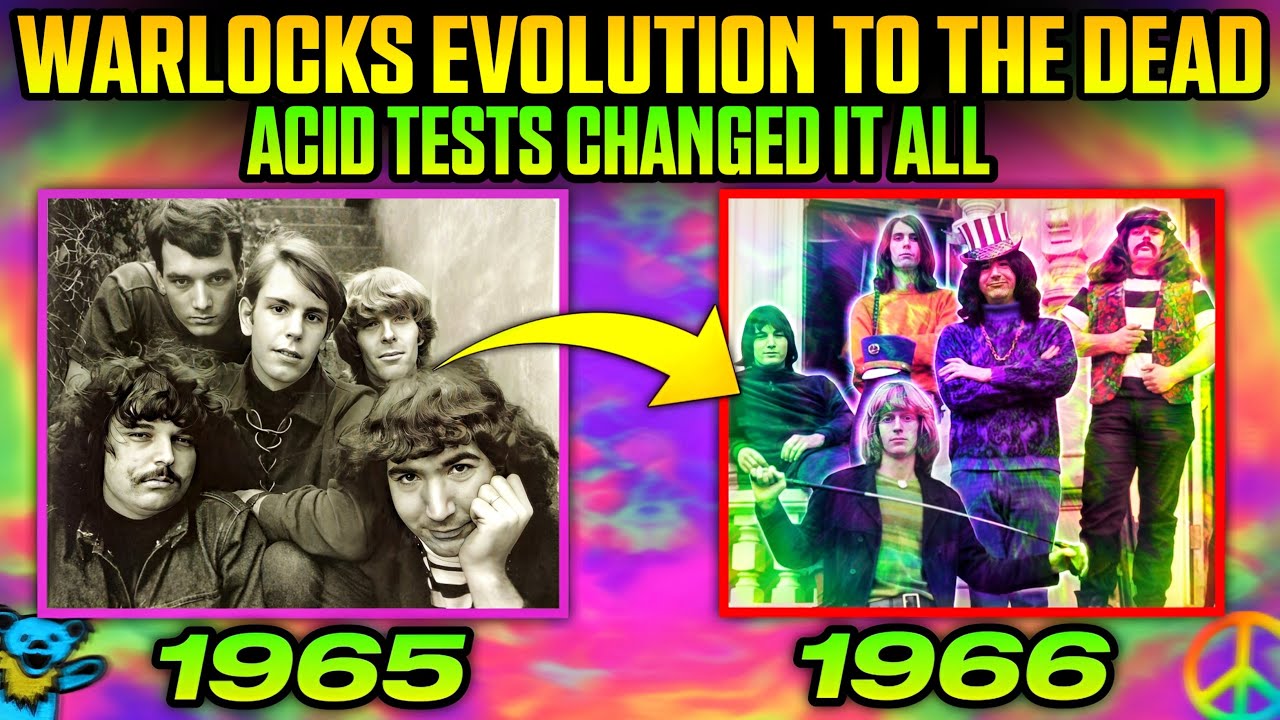
Before the Grateful Dead became synonymous with 20-minute guitar solos and endless jam sessions, they were a bar band called the Warlocks who stumbled upon something entirely unexpected. On November 27th, 1965, a group of musicians showed up to a Halloween party in California with no instruments, no performance plan, and no idea they were about to experience the catalyst for one of rock music’s most revolutionary approaches to sound. They weren’t there to entertain—they were there to experience something that would change everything.
What they found was Ken Kesey’s acid test, an event that existed in a strange liminal space between art installation, light show, and dance party. Kesey, fresh off writing One Flew Over the Cuckoo’s Nest, had teamed up with his Merry Pranksters to create something completely new in American culture. The secret ingredient was 250-microgram LSD capsules, perfectly legal in California at the time, being handed freely to anyone who wanted them. Rolling Stone would later describe this first SoCal event as a launching point for both the Grateful Dead and the entire San Francisco counterculture.
The Permission to Fail
What made the acid tests genuinely transformative wasn’t the LSD alone—it was the radical permission they granted musicians. In later interviews, Jerry Garcia described the experience with clarity: the band could plug in, play for five minutes, and stop if things got too weird. There were no rules about how a band was supposed to perform. For the first and only time in their career, the Warlocks could choose whether to play at all. They would show up to Ken Kesey’s weekly gatherings at La Honda, his ranch in the Santa Cruz Mountains, and the freedom was intoxicating in ways that had nothing to do with chemicals.
Most bands in 1965 were playing three-minute songs with predictable structures. The acid tests gave the Warlocks permission to experiment with sound itself. They would start with blues covers and drift into 20-minute explorations of pure noise. Sometimes they’d stop mid-song and not pick up their instruments for an hour. The MAPS bulletin notes that as the band experimented at these LSD-fueled gatherings, their music became louder, looser, and infused with long wandering riffs that seemed to have no destination except the destination itself.
Building a New Language of Musical Communication
What nobody talks about is what this seemingly random approach was actually teaching them—the most important skill in their arsenal. By playing for five minutes at a time in chaotic environments, they were learning to communicate musically without words. They learned to read each other’s intentions, to follow musical ideas wherever they led. Every time they picked up their instruments, it was a completely new situation, which forced them to develop an intuitive musical language that would define them for the next 50 years.
By January 1966, the Warlocks had transformed so completely that they changed their name to the Grateful Dead and became the official house band for Kesey’s expanding acid test circuit. They maintained their experimental approach even as the events grew larger—they only played when they felt like it, preferring to immerse themselves as participants rather than performers. The January 29th, 1966 Sound City acid test, recorded and later streamed over 33,000 times on the Internet Archive, captures this raw experimental phase perfectly. You can hear blues covers morphing into psychotic interludes, primitive sound that somehow contains the seeds of everything that would come later.
The Controversy Nobody Wants to Talk About
There’s a fascinating contradiction at the heart of this story. Bob Weir, one of the band’s founding members, has consistently downplayed LSD’s role in their musical development, calling the acid tests “LSD advocacy parties” but insisting drugs didn’t play a major role in the band’s growth. Yet in the same breath he acknowledges they learned to play from a place of profound disorientation and fun. The tension reveals something deeper: the acid tests weren’t transformative because everyone was on LSD. They were transformative because they created a space where normal rules didn’t apply.
Bear Stanley, the legendary sound engineer and LSD chemist, was developing new amplification systems specifically for the acid tests. He wasn’t just making the music louder—he was creating sound systems that could reproduce the full frequency range of the band’s increasingly complex improvisations. The Wall of Sound, which would later make the Dead famous, was actually born in these LSD-fueled experiments.
Total Sensory Experience
The visual elements were equally important to this musical evolution. Black lights, strobe lights, and fluorescent paint created an environment where sound and vision merged completely. The band wasn’t just providing a soundtrack to light shows—they were collaborating with visual artists to create total sensory experiences that pushed them to think beyond traditional song structures.
The legal context made this period even more remarkable. LSD remained legal in California until October 6th, 1966, giving the acid tests a narrow window to operate openly. As 1966 progressed, the events grew larger and more elaborate. The January 8th Fillmore acid test and the March 12th Pico Acid Test drew hundreds of participants, but the Dead maintained their experimental approach throughout.
The Legacy of Permission
The most important legacy of the acid test period was this: the Grateful Dead didn’t just learn to improvise during those six months. They learned that improvisation could be the foundation of an entire musical philosophy. Every concert for the next 30 years would be an extension of those early experiments at La Honda. What made their approach unique was that most musicians master their instruments and then use that mastery to express ideas. The Grateful Dead learned their instruments by surrendering control, by allowing the music to teach them what it wanted to become.
By October 1966, when LSD became illegal, the transformation was complete. The Grateful Dead had evolved from a competent bar band into something unprecedented in American music. They had learned to use improvisation not as a solo showcase but as a form of collective consciousness. When one member followed a musical idea, the others intuitively understood where to go. The next time you hear a 20-minute Grateful Dead jam, remember where it started—not in a recording studio, but in a chaotic room full of people experiencing consciousness expansion together.
Watch the full documentary on YouTube →
Subscribe to The Shakedown Archives for more Grateful Dead documentaries, and explore more stories at TheShakedownArchives.com.
One Comment