How “Not Fade Away” Became the Dead’s Most Powerful Promise
From B-Side to Bedrock
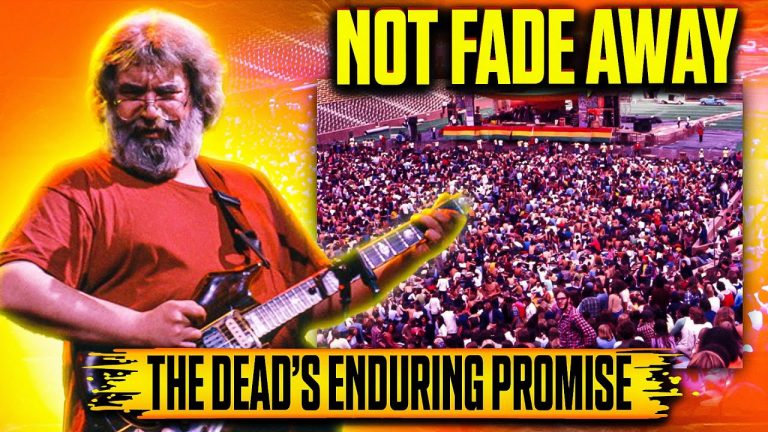
When Buddy Holly and Norman Petty penned “Not Fade Away” in 1957, they created a song that would become far more significant in rock history than they could have possibly imagined. They built the composition on a simple but infectious foundation: a variant of the Bo Diddley beat, that syncopated rhythm pattern that had emerged from the blues tradition and was reshaping the very foundations of rock and roll. It was never intended as a main attraction; the song shipped as the B-side to “Oh Boy,” a track that would be forgotten almost immediately by the broader public. Yet the Grateful Dead would transform this overlooked single into something far more significant: a musical promise kept more than 500 times across their 25-year performing life, a song that became a covenant between a band and their audience, renewed night after night with genuine commitment.
The Rhythm That Changed Everything
The Bo Diddley beat wasn’t new in 1957, but Petty’s arrangement gave it a specific pocket, a rhythmic space where meaning could breathe and develop. The underlying pattern, built on a simple rhythmic foundation, had proven endlessly adaptable across multiple genres and artists. The song’s structure was deceptively simple—a declarative statement wrapped in a question: “I’m going to tell you how it’s going to be. Are you going to give your love to me?” That opening line carried a contractual weight, almost a dare to the listener to commit alongside the singer. The song posed a simple proposition: reciprocal love. Give me your love, and I’ll give you mine. This opening line was what the Dead would inherit and remake according to their own vision, transforming a straightforward love song into something more expansive and spiritually complex. The composition became malleable in their hands.
The Dead’s Radical Reimagining
The Grateful Dead first recorded their version, capturing the essential structure and energy of the original composition while adding their own harmonic sophistication. But the real alchemy happened on stage, in the organic, unpredictable environment where the Dead did their most important artistic work. Night after night, year after year, they stretched the song across their improvisational framework, treating the core melody and structure as a launching point rather than a template to be rigidly followed. The song became a ritual, a moment when the band and audience made a mutual pledge. Every performance was different yet fundamentally the same—always rooted in that Bo Diddley pulse, always asking the same question, always inviting the same answer. Between their first recorded version and their final show, they performed “Not Fade Away” 507 times, creating one of rock music’s most enduring and intimate relationships with a single composition. This was not repetition; this was renewal.
A Promise Made Flesh
What made “Not Fade Away” different from other covers in the Dead’s extensive repertoire was its function as a promise rather than a narrative or a deconstruction of an existing standard. It wasn’t a story they reimagined or a musical form they deconstructed and rebuilt. It was a vow renewed. Every time they played it, they were saying to their audience: “I’m still here. I’m still giving my love. This doesn’t fade away. We’re still committed to this experiment together.” For deadheads, the song became shorthand for faith in persistence, in commitment, in the idea that genuine connection transcends time and circumstance. The simple B-side from 1957 had become the Dead’s most powerful artistic statement, a meditation on constancy in an ever-changing performance context.
The Legacy of Fidelity
Over 25 years, the Grateful Dead played “Not Fade Away” more than 500 times, and those performances transformed both the song and the band’s relationship with their audience in ways that neither Holly nor Petty could have anticipated. What began as a Buddy Holly composition became a Grateful Dead institution, proof that devotion to a simple idea—expressed through consistent, evolving performance—can create something timeless and deeply meaningful. The song never faded away because the band refused to let it, turning a B-side into an epitaph for their entire career, a statement about the kind of commitment they made not just to their music but to their audience’s faith in them. Every time they played it, they validated the bond.
Watch the full documentary on YouTube →
Subscribe to The Shakedown Archives for more Grateful Dead documentaries, and explore more stories at TheShakedownArchives.com.