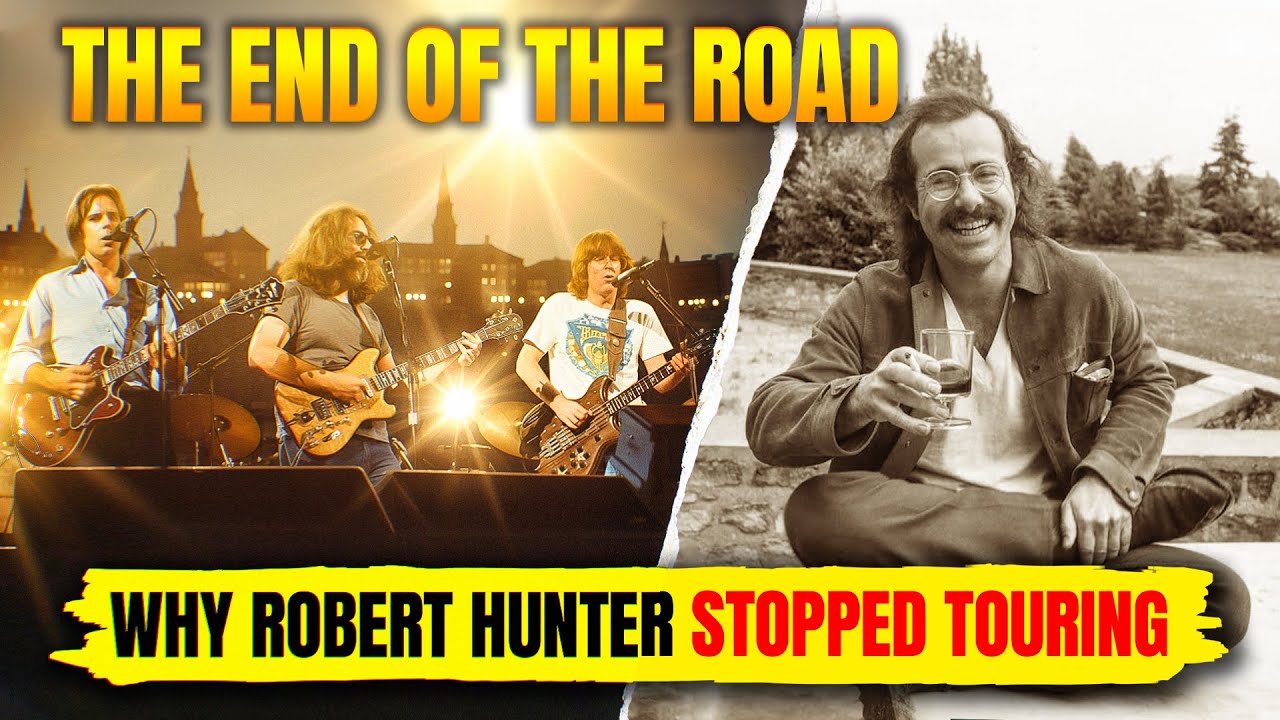
The Untold Story of Why Robert Hunter Stopped Touring: Food Fights & The 10 Commandments
The Legend of Europe ’72
Europe ’72 stands as one of rock and roll’s most mythologized tours. The Grateful Dead spent weeks traversing stages from Copenhagen to London, capturing performances so tight and inspired that they were eventually released as a celebrated live album series. Songs like “China Sunflower,” “Tennessee Jed,” and “Jack Straw” represented the Dead at their peak, delivering controlled yet exploratory performances that seemed to defy their reputation for wild unpredictability.
Yet beneath the legendary status of this European adventure lay a story far more human and complicated—one involving Robert Hunter, the band’s lyricist and a key creative force, and the personal struggles that nearly prevented him from seeing the tour through.
The Pressure of Creative Responsibility
Robert Hunter was not just another member of the Grateful Dead organization. As the primary lyricist and conceptual voice, he carried a distinct creative burden. The songs he crafted defined what the Dead would play, shaped how fans understood the band’s message, and influenced the entire sonic landscape that Garcia’s guitar inhabited. This was extraordinary power, but it came with extraordinary pressure.
By the time the band prepared to embark on the European journey, Hunter was feeling the weight of expectation. Every new song needed to be better than the last. Every lyric had to resonate with audiences who had come to expect profound, meaningful words paired with Garcia’s soaring melodies. The touring schedule was relentless, the creative demands unceasing, and the emotional toll accumulating.
When Everything Came Crashing Down
The precise details of Hunter’s crisis during Europe ’72 remain partly shrouded in privacy, but the band’s accounts reveal a musician pushed to his limit. At some point during the tour, Hunter found himself unable to continue. Whether from exhaustion, emotional overwhelm, or the simple fact that he had nothing left to give creatively, he reached a breaking point. The man who had been essential to the Dead’s artistic vision suddenly couldn’t be part of what was happening on stage every night.
What makes this story particularly poignant is that the causes of his withdrawal weren’t the dramatic rock and roll clichés—no drug overdose, no public scandal. Instead, Hunter’s struggle involved something that rarely gets discussed openly in band histories: the spiritual and emotional exhaustion of being the constant creative source for dozens of musicians and hundreds of thousands of fans.
Loyalty, Food Fights, and Second Chances
The band’s response to Hunter’s crisis revealed something about their character. Rather than replacing him or pushing him to return before he was ready, they gave him space. They honored the work he’d done, acknowledged his irreplaceability, and trusted that he would return when the time was right. This wasn’t a typical rock and roll response to a crisis—bands in 1972 weren’t known for patience and understanding.
The stories that emerged from Europe ’72 captured the human side of a legendary tour. Yes, the music was extraordinary, but what kept the band functioning was their willingness to fight, to argue, to work through disagreements, and ultimately to stick together. Whether it was food fights on buses or real conflicts about creative direction, the Dead tackled problems head-on rather than pretending everything was fine.
Hunter’s temporary withdrawal and subsequent return to the band’s fold became a microcosm of the Dead’s larger ethos. They believed in people. They believed in second chances. They believed that the sum of all their contradictions and struggles created something greater than any individual could achieve alone.
The Commandments of Survival
The “10 Commandments” that governed the band’s tour behavior weren’t formally written rules but rather unspoken understandings about how they would treat each other and maintain their collective mission. The first was simple: nobody gets left behind. If someone was struggling, the band would slow down, adjust, and wait. Robert Hunter’s crisis tested this principle, and the band passed the test.
Second was the commitment to honest communication. Whether through conversations or through the music itself, the Dead expressed what needed to be expressed. They didn’t bottle things up or pretend everything was harmonious. They brought the real, messy humanity to every interaction, every show, and every moment together.
A Tour That Changed Everything
Europe ’72 ultimately became more than a legendary series of performances. It became a testament to how a band survives internal crises by choosing loyalty over convenience. Robert Hunter’s struggle was real, his withdrawal was genuine, but the Dead’s response—meeting him with compassion and patience—allowed him to eventually return stronger and more creative than before. The songs that came after Europe ’72 carried his renewed voice, informed by the struggle he’d endured and the grace he’d received from his bandmates.
Watch the full documentary on YouTube →
Subscribe to The Shakedown Archives for more Grateful Dead documentaries, and explore more stories at TheShakedownArchives.com.