Truckin’ by Grateful Dead: The Story Behind America’s National Treasure
From Throwaway Single to Cultural Touchstone
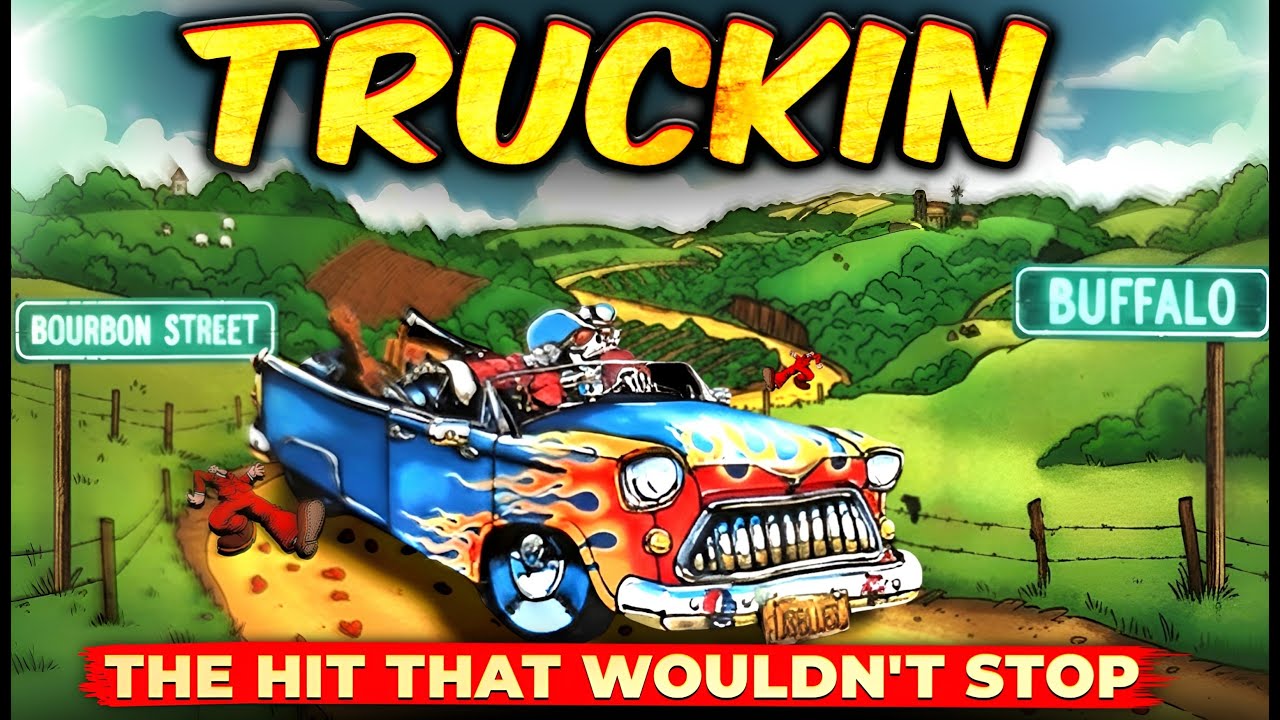
In 1970, the Grateful Dead released a song that wasn’t supposed to matter. A three-minute Chuck Berry knockoff edited down for radio because Warner Brothers needed a single. Something strange happened on the way to obscurity. That throwaway track became a 20-minute jam vehicle, a phrase quoted on Monday Night Football, and eventually a national treasure recognized by the Library of Congress. The song about getting busted on Bourbon Street somehow became required American culture.
The word “truckin'” dates back to the 1920s Harlem—a dance step that blues singers like Blind Boy Fuller referenced in “Keep On Truckin’ Mama,” “Truckin’ My Blues Away.” It meant to persevere, to push forward no matter what. In 1968, underground cartoonist Robert Crumb drew his iconic “Keep on Truckin'” comic with those big-footed men strutting across the page. Crumb later called it “the curse of my life. This stupid little cartoon caught on hugely,” but the Dead would take that phrase somewhere entirely different.
A Road Song Written on the Road
In March 1970, lyricist Robert Hunter joined the Dead on tour with a mission: write them a road song. Hunter later recalled, “I wrote that song in several different cities,” starting in San Francisco and then penning verses in hotel rooms, at truck stops, backstage. Then came the motel pool in Florida where he finished the lyrics. He brought them down to where the band was sitting around the swimming pool. The boys picked up their guitars and wrote some rock-and-roll changes behind it.
But here’s what most people don’t know. Jerry Garcia later admitted, “We assembled it. It wasn’t natural and it didn’t flow. We really labored over the bastard. All of us together.” In the studio, Hunter had to feed the lyrics to Bob Weir one line at a time, coaching him on pronunciation. Weir would go in and put a line down, then go back in and work out how to pronounce the next line. Weir would later joke, “‘Truckin” is kind of a tongue twister.” Hunter wrote it that way out of spite, deliberately making it impossible to sing.
The Meaning Hidden in the Groove
The Chuck Berry influence was intentional. Listen to Berry’s “School Days” and you can hear the blueprint—that loping rhythm, those rapid-fire lyrics. But the Dead added something Berry never did: a line that Phil Lesh contributed, “Sometimes the light’s all shining on me.” Garcia explained what that line meant—the onstage part with bright lights, loud music, people screaming. Then you’re backstage between sets with milling crowds, people going “Hey, man, hey, man,” weird stuff coming at you that you have to duck and get out of the way. The spotlight and the chaos behind it. The verses were autobiographical in ways fans wouldn’t understand for years.
“Busted down on Bourbon Street, set up like a bowling pin” wasn’t metaphor. On January 31st, 1970, just months before Hunter wrote those words, the New Orleans narcotics squad raided the Dead’s hotel after a show and arrested most of the band. The Dead wouldn’t return to New Orleans for 10 years. The other cities fused into one—Dallas, Houston, New York—all stops on a tour that had become its own strange pilgrimage.
The Song Transforms Itself
When “Truckin'” debuted in August 1970 at the Fillmore West, it was acoustic with Bob Weir’s voice deep and soulful, sweet harmonies, Pigpen tasteful on piano. But within two months, they’d plugged it in. On October 23rd, 1970, at Georgetown University, they played the first-ever “Truckin'” into “The Other One” segue—no drum break, no announcement, just a seamless continuation that sounded perfectly organic.
Warner Brothers rushed out a three-minute single version. It reached number 64 on the pop charts—the Dead’s most successful single until “Touch of Grey” in 1987. But there was a secret on that album track: an alternate mix where the song fades out just as the band launches into a lengthy blues jam, with Weir spontaneously singing the folk tune “Frozen Logger.” That complete version remained unreleased for decades. They’d cut a spontaneous jam to fit radio length, but on stage there was no radio, no format restrictions—just open highway.
The Evolution Into Infinity
1972 was the year “Truckin'” exploded. The tempo picked up. The ending jams became torrential. On March 26th at the Academy of Music in New York, “Truckin'” broke out in the first huge jam—17 minutes of jazzy improvisation. During the Europe ’72 tour, versions routinely hit 20 minutes. The May 26th Lyceum show in London featured an amazing, intense jam that made it onto the Europe ’72 album. The band was discovering that “Truckin’s” simple E minor pentatonic groove could become a blank canvas. Keith Godchaux’s piano added jazz voicings, Phil Lesh introduced ascending basslines that pushed into modal territory, and Garcia’s leads got longer, more exploratory. The song was mutating in real time.
What changed the song forever was the addition of “Nobody’s Fault but Mine,” a blues standard they’d dropped years before. In fall ’72, the “Nobody’s” jam became a standard follower to the “Truckin'” jam, sometimes with lyrics, sometimes not. That minor-blues riff fit perfectly with “Truckin’s” key and became a gateway into some of the Dead’s biggest jams—”Dark Star,” “Eyes of the World,” “Spanish Jam.” By 1973, “Truckin'” had found its home in the second set, most commonly emerging out of “He’s Gone” and flowing into “The Other One.” The song had stopped being a song. It had become architecture.
The Phrase That Escaped
While the jams were getting longer and more complex, something else was happening. The song’s chorus was escaping into the wider culture. “What a long, strange trip it’s been.” Seven words that somehow captured everything—not just the Dead’s journey, but something universal about American life. Sportscaster Howard Cosell started quoting it on Monday Night Football in the ’70s. It appeared on graduation cards, retirement speeches, wedding toasts, on corporate slideshows at tech companies. The phrase had entered the cultural psyche in a way few song lyrics ever do.
Robert Hunter had an idea early on. He thought they could keep adding verses to “Truckin'” over the years, making it a living song that evolved with the band. But as he later admitted, “The funny thing is once you get it down, it is down. You don’t go back. You don’t revisit it.” Once it was fixed in people’s minds, it became a cultural artifact that had to stay the same.
The National Treasure
In 1997, the U.S. Library of Congress selected “Truckin'” for its National Recording Registry. They called it a national treasure. The song about getting busted and being set up like a bowling pin had become official American culture. That same year, the documentary Classic Albums: Anthem to Beauty aired, revealing studio outtakes and interviews. Bob Weir talked about the romance of being a young man on the road in America. It was a rite of passage and the material you drew from to write about.
Maybe that’s the answer to why “Truckin'” works so perfectly. It’s true. Not metaphorically true—actually true. They really got busted on Bourbon Street. They really were truckin’ up to Buffalo, living out of motel rooms, facing the bright lights and the weird backstage chaos. When they stretched that three-minute song into a 20-minute journey, they were doing what they do best: taking something simple and finding infinity inside it. The road keeps moving. You get knocked down on Bourbon Street. You get back truckin’ on. Fifty-plus years later, people still quote that chorus without knowing where it came from. Most people have no idea they’re quoting a song about drug busts and motel pools and the chaos of life on tour. They just know it’s true. What a long, strange trip it’s been.
Watch the full documentary on YouTube →
Subscribe to The Shakedown Archives for more Grateful Dead documentaries, and explore more stories at TheShakedownArchives.com.