The Night the Grateful Dead Stole Their Own Equipment: Fillmore West August 1969
The Grateful Dead weren’t just six musicians playing guitars and drums. They were a family—a touring operation that depended on a crew whose dedication to the mission rivaled that of the band members themselves. This reality became crystal clear on August 17, 1969, at the Fillmore West in San Francisco, when a payment dispute with the venue’s promoter forced the Dead’s crew into an unexpected act of desperation that defined their entire ethos.
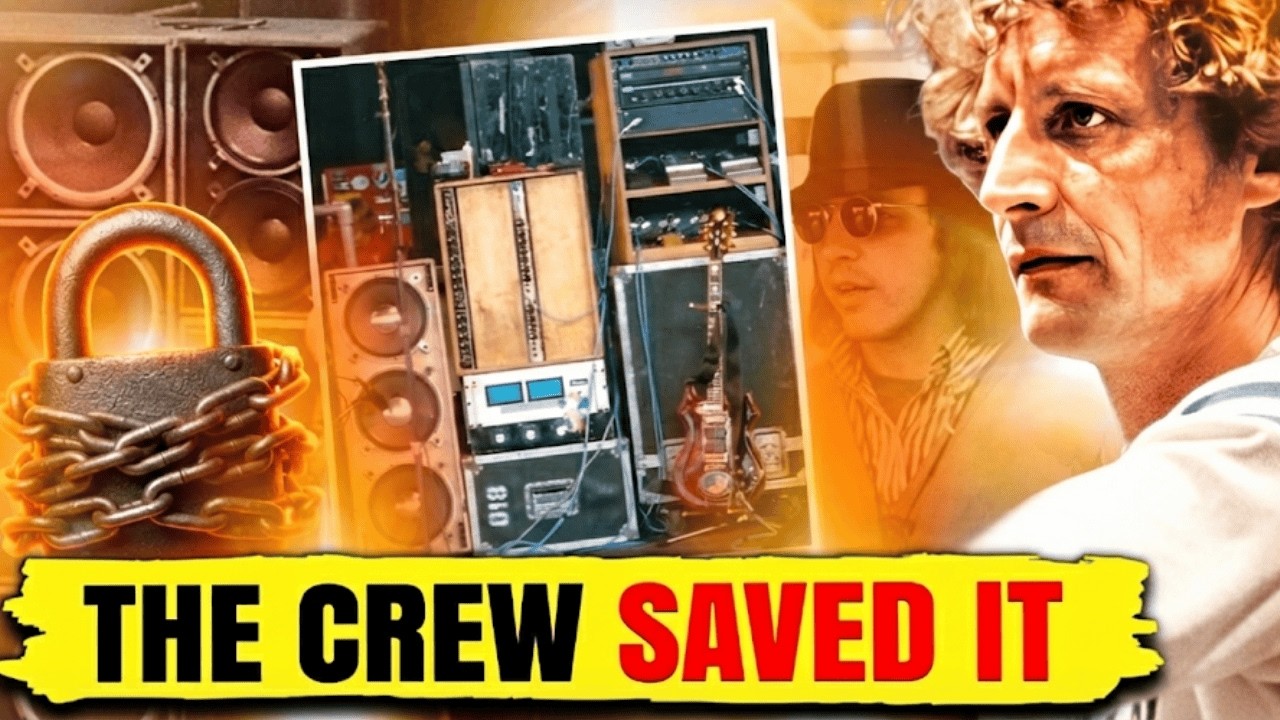
By 1969, the Grateful Dead had evolved beyond the typical rock and roll touring operation. Through the tireless work of Owsley “Bear” Stanley and equipment manager Ram Rod—a veteran of Ken Kesey’s Merry Pranksters—the band had built a custom sound system that was as essential to their identity as Jerry Garcia’s guitar tone. This wasn’t just a PA system; it was an instrument in itself, a carefully calibrated extension of the band’s musical philosophy.
Bear had spent years designing and building audio
Bear had spent years designing and building audio equipment specifically for the Dead. Ram Rod, meanwhile, had developed an almost mystical relationship with the gear, understanding that the quality of the equipment directly impacted the quality of the music. When Mickey Hart spoke about Ram Rod, he didn’t mince words: “I play for Ram Rod first.” For a drummer in a band as improvisational and dynamic as the Grateful Dead, this wasn’t hyperbole—it was recognition that the crew chief controlled an essential variable in the band’s sonic output.
Ram Rod possessed an unusual form of power. As he himself acknowledged, “I know that I can make the music bad if I want to, just by thinking.” This reflected something profound about the Dead’s operation: the band understood that the technical crew wasn’t working for them in a traditional employer-employee sense. They were working toward the same artistic goal, with the same level of commitment and creative investment.
The Grateful Dead completed their two-set performance at the Fillmore West on August 17, 1969, in exemplary fashion. The setlist traced a path through their most adventurous material—a Dark Star flowing into Saint Stephen, culminating in The Eleven. These were songs that demanded both technical precision and improvisational freedom, tracks that showcased why the band had become essential to San Francisco’s musical scene.
But the evening took a dramatic turn after
But the evening took a dramatic turn after the final notes faded. The promoter held up payment to the band, citing a dispute over terms. In response, the promoter locked down the Dead’s entire equipment collection—securing the PA system, instruments, cables, and every other piece of gear the band had brought into the venue. This wasn’t just a financial dispute; it was an attempt to use the equipment as collateral or leverage.
What the promoter apparently didn’t anticipate was that this was a line no one in the Grateful Dead family would allow him to cross. Ram Rod, Bear Stanley, and the rest of the crew assessed the situation and made a decision: they were going to retrieve their equipment by any means necessary. That night, they broke into the Fillmore West and stole back the gear.
To understand the significance of this decision, one must recognize that for the Grateful Dead, equipment wasn’t a commodity to be seized in disputes. It was the physical manifestation of their artistic identity. The custom PA system Bear had built represented hundreds of hours of engineering and creative problem-solving. The instruments and cables represented the band’s entire sonic signature.
Steve Parish
Steve Parish, who would become Garcia’s legendary guitar technician, articulated this sentiment perfectly: “I could not let go of the equipment.” This wasn’t about replacing gear—it was about the irreplaceability of the specific systems that had been built for the Dead’s particular sound.
The incident at the Fillmore West wasn’t an isolated case. The following February 1, 1970, federal agents arrested Owsley Stanley and confiscated the entire PA system in New Orleans. The impact was immediately apparent. The next night in St. Louis, forced to borrow a local sound system for their performance, the band sounded completely different. The custom equipment wasn’t interchangeable; it was fundamental to how the Grateful Dead communicated musically.
Further complications arose on May 10, 1970, when the Dead arrived in Atlanta for a show at the Sports Arena, only to discover that their equipment hadn’t arrived. Faced with another equipment catastrophe, local musician Duane Allman, recognizing both the emergency and the talent before him, offered his own PA system to the band. This act of generosity led directly to one of the most legendary performances in Dead history: a transcendent version of “Turn On Your Lovelight” that demonstrated the band’s ability to adapt and transcend technical limitations.
Yet these incidents collectively revealed a hard truth
Yet these incidents collectively revealed a hard truth about touring as a professional musician: equipment dependency was real, and it required a crew willing to work at an extraordinary level of intensity. Mickey Hart articulated the band’s professional philosophy succinctly: “We work for a living. We’re a working band.” This wasn’t a casual project—it was a job that demanded dedication from everyone involved.
The crew worked 16 to 20 hour days, often with minimal recognition or compensation. They were the invisible infrastructure that allowed the Grateful Dead to function as a touring operation. Ram Rod, despite his legendary status and Mickey Hart‘s devotion to him, remained characteristically quiet about his own contributions. Robert Hunter captured this perfectly in a joke about Ram Rod that spoke to the crew chief’s standing within the family: “Ram Rod never says anything, but every time he does he’s wrong.” It was spoken with affection—the kind of ribbing that came from genuine respect.
The story of the Fillmore West equipment heist ultimately reveals something essential about the Grateful Dead that transcends typical rock and roll narrative. The band wasn’t a collection of six musicians supported by staff. It was a multifaceted extended family where crew members possessed agency, creative authority, and genuine power within the organization. Ram Rod wasn’t taking orders—he was protecting something that belonged to all of them.
This emphasis on crew integrity and equipment independence
This emphasis on crew integrity and equipment independence would influence how the band operated for decades. The Grateful Dead’s obsession with sound quality, their willingness to invest in custom equipment, and their fierce protection of that equipment all traced back to moments like the Fillmore West in 1969, when Ram Rod decided that some things couldn’t be negotiated away.
The equipment wasn’t just infrastructure. It was the physical embodiment of the band’s values: quality, consistency, and the uncompromising pursuit of excellence in service of the music. When Ram Rod and Bear broke into that venue and reclaimed what was theirs, they weren’t committing theft—they were protecting the foundation upon which the Grateful Dead’s entire operation rested.
The Song in Context
Understanding any Grateful Dead song requires understanding the partnership between Jerry Garcia and Robert Hunter that produced it. Hunter was not a conventional lyricist — he was a poet who happened to write for a rock band. His words drew from American folk traditions, Beat poetry, and a mythological imagination that created characters and landscapes existing outside of any specific time or place. Garcia’s melodies, in turn, had a quality that musicologists have struggled to categorize — folk-informed but jazz-inflected, simple on the surface but harmonically sophisticated beneath.
The songs they created together entered the Grateful Dead’s live repertoire and evolved constantly. A song might be performed hundreds of times over decades, and no two versions were identical. Tempos shifted, arrangements expanded and contracted, and improvisational passages grew or shrank depending on the band’s collective mood on any given night. For Deadheads, the song as recorded in the studio was merely a starting point — a sketch that live performance would elaborate into something far more complex and unpredictable.
The Live Experience
The Grateful Dead’s live performances were fundamentally different from those of any other major rock band. While most acts rehearsed and repeated a fixed setlist, the Dead approached each show as a unique event. Setlists were chosen shortly before the performance, and the transitions between songs — the spaces where improvisation lived — were entirely spontaneous. A concert might last three hours or more, moving through structured songs, extended jams, and passages of pure collective improvisation that could be transcendent or chaotic, sometimes both simultaneously.
This approach demanded extraordinary musical communication. Each member of the band had to listen constantly to every other member, responding in real time to melodic suggestions, rhythmic shifts, and dynamic changes. Garcia often described it as a conversation — not a performance, but a dialogue between musicians who had developed, over years of playing together, an almost telepathic understanding of each other’s musical instincts. When it worked, the result was music that felt inevitable and surprising at the same time.
The Business of the Dead
The Grateful Dead’s business model was as unconventional as their music. While other major bands relied on record sales as their primary revenue source, the Dead built their economy on live performance. Their recording contracts were modest by industry standards, and they made little effort to produce radio-friendly singles. Instead, they invested in their live operation — a touring infrastructure that employed dozens of crew members and generated revenue through ticket sales, merchandise, and the loyalty of an audience that returned show after show.
This model was risky. It required constant touring to maintain cash flow, and it left the band vulnerable to the physical toll of life on the road. But it also gave them a degree of independence that few artists in the music industry have ever achieved. The Dead answered to their audience, not to record executives. They could play what they wanted, for as long as they wanted, in the way they wanted — a creative freedom that was the foundation of everything they built.
Related Articles
- From Jug Bands to Grateful Dead: The Folk and Bluegrass Roots of American Rock
- Frankie Weir, Sugar Magnolia, and the Women Who Actually Ran the Grateful Dead
- His Father Swore on a Bible. Then Robbed the Grateful Dead.
The Shakedown Archives publishes new research on Grateful Dead history each week. If you enjoyed this essay, you can subscribe to the companion YouTube channel below.
Subscribe on YouTube