Deadheads vs. Phish Fans: How Two Bands Engineered Participatory Culture Using Different Tools
The popular narrative frames Deadheads and Phish fans as rival tribes—competing for authenticity, touring miles, and the title of “most dedicated followers.” This framing misses the deeper truth: these aren’t rival communities born from competition. They’re fundamentally different participatory systems, each engineered to transform crowds into essential components of the music itself. The difference isn’t ideology; it’s infrastructure.
When Jerry Garcia sat down in 1988 to discuss the Acid Tests of the 1960s, he articulated a principle that would define three decades of Deadhead culture: “Everybody there was as much performer as audience.” This wasn’t metaphorical. The Dead built a technological and social system that literally required audience participation to function.
The Wall of Sound represents the most literal
The Wall of Sound represents the most literal interpretation of this philosophy. Between 1968 and 1974, the Dead deployed a speaker system with over 600 individual components, designed to deliver pristine, equal sound to every human in the venue. This wasn’t about amplification; it was about auditory democracy. Every attendee received an identical sonic experience, which meant every attendee could participate authentically in interpreting what Garcia, Weir, and the musicians were doing in real time.
But the technological innovation extended beyond hardware. The Dead pioneered the taper section—designated areas within venues where audience members could legally record shows using primitive tape equipment. This created a distributed oral tradition. Tapes moved through networks via mail, hand-to-hand, creating a secondary economy of music that lived entirely outside official channels. You didn’t own a show; you held it temporarily, made a copy, and passed it forward.
This system had profound implications. The Dead’s temporal authority became absolute. As documented during their Europe ’72 run, they played “until everybody had left”—literally holding control over when the night ended. Without setlists published in advance, without media previews, the experience became mythological. The only way to know what happened was to be there or to be deeply embedded in the trading networks. Phish fans joke about the information they can access instantly; Dead fans built a culture on what they couldn’t know.
Phish emerged in the 1980s into a fundamentally
Phish emerged in the 1980s into a fundamentally different technological landscape. When they developed their culture with devoted followers, the internet was emerging. Real-time information sharing became possible. Digital forums, particularly rec.music.phish, transformed fandom into a collective analytical practice.
The Clifford Ball in August 1996—Phish’s first massive festival drawing 70,000 people—marked a watershed moment. Live setlist tracking was happening in real time, with fans updating databases as songs were called. A three-hour flatbed truck jam at three in the morning wasn’t folklore; it was being analyzed, notated, and filed in permanent digital record while it happened.
This evolved into something revolutionary. During Baker’s Dozen—thirteen consecutive shows at Madison Square Garden in July-August 2017—Phish played 237 distinct songs with zero repeats across all thirteen nights. Phish fans didn’t just experience this; they tracked it obsessively. Spreadsheets documented song gaps, gaps between gaps, thematic connections, and statistical probabilities. The community engaged in what might be called “meta-participation”—analyzing the patterns that Trey Anastasio and the band were creating, then predicting what might come next based on data.
Trey Anastasio has said
Trey Anastasio has said: “Ideally the point of music is community, not the player.” This reflects a fundamentally different model from the Dead’s. The Dead positioned themselves as mysterious conductors; Phish positioned themselves as collaborators in an open intellectual exercise.
These aren’t different philosophies; they’re responses to available infrastructure. The Dead didn’t choose analog obscurity out of principle—they worked with the technology that existed. Oral tradition, tape trading, and mythology became the only possible way to circulate music in the pre-digital era. The community that formed was optimized for this system: mobile, transient, memory-based, reliant on direct transmission from person to person.
Phish inherited a different infrastructure and built accordingly. The internet made archival feasible. Pattern recognition became a leisure activity. Community meant shared analysis, collective spreadsheets, and real-time discussion. Phish fans could work jobs in static locations and still participate fully because participation meant intellectual engagement, not just physical presence.
When “Touch of Grey” became a mainstream radio
When “Touch of Grey” became a mainstream radio hit in 1987, it exposed a structural weakness in the Dead’s system. New audiences discovered the Dead through FM radio without understanding the implicit rules: the culture of trading, the unwritten codes about venue behavior, the mythological framework. These “Touchheads” created friction precisely because they hadn’t been socialized into the participatory system through traditional channels.
Yet both communities survived. The Dead persisted through cultural fracture and eventual dissolution. Phish weathered a break from 2004-2009 and reconvened to create their most ambitious shows. The resilience came because neither community was dependent on the band’s moment-to-moment activity. The infrastructure—the system for participation—became the actual engine. When the musicians paused or passed away, the community continued because it had been designed as the point itself.
A Deadhead traveling to a random show in 1991 needed no preview—they trusted the live experience and the band’s intuition. A Phish fan in 2024 can pull up spreadsheets of every show ever played, can predict setlist patterns with startling accuracy, can join Discord channels debating analytical minutiae. These are genuinely different ways of being in community.
Neither is better
Neither is better. The Dead’s system created mythology and mystery—the power of the unknowable. Phish’s system created collaborative intelligence—the power of collective analysis. The Dead made audiences into performers through mystique; Phish made audiences into researchers through transparency.
The Grateful Dead and Phish didn’t create rival fan bases. They created two different answers to the same question: How do you make a crowd part of the music? The Dead used analog tools—taper sections, tape trading, Wall of Sound, temporal control. Phish used digital tools—forums, archives, real-time tracking, meta-analysis. The crowd culture that drives each band isn’t a side effect of the music; it’s the essential technology through which the music happens.
Understanding this distinction reframes the entire conversation. We’re not comparing fan devotion or band authenticity. We’re examining how different technological eras generate different forms of participatory culture—and how both, in their own way, succeeded at making music fundamentally communal.
The Song in Context
Understanding any Grateful Dead song requires understanding the partnership between Jerry Garcia and Robert Hunter that produced it. Hunter was not a conventional lyricist — he was a poet who happened to write for a rock band. His words drew from American folk traditions, Beat poetry, and a mythological imagination that created characters and landscapes existing outside of any specific time or place. Garcia’s melodies, in turn, had a quality that musicologists have struggled to categorize — folk-informed but jazz-inflected, simple on the surface but harmonically sophisticated beneath.
The songs they created together entered the Grateful Dead’s live repertoire and evolved constantly. A song might be performed hundreds of times over decades, and no two versions were identical. Tempos shifted, arrangements expanded and contracted, and improvisational passages grew or shrank depending on the band’s collective mood on any given night. For Deadheads, the song as recorded in the studio was merely a starting point — a sketch that live performance would elaborate into something far more complex and unpredictable.
The Live Experience
The Grateful Dead’s live performances were fundamentally different from those of any other major rock band. While most acts rehearsed and repeated a fixed setlist, the Dead approached each show as a unique event. Setlists were chosen shortly before the performance, and the transitions between songs — the spaces where improvisation lived — were entirely spontaneous. A concert might last three hours or more, moving through structured songs, extended jams, and passages of pure collective improvisation that could be transcendent or chaotic, sometimes both simultaneously.
This approach demanded extraordinary musical communication. Each member of the band had to listen constantly to every other member, responding in real time to melodic suggestions, rhythmic shifts, and dynamic changes. Garcia often described it as a conversation — not a performance, but a dialogue between musicians who had developed, over years of playing together, an almost telepathic understanding of each other’s musical instincts. When it worked, the result was music that felt inevitable and surprising at the same time.
The Deadhead Phenomenon
The community that formed around the Grateful Dead was unprecedented in popular music. Deadheads didn’t just attend concerts — they built a culture. Tape trading networks distributed live recordings across the country before the internet existed, creating a shared archive of performances that fans studied with scholarly intensity. The parking lot scene at Dead shows became a self-sustaining economy of food vendors, craft sellers, and itinerant entrepreneurs who followed the band from city to city.
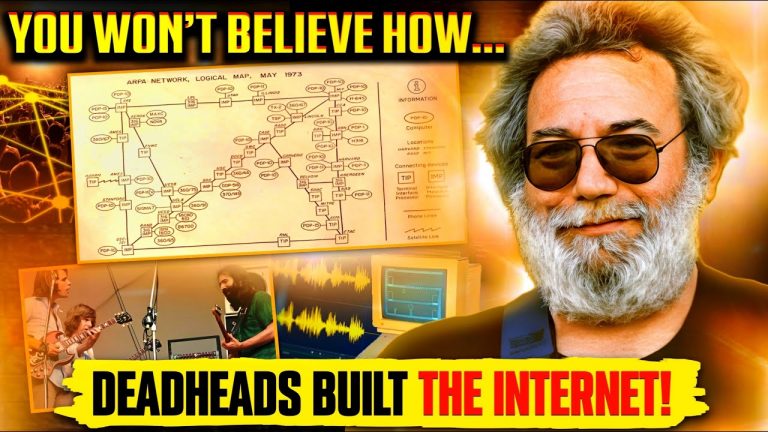
What distinguished Deadhead culture from ordinary fandom was its participatory nature. Deadheads didn’t consume the Grateful Dead’s music passively — they actively shaped the experience. Their energy in the audience influenced the band’s playing. Their tape trading preserved and disseminated the music. Their economic activity in the parking lots created the ecosystem that made extended touring financially viable. The relationship between the Dead and their audience was genuinely symbiotic, each sustaining and inspiring the other across three decades of continuous performance.
The Chemical Reality
Drugs were inseparable from the Grateful Dead’s story, but the relationship was more complex than the caricature suggests. LSD was foundational — the Acid Tests were the crucible in which the Dead’s improvisational approach was forged, and psychedelics informed the expansive, boundary-dissolving quality of their music throughout their career. But the drug culture that surrounded the Dead evolved over the decades, and not always in positive directions.
By the 1980s, harder drugs — particularly cocaine and heroin — had infiltrated both the band and their community. Garcia’s well-documented struggles with heroin addiction took a devastating toll on his health and his playing. The parking lot scene, once dominated by psychedelics, increasingly included dealers selling substances that were addictive and dangerous. The Dead’s open, tolerant culture — which had been a strength in the 1960s and 1970s — became a liability when that openness was exploited by people whose relationship with drugs was destructive rather than exploratory.
Related Articles
- How Owsley “Bear” Stanley’s LSD Built the Grateful Dead’s Sound
- Owsley’s Ultimatum: The Grateful Dead’s 1970 Breaking Point
- The Night the Grateful Dead Played with the Sufi Choir — A Lost 1971 Performance
The Shakedown Archives publishes new research on Grateful Dead history each week. If you enjoyed this essay, you can subscribe to the companion YouTube channel below.
Subscribe on YouTube