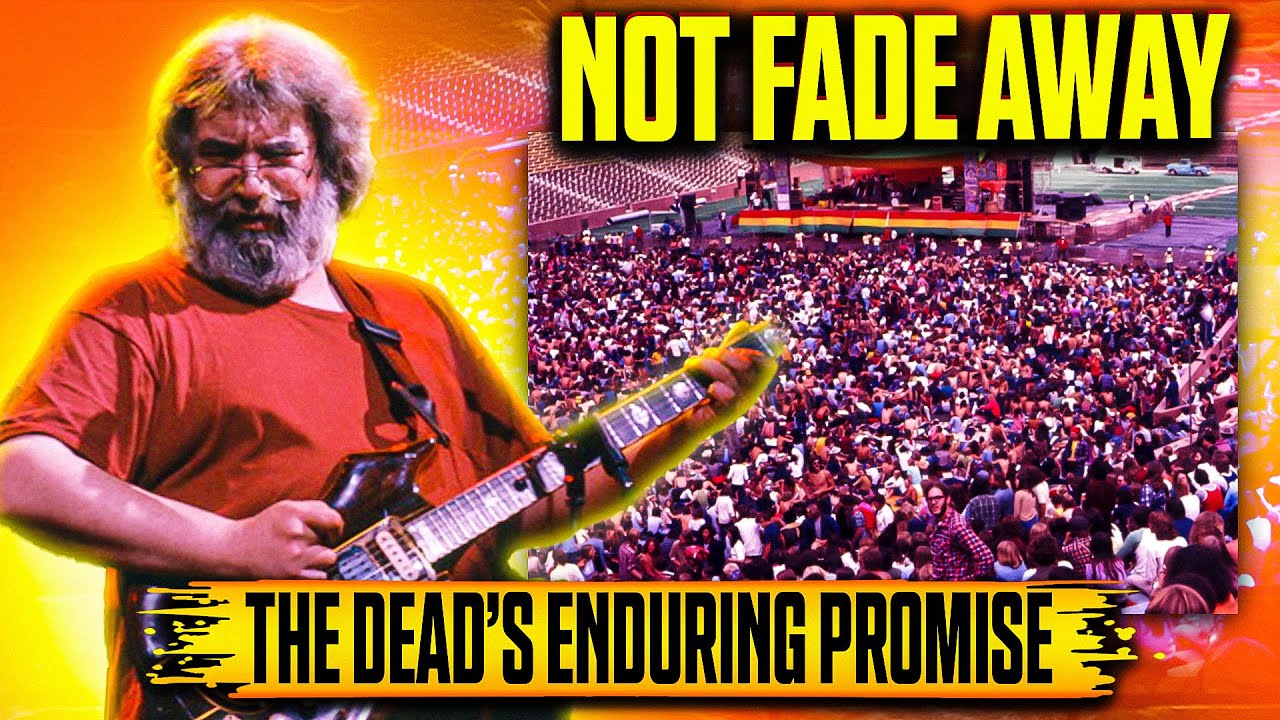
Not Fade Away: How the Grateful Dead Transformed Buddy Holly Into Their Most Powerful Promise
“Not Fade Away” is a deceptively simple song. Written by Buddy Holly and Norman Petty in 1957, it emerged from a specific moment in the history of rock and roll—a moment when Holly was experimenting with different rhythmic approaches and production techniques. The song is built on a foundation: the Bo Diddley beat, that distinctive rhythmic pattern that had emerged from Chicago blues and become a defining sound of early rock and roll.
Buddy Holly’s original version is charming and energetic, performed with the distinctive vocal style and the rhythmic precision that made Holly one of the most innovative musicians of the 1950s. The lyrics are straightforward romantic declarations—promises that love will endure, that genuine connection “will not fade away.” It’s a love song, simple in conception but sophisticated in execution.
The song had already been successful when the
The song had already been successful when the Grateful Dead encountered it. But the Dead’s relationship with “Not Fade Away” transformed it into something else entirely. It became, over the course of more than twenty-five years, one of the most performed and beloved songs in the Grateful Dead’s repertoire, a composition that would be played more than 500 times across thousands of performances.
The foundation of “Not Fade Away”—the Bo Diddley beat—deserves specific attention. This rhythmic pattern emerged from African American blues traditions, particularly from the work of Bo Diddley himself, who developed it as a distinctive signature sound. The beat has a particular quality: it’s percussive, it’s dance-oriented, but it also has a kind of relentlessness to it. Once the beat is established, it creates an irresistible forward momentum.
For the Grateful Dead, this rhythmic foundation proved to be essential. The Dead were always interested in grooves and rhythmic conversations. Mickey Hart, the band’s percussionist, and Bill Kreutzmann, their drummer, could build on this Bo Diddley foundation and create something much larger and more complex. The basic beat could be augmented with additional percussion, with shifts in dynamics, with the kind of rhythmic sophistication that the Dead brought to every performance.
The Bo Diddley beat also had a cultural
The Bo Diddley beat also had a cultural resonance. It connected “Not Fade Away” to rock and roll’s foundational traditions, to the blues roots that informed the Grateful Dead’s approach to music. Playing a song built on this beat meant playing something that existed within a continuous tradition of American music, from blues to rock and roll.
The Grateful Dead first performed “Not Fade Away” in 1969, early in their career. But unlike many cover songs that bands play for a period and then abandon, “Not Fade Away” remained in consistent rotation throughout the band’s entire history. It was performed at shows in the 1970s, the 1980s, the 1990s, and into their final performances in 1995.
Over the course of more than twenty-five years, the band played this song more than 500 times—making it one of the most frequently performed songs in their entire repertoire. For perspective, this is more often than many of their original compositions. The frequency of performance speaks to something beyond mere catalogue filling or nostalgia. “Not Fade Away” meant something to the Grateful Dead.
The song was frequently paired with “Going Down
The song was frequently paired with “Going Down the Road Feeling Bad,” another blues-based number that shared a rhythmic sensibility with “Not Fade Away.” The pairing made sense: both songs were built on foundations that allowed the Dead to explore rhythm, to build grooves, to create the kind of musical conversation that defined their approach. A “Not Fade Away”/”Going Down the Road” combination could stretch for ten, fifteen, twenty minutes or more, with the band using the basic frameworks as launching points for extended exploration.
What’s crucial to understand is that “Not Fade Away” took on gradually deeper and more specific meaning as the Grateful Dead continued to exist and perform. A song written as a romantic promise in 1957 became, in the context of the Grateful Dead’s career, something else: a promise about the music itself, about the community that gathered around the Dead, about the possibility of endurance and continuity.
The lyrics—”Well, my love is bigger than a Cadillac / I try to show you but I think you’re holdin’ back”—remained the same. But their resonance changed over time. As the Grateful Dead endured through decades of cultural change, through the deaths of band members, through countless transformations in the music industry and in American life, “Not Fade Away” became a covenant. It was a statement of faith in the music, in the community, in the possibility that something genuine and meaningful could persist.
This deepening was not something that happened in
This deepening was not something that happened in the recording studio or through careful artistic intention. It happened through repeated performance, through the accumulated experience of thousands of shows, through the gathering of a community that understood the song as a reflection of something central to their relationship with the music and with each other.
By the 1990s, performances of “Not Fade Away” had taken on a ritualistic quality. The audience knew the song intimately. They knew the moment when the percussion would kick in, the moment when the band would settle into the groove. And they knew that this was a moment for collective expression—a moment when the crowd’s voices would join the band’s instruments in a kind of unified statement.
The phrase “not fade away” became a chant, a mantra, a statement of continued faith in the music and the community. When the Dead performed “Not Fade Away,” the separation between performers and audience became permeable. The song belonged to everyone present. It represented something shared and valued by the entire gathering.
This transformation of a cover song into a
This transformation of a cover song into a communal ritual speaks to something profound about the Grateful Dead’s understanding of music. They didn’t approach cover songs with the attitude of tribute artists or historians. They understood songs as living things that could change, that could take on new meanings in new contexts, that could become vehicles for different kinds of human experience and connection.
There’s something counterintuitive about the fact that “Not Fade Away”—one of the Dead’s most performed songs—is also one of their simplest. It’s not a complex composition like “Terrapin Station” or a deeply intricate narrative like “Terrapin Station.” It doesn’t showcase the band’s full instrumental range the way some of their original compositions do.
But the Grateful Dead understood that simplicity could be a form of sophistication. A simple song provides the perfect vehicle for improvisational exploration. The basic framework of “Not Fade Away” was so clear and so strong that the band could explore rhythmic variations, instrumental dialogues, and extended passages without losing the listener. The song’s structure could support almost unlimited expansion while remaining coherent and recognizable.
The Bo Diddley beat provided a rhythmic anchor
The Bo Diddley beat provided a rhythmic anchor that the band’s percussion section could build upon infinitely. The basic chord progression was familiar enough that the audience could follow the band through all manner of instrumental digression. The lyrics were simple enough that they could fade into the background when the band wanted to explore purely instrumental terrain, but powerful enough that they could resurface and carry deep emotional significance.
The final performances of the Grateful Dead in 1995 included “Not Fade Away.” It was fitting that this song—a promise about endurance and continuity, a statement that genuine connection would persist—remained in the band’s rotation until the very end. When Jerry Garcia died on August 9, 1995, “Not Fade Away” had been part of the band’s musical vocabulary for more than twenty-five years and had been performed more than 500 times.
In the decades since the band’s initial breakup, “Not Fade Away” has continued to resurface in the bands that emerged from the Dead’s legacy, in the tribute bands and side projects and new configurations that have kept the music alive. The song’s meaning has continued to evolve, to deepen, to take on new resonances for new generations of listeners.
What Buddy Holly created as a simple rock
What Buddy Holly created as a simple rock and roll love song in 1957 became, in the hands of the Grateful Dead, something larger: a statement about the power of music to endure, to create community, to offer promises that could be kept not through grand gestures but through repeated commitment to showing up, to playing together, to refusing to fade away.
The Grateful Dead proved that the greatest transformations of songs don’t always require radical reinterpretation. Sometimes they require simple commitment—the willingness to play a song again and again, to allow its meanings to deepen over time, to let a community pour its own hopes and values into a musical framework. “Not Fade Away” became powerful not because the Dead fundamentally changed it, but because they demonstrated sustained faith in its capacity to mean something true.
Related Articles
- Why The Dead Took 7 Years To Rise Again
- His Father Swore on a Bible. Then Robbed the Grateful Dead.
- Warren Haynes Had to be Jerry Garcia and Duane Allman — In the Same Year
The Shakedown Archives publishes new research on Grateful Dead history each week. If you enjoyed this essay, you can subscribe to the companion YouTube channel below.
Subscribe on YouTube