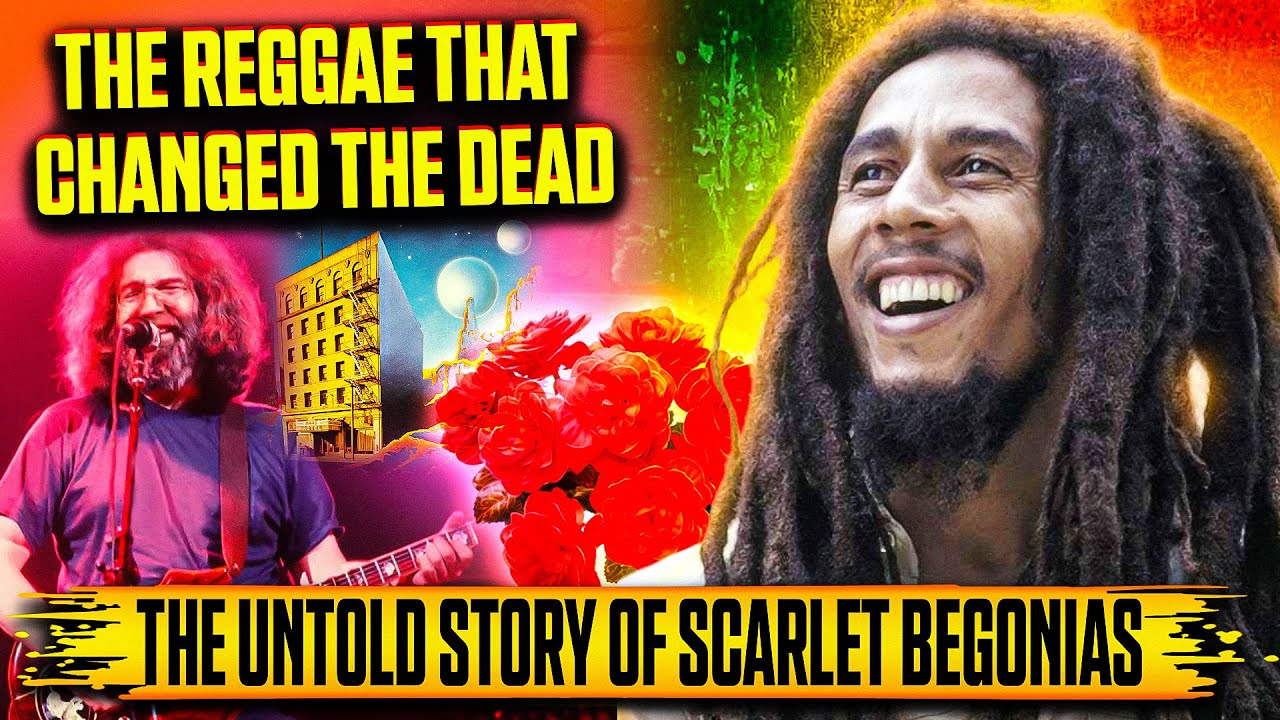
How Bob Marley’s Rejection Led to “Scarlet Begonias” — and the Greatest Grateful Dead Segue
“Scarlet Begonias” appeared on the Grateful Dead‘s 1974 album From the Mars Hotel as a mid-tempo shuffle with a reggae-inflected groove. It was pleasant. It was catchy. Nobody would have predicted that within four years it would become the first half of the most celebrated segue in Dead history — the Scarlet Begonias > Fire on the Mountain pairing that Deadheads shortened to “Scarlet > Fire” and spent decades chasing across setlists. But the song’s origin involves a failed collaboration that redirected Jerry Garcia and Robert Hunter‘s songwriting in a direction nobody expected.
The reggae influence in “Scarlet Begonias” wasn’t accidental. Garcia had become deeply interested in reggae music by the early seventies — Bob Marley, Jimmy Cliff, the emerging roots music from Jamaica. The Dead’s camp made overtures toward a collaboration with Marley, but nothing materialized. The specifics of why vary by source, but the outcome was clear: Garcia couldn’t work with Marley directly, so he absorbed the influence and filtered it through Hunter’s lyrics and the Dead’s improvisational framework. “Scarlet Begonias” carries reggae’s offbeat rhythmic emphasis in its chord pattern, but Garcia’s guitar treatment pulls it into Dead territory — jazzy, exploratory, open-ended.
Hunter’s lyrics operate on a different plane entirely
Hunter’s lyrics operate on a different plane entirely. The song describes an encounter with a woman on Grosvenor Square in London — “she had scarlet begonias tucked into her curls” — that reads like a mystical coincidence, a moment of recognition between strangers. Hunter is working with a theme he’d return to throughout his career: the idea that certain encounters are fated, that the universe arranges meetings between people who are supposed to find each other. The line “the sky was yellow and the sun was blue” establishes an inverted reality where normal rules don’t apply. This isn’t a love song. It’s a song about the uncanny feeling that you’ve stumbled into something larger than yourself.
The studio version on From the Mars Hotel is fine. Well-played, nicely arranged, forgettable by Dead standards. The song’s real life happened onstage. In the live setting, Garcia turned the opening riff into a launchpad for extended improvisation, stretching the introductory passage into five, ten, sometimes fifteen minutes of exploratory jamming before the first verse. The band learned to use “Scarlet Begonias” as a vehicle for communication — Garcia would signal shifts in direction, Lesh would respond with harmonic counterpoint, Weir would adjust his rhythmic comping, and the drummers would follow the collective momentum wherever it led.
Then, in 1977, something remarkable happened. The Dead began segueing directly from “Scarlet Begonias” into “Fire on the Mountain,” a Mickey Hart composition with lyrics by Robert Hunter. The pairing debuted on March 18, 1977, at Winterland in San Francisco, and from that point forward, the two songs became functionally inseparable. “Scarlet > Fire” appeared in setlists as a unit — a twenty-to-thirty-minute passage that moved from the lilting mysticism of “Scarlet Begonias” through an extended jam and into the driving, percussive groove of “Fire on the Mountain” with no break, no pause, no visible seam.
The transition between the songs is where the
The transition between the songs is where the magic lives. The jam that connects “Scarlet” to “Fire” is the Dead at their most telepathic — six musicians navigating a collective improvisation without a predetermined destination, finding their way from one song’s tonal center to another’s through shared intuition. The best versions — May 8, 1977 at Cornell, September 2, 1978 at Giants Stadium — achieve a kind of musical levitation, where the audience can feel the band searching for the path and the moment when they find it.
What makes “Scarlet > Fire” significant beyond the music is what it represents about the Dead’s compositional philosophy. Most rock bands write songs as fixed objects — a verse, a chorus, a bridge, always in the same order, always roughly the same length. The Dead wrote songs as starting points. “Scarlet Begonias” and “Fire on the Mountain” existed independently on albums, but onstage they became raw material for something that could never be replicated. Each “Scarlet > Fire” was different. The jam could go anywhere. The transition could take three minutes or twelve. This is what brought Deadheads back to shows night after night — not the songs themselves, but the unrepeatable thing that happened between them.
The full story of how a failed Bob Marley collaboration, a mystical lyric, and a percussive Mickey Hart tune became the Dead’s most celebrated segue is.
Subscribe to The Shakedown Archives on YouTube
youtube.com/@theshakedownarchives
The Song in Context
Understanding any Grateful Dead song requires understanding the partnership between Jerry Garcia and Robert Hunter that produced it. Hunter was not a conventional lyricist — he was a poet who happened to write for a rock band. His words drew from American folk traditions, Beat poetry, and a mythological imagination that created characters and landscapes existing outside of any specific time or place. Garcia’s melodies, in turn, had a quality that musicologists have struggled to categorize — folk-informed but jazz-inflected, simple on the surface but harmonically sophisticated beneath.
The songs they created together entered the Grateful Dead’s live repertoire and evolved constantly. A song might be performed hundreds of times over decades, and no two versions were identical. Tempos shifted, arrangements expanded and contracted, and improvisational passages grew or shrank depending on the band’s collective mood on any given night. For Deadheads, the song as recorded in the studio was merely a starting point — a sketch that live performance would elaborate into something far more complex and unpredictable.
The Live Experience
The Grateful Dead’s live performances were fundamentally different from those of any other major rock band. While most acts rehearsed and repeated a fixed setlist, the Dead approached each show as a unique event. Setlists were chosen shortly before the performance, and the transitions between songs — the spaces where improvisation lived — were entirely spontaneous. A concert might last three hours or more, moving through structured songs, extended jams, and passages of pure collective improvisation that could be transcendent or chaotic, sometimes both simultaneously.
This approach demanded extraordinary musical communication. Each member of the band had to listen constantly to every other member, responding in real time to melodic suggestions, rhythmic shifts, and dynamic changes. Garcia often described it as a conversation — not a performance, but a dialogue between musicians who had developed, over years of playing together, an almost telepathic understanding of each other’s musical instincts. When it worked, the result was music that felt inevitable and surprising at the same time.
The Deadhead Phenomenon
The community that formed around the Grateful Dead was unprecedented in popular music. Deadheads didn’t just attend concerts — they built a culture. Tape trading networks distributed live recordings across the country before the internet existed, creating a shared archive of performances that fans studied with scholarly intensity. The parking lot scene at Dead shows became a self-sustaining economy of food vendors, craft sellers, and itinerant entrepreneurs who followed the band from city to city.
What distinguished Deadhead culture from ordinary fandom was its participatory nature. Deadheads didn’t consume the Grateful Dead’s music passively — they actively shaped the experience. Their energy in the audience influenced the band’s playing. Their tape trading preserved and disseminated the music. Their economic activity in the parking lots created the ecosystem that made extended touring financially viable. The relationship between the Dead and their audience was genuinely symbiotic, each sustaining and inspiring the other across three decades of continuous performance.
Related Articles
- Why The Dead Took 7 Years To Rise Again
- Bob Weir’s Legacy: The Rhythm Guitarist Who Made the Grateful Dead Possible
- Tiger Rose: The Mysterious Album Robert Hunter Tried to Erase From History
The Shakedown Archives publishes new research on Grateful Dead history each week. If you enjoyed this essay, you can subscribe to the companion YouTube channel below.
Subscribe on YouTube