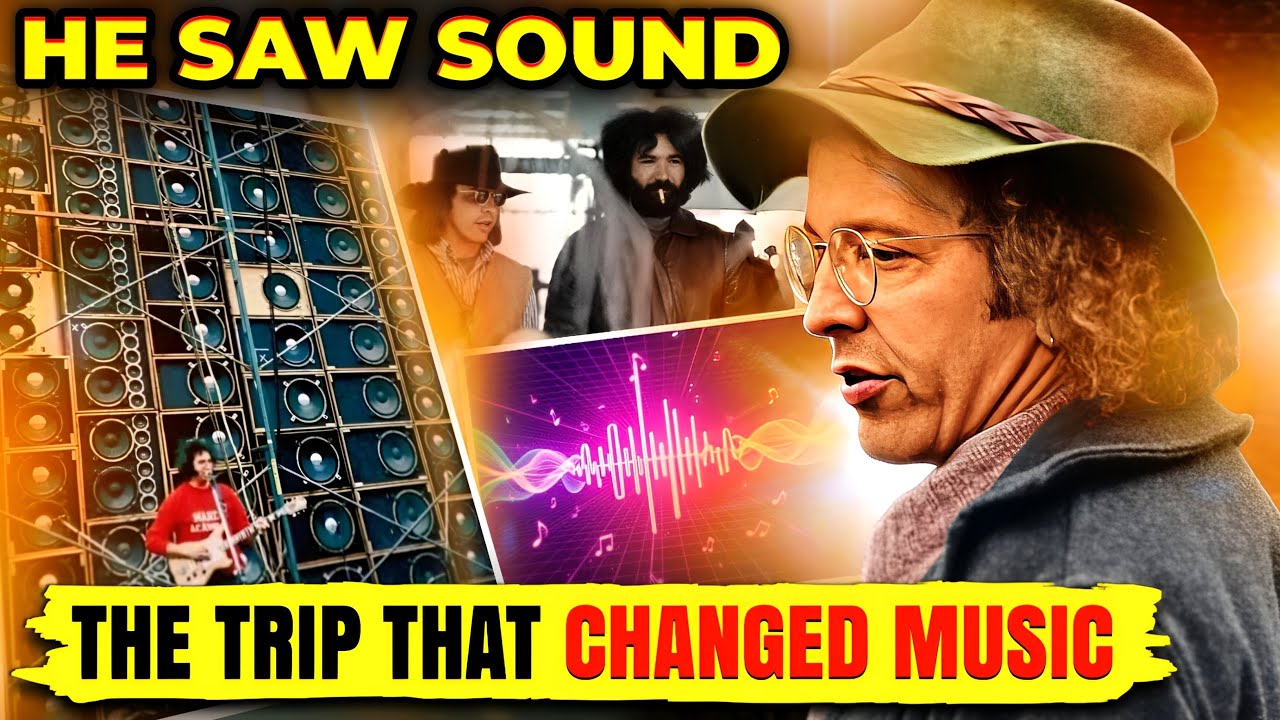
How Owsley “Bear” Stanley’s LSD Built the Grateful Dead’s Sound
Augustus Owsley Stanley III walked into the Grateful Dead‘s world in 1965 with two things: a genius-level understanding of chemistry and enough money from illegal LSD manufacturing to fund anything he wanted. What he wanted was to make the Grateful Dead the loudest, clearest band on the planet. The acid was just the beginning.
Owsley — Bear, to everyone who knew him — was already the most prolific LSD manufacturer in the United States when he latched onto the Dead. Operating out of a lab in Berkeley, he’d produced an estimated 1.25 million doses of LSD between 1965 and 1967, at a time when the drug was still technically legal. The operation generated enormous cash, and Owsley needed somewhere to put it. He found the Grateful Dead.
The patronage wasn’t charity
The patronage wasn’t charity. Owsley heard something in the Dead’s early performances — particularly in the extended jams at the Acid Tests, where Ken Kesey’s Merry Pranksters dosed audiences while the Dead played for hours — that convinced him this band could be an instrument of consciousness expansion on a mass scale. But the Dead’s equipment was garbage. They were playing through underpowered amps with distorted speakers in rooms that turned everything to mud. Owsley, who had an obsessive ear and an engineer’s intolerance for imprecision, decided to fix the problem himself.
He moved into 710 Ashbury Street with the band. He started buying equipment — amplifiers, speakers, microphones, mixing boards. Not mid-range gear. The best available. Owsley spent tens of thousands of dollars outfitting the Dead with a sound system that no band at their level had any business owning. By 1966, the Grateful Dead had better PA equipment than acts selling out arenas, and they were still playing to a few hundred people at the Fillmore.
But Owsley didn’t stop at buying gear. He started designing it. Working with the Dead’s sound crew — and later with Dan Healy, who would become the band’s longtime engineer — Owsley developed custom speaker cabinets and monitoring systems built around a single principle: the audience should hear exactly what the band hears onstage. No distortion. No coloring. No compromise. This idea, radical for the mid-sixties, eventually evolved into the Wall of Sound — the legendary 604-speaker, 26,400-watt PA system that the Dead debuted in 1974. The Wall of Sound cost an estimated $350,000 (over $2 million in today’s dollars), required four semi-trucks to transport, and was so heavy it needed its own structural engineering calculations at every venue.
Owsley’s influence on the Dead went beyond hardware
Owsley’s influence on the Dead went beyond hardware. He insisted on recording every show. At a time when most bands treated live performances as ephemeral — you played, the sound dissipated, it was gone — Owsley was running tape machines from the mixing board, capturing everything. Those recordings became the foundation of the Dead’s legendary tape-trading culture. Without Owsley’s compulsive documentation, the archive that Deadheads built over the next three decades wouldn’t exist.
He was also, by most accounts, impossible to work with. Owsley had rigid opinions about everything — what the band should eat (he was a committed carnivore who refused to allow vegetables in the communal kitchen at 710 Ashbury), how loud the monitors should be, which songs worked and which didn’t. He’d stop mid-show to adjust levels. He’d lecture Garcia about mic technique. He treated the Dead’s music as an engineering problem with an optimal solution, and his refusal to compromise created friction that lasted years.
The relationship between Owsley and the Dead fractured repeatedly. His arrest in 1967 for LSD manufacturing sent him to federal prison, cutting off both his funding and his physical presence. When he returned, the band had evolved. They’d survived without him. They’d hired professional engineers. The dynamic had shifted from patron-and-artists to something more adversarial — Owsley still wanted control, and the Dead had learned they didn’t need him the way they once had.
But the infrastructure he built remained
But the infrastructure he built remained. The recording philosophy remained. The obsession with live sound quality — the idea that a Grateful Dead show should sound like a studio recording in a concert hall — became the band’s defining technical characteristic, and it started with a twenty-something acid manufacturer who spent his drug profits on speakers and tape machines.
The full origin story — how Owsley found the Dead, what he built, and what it cost everyone involved — is.
Subscribe to The Shakedown Archives on YouTube
youtube.com/@theshakedownarchives
The Song in Context
Understanding any Grateful Dead song requires understanding the partnership between Jerry Garcia and Robert Hunter that produced it. Hunter was not a conventional lyricist — he was a poet who happened to write for a rock band. His words drew from American folk traditions, Beat poetry, and a mythological imagination that created characters and landscapes existing outside of any specific time or place. Garcia’s melodies, in turn, had a quality that musicologists have struggled to categorize — folk-informed but jazz-inflected, simple on the surface but harmonically sophisticated beneath.
The songs they created together entered the Grateful Dead’s live repertoire and evolved constantly. A song might be performed hundreds of times over decades, and no two versions were identical. Tempos shifted, arrangements expanded and contracted, and improvisational passages grew or shrank depending on the band’s collective mood on any given night. For Deadheads, the song as recorded in the studio was merely a starting point — a sketch that live performance would elaborate into something far more complex and unpredictable.
The Live Experience
The Grateful Dead’s live performances were fundamentally different from those of any other major rock band. While most acts rehearsed and repeated a fixed setlist, the Dead approached each show as a unique event. Setlists were chosen shortly before the performance, and the transitions between songs — the spaces where improvisation lived — were entirely spontaneous. A concert might last three hours or more, moving through structured songs, extended jams, and passages of pure collective improvisation that could be transcendent or chaotic, sometimes both simultaneously.
This approach demanded extraordinary musical communication. Each member of the band had to listen constantly to every other member, responding in real time to melodic suggestions, rhythmic shifts, and dynamic changes. Garcia often described it as a conversation — not a performance, but a dialogue between musicians who had developed, over years of playing together, an almost telepathic understanding of each other’s musical instincts. When it worked, the result was music that felt inevitable and surprising at the same time.
The Deadhead Phenomenon
The community that formed around the Grateful Dead was unprecedented in popular music. Deadheads didn’t just attend concerts — they built a culture. Tape trading networks distributed live recordings across the country before the internet existed, creating a shared archive of performances that fans studied with scholarly intensity. The parking lot scene at Dead shows became a self-sustaining economy of food vendors, craft sellers, and itinerant entrepreneurs who followed the band from city to city.
What distinguished Deadhead culture from ordinary fandom was its participatory nature. Deadheads didn’t consume the Grateful Dead’s music passively — they actively shaped the experience. Their energy in the audience influenced the band’s playing. Their tape trading preserved and disseminated the music. Their economic activity in the parking lots created the ecosystem that made extended touring financially viable. The relationship between the Dead and their audience was genuinely symbiotic, each sustaining and inspiring the other across three decades of continuous performance.
The Business of the Dead
The Grateful Dead’s business model was as unconventional as their music. While other major bands relied on record sales as their primary revenue source, the Dead built their economy on live performance. Their recording contracts were modest by industry standards, and they made little effort to produce radio-friendly singles. Instead, they invested in their live operation — a touring infrastructure that employed dozens of crew members and generated revenue through ticket sales, merchandise, and the loyalty of an audience that returned show after show.
This model was risky. It required constant touring to maintain cash flow, and it left the band vulnerable to the physical toll of life on the road. But it also gave them a degree of independence that few artists in the music industry have ever achieved. The Dead answered to their audience, not to record executives. They could play what they wanted, for as long as they wanted, in the way they wanted — a creative freedom that was the foundation of everything they built.
The Chemical Reality
Drugs were inseparable from the Grateful Dead’s story, but the relationship was more complex than the caricature suggests. LSD was foundational — the Acid Tests were the crucible in which the Dead’s improvisational approach was forged, and psychedelics informed the expansive, boundary-dissolving quality of their music throughout their career. But the drug culture that surrounded the Dead evolved over the decades, and not always in positive directions.
By the 1980s, harder drugs — particularly cocaine and heroin — had infiltrated both the band and their community. Garcia’s well-documented struggles with heroin addiction took a devastating toll on his health and his playing. The parking lot scene, once dominated by psychedelics, increasingly included dealers selling substances that were addictive and dangerous. The Dead’s open, tolerant culture — which had been a strength in the 1960s and 1970s — became a liability when that openness was exploited by people whose relationship with drugs was destructive rather than exploratory.
Related Articles
- Deadheads vs. Phish Fans: How Two Bands Engineered Participatory Culture Using Different Tools
- Dan Healy: How the Dead’s Sound Engineer Built Modern Concert Sound
- Owsley’s Ultimatum: The Grateful Dead’s 1970 Breaking Point
The Shakedown Archives publishes new research on Grateful Dead history each week. If you enjoyed this essay, you can subscribe to the companion YouTube channel below.
Subscribe on YouTube