The Impossible Job: Replacing Jerry Garcia at Fare Thee Well
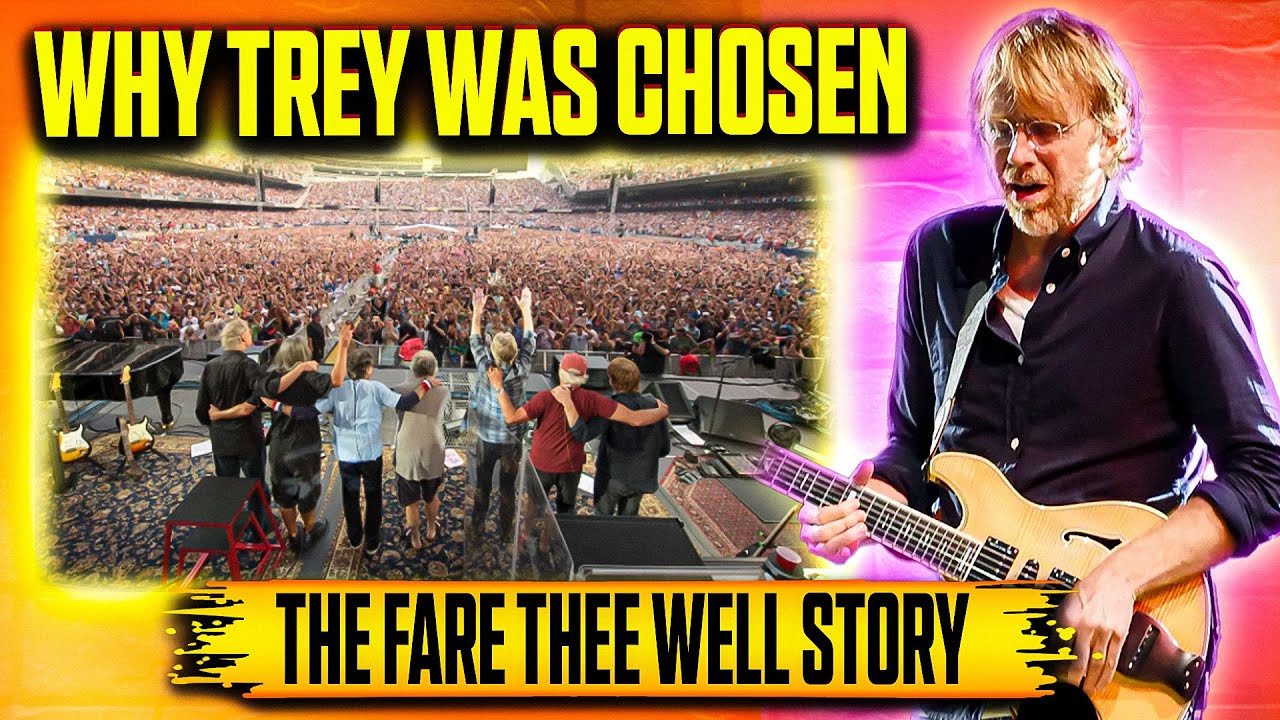
On July 3, 4, and 5, 2015, the surviving members of the Grateful Dead played three shows at Soldier Field in Chicago under the banner “Fare Thee Well: Celebrating 50 Years of the Grateful Dead.” Bob Weir, Phil Lesh, Bill Kreutzmann, and Mickey Hart would play together for what was billed as the last time. And standing in Jerry Garcia‘s spot — playing Garcia’s guitar parts, singing Garcia’s vocal lines, navigating the improvisational vocabulary that Garcia had spent thirty years developing — was Trey Anastasio, the frontman of Phish.
The choice was either inspired or insane, depending on your perspective. Trey Anastasio was not a Grateful Dead musician. He’d built Phish into the most successful improvisational rock band of the post-Garcia era, but Phish’s musical DNA was different from the Dead’s. Phish compositions were more tightly structured, more compositionally complex, more influenced by Frank Zappa and progressive rock than by the folk, blues, and jazz traditions that shaped the Dead. Anastasio’s guitar style — precise, rhythmically complex, built on composed passages rather than open-ended exploration — was the opposite of Garcia’s conversational, melodically fluid approach.
But Anastasio had been a Deadhead since he
But Anastasio had been a Deadhead since he was a teenager. He’d attended shows. He’d studied Garcia’s playing. He understood, at a level that most guitarists didn’t, what Garcia’s role in the Dead actually was — not a lead guitarist in the conventional sense, but a melodic narrator whose lines wove through the ensemble, responding to what he heard rather than imposing what he’d planned. Garcia’s playing was reactive. It required listening more than technique. And Anastasio, for all the differences in his style, was one of the best listeners in rock guitar.
The preparation was exhaustive. By multiple accounts, Anastasio spent months learning the Dead’s catalog — not just the songs, but the improvisational conventions, the signal phrases Garcia used to communicate with the band, the ways specific jams typically evolved. He listened to hundreds of hours of Dead recordings. He studied the transitions — how “Scarlet Begonias” moved into “Fire on the Mountain,” how “China Cat Sunflower” dissolved into “I Know You Rider,” how “Playing in the Band” could open into forty-five minutes of collective improvisation before finding its way home. The Dead’s music wasn’t written on paper. It lived in the accumulated memory of thousands of performances, and Anastasio had to absorb as much of that memory as possible in a compressed timeline.
The shows themselves were imperfect and occasionally transcendent. The first night was cautious — Anastasio visibly nervous, the band still finding its chemistry, the weight of the occasion pressing down on everyone. The second night loosened up. By the third night — the final show, the one that seventy thousand people inside Soldier Field and millions watching via pay-per-view knew was the end — something remarkable happened. The band found the thing that everyone was hoping for and nobody expected: genuine collective improvisation, the telepathic communication between musicians that the Grateful Dead had spent decades perfecting and that couldn’t be faked.
The criticism was predictable
The criticism was predictable. Deadheads who’d spent decades with Garcia’s playing heard every difference in Anastasio’s approach — the wrong tone, the wrong phrasing, the moments where Trey’s instinct to compose conflicted with Garcia’s instinct to discover. Purists argued that the shows shouldn’t have happened at all, that playing Garcia’s music without Garcia was a contradiction that no substitute could resolve. The financial dimension — ticket prices that reached four figures on the secondary market, a pay-per-view deal, merchandise revenue — made the “celebration” feel commercial to skeptics.
The defense was equally straightforward. The Grateful Dead’s music was bigger than any individual member. Garcia himself had resisted the cult of personality that formed around him, repeatedly insisting that the Dead were a collective endeavor. Playing the music with a different guitarist wasn’t a betrayal of Garcia’s legacy — it was an expression of it. The music was meant to live, to be played, to evolve. Keeping it locked in a museum because the original guitarist was gone would have been the real betrayal.
Anastasio walked into Soldier Field carrying thirty years of preparation and the expectations of the most demanding audience in rock music. He didn’t try to be Garcia. He tried to serve the music the way Garcia had served it — by listening, responding, and trusting the collective. Whether he succeeded is a question that every Deadhead answers differently.
The full story of how Anastasio got the
The full story of how Anastasio got the call, how he prepared, and what happened across those three nights is.
Subscribe to The Shakedown Archives on YouTube
youtube.com/@theshakedownarchives
The Song in Context
Understanding any Grateful Dead song requires understanding the partnership between Jerry Garcia and Robert Hunter that produced it. Hunter was not a conventional lyricist — he was a poet who happened to write for a rock band. His words drew from American folk traditions, Beat poetry, and a mythological imagination that created characters and landscapes existing outside of any specific time or place. Garcia’s melodies, in turn, had a quality that musicologists have struggled to categorize — folk-informed but jazz-inflected, simple on the surface but harmonically sophisticated beneath.
The songs they created together entered the Grateful Dead’s live repertoire and evolved constantly. A song might be performed hundreds of times over decades, and no two versions were identical. Tempos shifted, arrangements expanded and contracted, and improvisational passages grew or shrank depending on the band’s collective mood on any given night. For Deadheads, the song as recorded in the studio was merely a starting point — a sketch that live performance would elaborate into something far more complex and unpredictable.
The Live Experience
The Grateful Dead’s live performances were fundamentally different from those of any other major rock band. While most acts rehearsed and repeated a fixed setlist, the Dead approached each show as a unique event. Setlists were chosen shortly before the performance, and the transitions between songs — the spaces where improvisation lived — were entirely spontaneous. A concert might last three hours or more, moving through structured songs, extended jams, and passages of pure collective improvisation that could be transcendent or chaotic, sometimes both simultaneously.
This approach demanded extraordinary musical communication. Each member of the band had to listen constantly to every other member, responding in real time to melodic suggestions, rhythmic shifts, and dynamic changes. Garcia often described it as a conversation — not a performance, but a dialogue between musicians who had developed, over years of playing together, an almost telepathic understanding of each other’s musical instincts. When it worked, the result was music that felt inevitable and surprising at the same time.
The Deadhead Phenomenon
The community that formed around the Grateful Dead was unprecedented in popular music. Deadheads didn’t just attend concerts — they built a culture. Tape trading networks distributed live recordings across the country before the internet existed, creating a shared archive of performances that fans studied with scholarly intensity. The parking lot scene at Dead shows became a self-sustaining economy of food vendors, craft sellers, and itinerant entrepreneurs who followed the band from city to city.
What distinguished Deadhead culture from ordinary fandom was its participatory nature. Deadheads didn’t consume the Grateful Dead’s music passively — they actively shaped the experience. Their energy in the audience influenced the band’s playing. Their tape trading preserved and disseminated the music. Their economic activity in the parking lots created the ecosystem that made extended touring financially viable. The relationship between the Dead and their audience was genuinely symbiotic, each sustaining and inspiring the other across three decades of continuous performance.
Related Articles
- Why The Dead Took 7 Years To Rise Again
- Bob Weir Has Died. What Happens to the Grateful Dead Now?
- Warren Haynes Had to be Jerry Garcia and Duane Allman — In the Same Year
The Shakedown Archives publishes new research on Grateful Dead history each week. If you enjoyed this essay, you can subscribe to the companion YouTube channel below.
Subscribe on YouTube