Watkins Glen ’73: The Historic Festival That Beat Woodstock in Size & Spirit!
The Festival Nobody Remembers
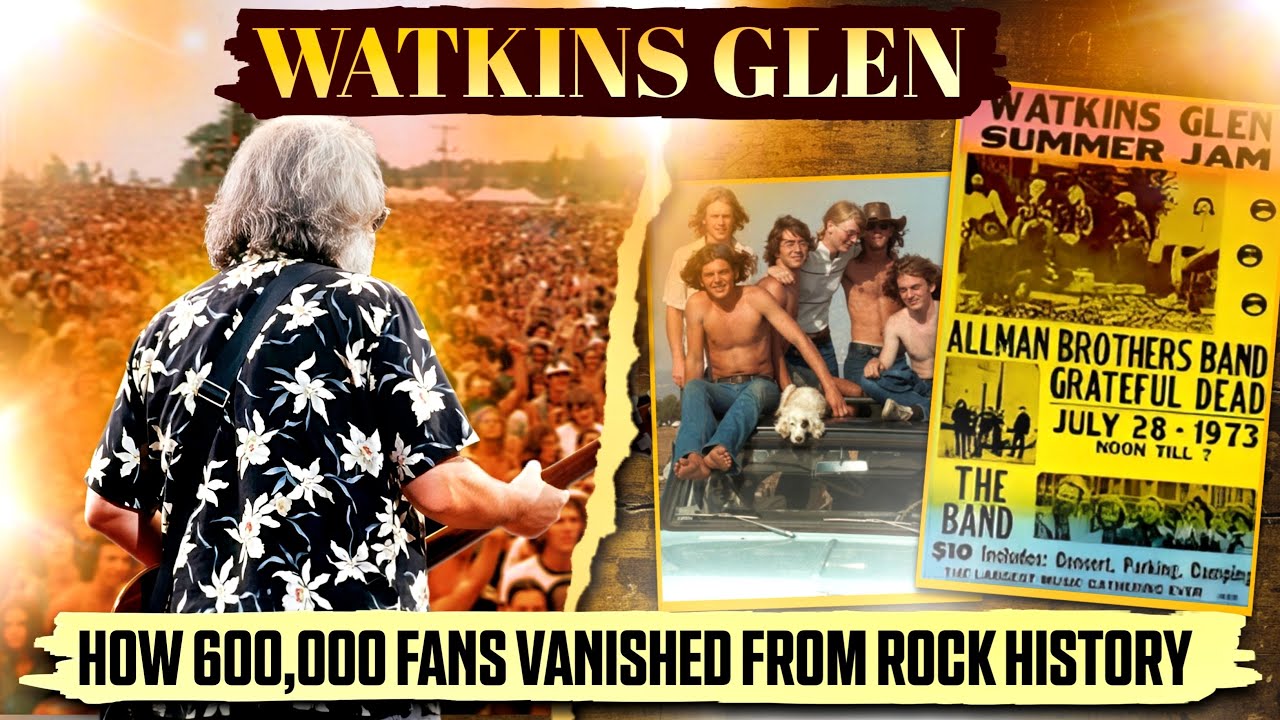
On July 28th, 1973, 600,000 people gathered at a racetrack in upstate New York for the largest concert in American history. The Grateful Dead, the Allman Brothers Band, and The Band all played. It was bigger than Woodstock by 150,000 people, and most people have never heard of it. Watkins Glen Summer Jam has become rock and roll’s greatest disappearing act—no iconic movie, no legendary live album, just a footnote that Deadheads bring up to one-up Woodstock fans. But the real story isn’t what happened on Saturday. It’s what happened the night before, when the Grateful Dead played what many consider one of their greatest performances ever during what was supposed to be just a soundcheck.
The groundwork started two years earlier when Grateful Dead tour manager Sam Cutler had an idea. Having been the Rolling Stones’ tour manager at Altamont, he understood festival disasters intimately. He wanted to prove the counterculture could scale without chaos. In an interview years later, Cutler explained his vision: the Grateful Dead needed to play with other people as collaborative trips, not where one band was second on the bill. The perfect partner was the Allman Brothers Band.
The Bands Come Together
In the summer of 1972, members of both bands started jamming together at shows in Hartford and the Bronx. When Dickey Betts and Jerry Garcia played guitar together, something clicked. Allman Brothers biographer Alan Paul says Dickey told him, “I always had this concept in my head of what I wanted to do. And the first time I heard Garcia, I thought, ‘Oh, damn. That guy beat me to it.'” By late 1972, Cutler and the Allman Brothers’ booking agent, Bunky Odom, were planning something massive at Watkins Glen International Speedway in upstate New York. They needed a third act to guarantee maximum ticket sales. The promoters initially booked Leon Russell, who was huge at the time. Then Jerry Garcia stopped them. Garcia felt that upstate New York was The Band’s home territory, and they owed them the respect of asking first. The promoters figured The Band would decline since they weren’t really touring in 1973, but when they heard Garcia specifically requested them, they said yes. The promoters had to pay Leon Russell not to play.
The Crowd That Never Should Have Happened
The festival was announced in early June with a planned capacity of 150,000 people. By Wednesday, July 25th, three days before the scheduled concert, 50,000 people had already arrived. By Thursday, the number hit 100,000. Traffic on the New York State Thruway came to a complete standstill. People abandoned their cars on the highway and walked miles through the countryside. Sociologist Rebecca Adams, who was there, remembered in an interview: “We walked and had to leave the car behind, and I swear I thought we walked 20 miles, but maybe it was only 8 or 9 miles.” When she finally arrived at the festival, there was no ticket taker. “I remember we kind of climbed in through a hedge that was on the side of the road, pushing the branches out of the way. And then on the other side, there were all these people.”
By Friday morning, promoter Jim Koplik was in full panic mode. The New York State Thruway was so packed that police told them they were closing it and telling people to turn around. Koplik realized they’d never taken tickets at the gate, so they didn’t even know how many people were there. He thought he was about to go out of business. The state police reopened the Thruway 15 minutes later, but the crowd kept growing. By Friday afternoon, Bill Graham, who’d been brought in to handle production logistics, made the call: “Open the gates. Make it free.”
The Legendary Soundcheck
By Friday evening, Bill Graham decided the bands should do a public soundcheck. The Allman Brothers went first, then the Grateful Dead took the stage around sunset. The Dead played for 90 minutes across two sets, but it wasn’t their usual song-based show. It was almost entirely improvised jamming, pure instrumental exploration with no lyrics. Lee Ranaldo, who would later co-found Sonic Youth, was 17 years old in the crowd. In an interview decades later, he described it: “It kept feeling like it was going to go into this or that song, but they never did. It just stayed as this abstract jam with no singing, and it just felt like you were hearing them do brand-new music.”
Steve Silberman, who would later co-author Skeleton Key: A Dictionary for Deadheads, was just 15. Years later, helping edit a Grateful Dead box set, he called the Watkins Glen soundcheck one of the most beautiful pieces of purely improvised composition he’d ever heard. The temperature had dropped dramatically from the 95-degree daytime heat. People huddled together on wooden pallets salvaged from the water supply. Some had planted a pirate flag made from a bed sheet to find their friends in the massive crowd.
The Chaotic Finale
Saturday morning arrived with the Grateful Dead playing first in the afternoon daylight. It was a solid show, though everyone would dismiss it because they compared it to Friday’s soundcheck. After the Dead finished, storm clouds rolled in. The Band took the stage as lightning started striking around the venue. The band members left the stage, afraid of electrocution, but organist Garth Hudson stayed. His organ was protected in the back. He played an eight-minute improvised solo called “The Genetic Method” while lightning lit up the sky.
Around 2:00 in the morning, members of all three bands gathered for the super jam everyone had been waiting for. It was exhausted and sloppy. Rick Danko from The Band was heavily intoxicated. The lyrics were being slurred, and it was a pretty sloppy performance. The audience started booing. Danko said, “Oh, you don’t like that one, huh? Okay, I got another one,” and started the same song again. Robbie Robertson barely played. Jerry Garcia carried “Mountain Jam” until the first light of dawn broke over upstate New York.
The Deliberate Erasure
The next morning, promoter Jim Koplik stood on the stage looking out at the field. He remembered thinking, “We forgot something.” When asked what, he said, “We forgot garbage cans. 600,000 people had nowhere to throw anything.” The cleaning company they’d hired for $5,000 demanded $50,000. The state health department warned them they had until Monday to clean up or face arrests.
But the bigger question was what would happen to the music. The promoters desperately wanted to make a Woodstock-style documentary because that’s how Woodstock became profitable. The Dead refused unless they controlled the cameras. The Allmans refused to let the Dead control the cameras. So there was no movie. Both bands also refused to release a live album, not because of bad performances or technical problems, but as a deliberate choice. Rolling Stone later quoted Sam Cutler: “The Grateful Dead are delighted that Watkins Glen is only a fond memory and that there will be no further commercial exploitation of what was a tasteful musical trip.”
The Legacy That Refuses to Fade
The counterculture had proven that hundreds of thousands of people could gather peacefully for collaborative music without the chaos of Altamont, and they chose to let it exist only as memory because commodifying it would betray their principles. For the people who were there, it wasn’t an ending. Lee Ranaldo went on to co-found Sonic Youth, one of the most influential rock bands of the ’80s and ’90s. Steve Silberman became one of the Grateful Dead’s most important archivists and a celebrated science writer. Rebecca Adams became the first sociologist to seriously study Deadhead culture. Dan Hanklin, who was there with his pirate flag made from a bed sheet, remembered the moment years later: “The whole vibe was one of endurance. Everybody was sweaty and greasy and just miserable. And we were digging on the music. That was the one common denominator. And we were pretty much digging on each other.”
Watkins Glen was the moment they learned you could wander through fields and find your people. That the music was real. That the community was possible.
Subscribe to The Shakedown Archives for more Grateful Dead documentaries, and explore more stories at TheShakedownArchives.com.
The Shakedown Archives publishes new research on Grateful Dead history each week. If you enjoyed this essay, you can subscribe to the companion YouTube channel below.
Subscribe on YouTube