The Messy Truth About Keith Godchaux Leaving the Grateful Dead
The standard version of Keith Godchaux‘s departure from the Grateful Dead goes something like this: by 1979, Keith’s playing had declined, the band sat him down, they parted ways amicably, and Brent Mydland stepped in. It’s clean. It’s diplomatic. And it leaves out almost everything that actually happened.
Keith Godchaux joined the Grateful Dead in September 1971, recruited at a moment of crisis. Pigpen’s health was collapsing — liver damage from years of heavy drinking had landed him in the hospital — and the band had a Midwest tour starting in Minneapolis with no keyboard player. Keith’s wife Donna Jean, a former Muscle Shoals session vocalist who’d sung on records by Elvis Presley and Aretha Franklin, told Garcia directly that her husband was the Dead’s next pianist. Within weeks, Keith was onstage at the Northrup Auditorium. He was twenty-three years old.
For the first several years
For the first several years, Keith Godchaux was extraordinary. The 1972 and 1973 recordings — the Europe ’72 tour, the legendary Veneta show, the Watkins Glen soundcheck — feature a pianist who could match Garcia’s melodic runs note for note while anchoring the harmonic structure that Phil Lesh’s bass lines deliberately avoided. Keith didn’t just fill space. He gave the Dead a tonal center they’d never had before, and it freed Garcia to take longer, riskier improvisational journeys.
But by 1977, something had shifted. The playing that had once been fluid and responsive grew stiff. Keith’s comping became repetitive, his solos less adventurous. Multiple sources from inside the Dead’s circle — road crew, fellow musicians, friends — point to the same culprit: drugs. Not the psychedelics that had defined the band’s early years, but harder substances that were grinding Keith down physically and musically. Donna Jean’s vocals, always polarizing among Deadheads, became increasingly erratic during the same period.
The band noticed. The audience noticed. And by late 1978, the situation had become untenable.
What most people don’t know is how the
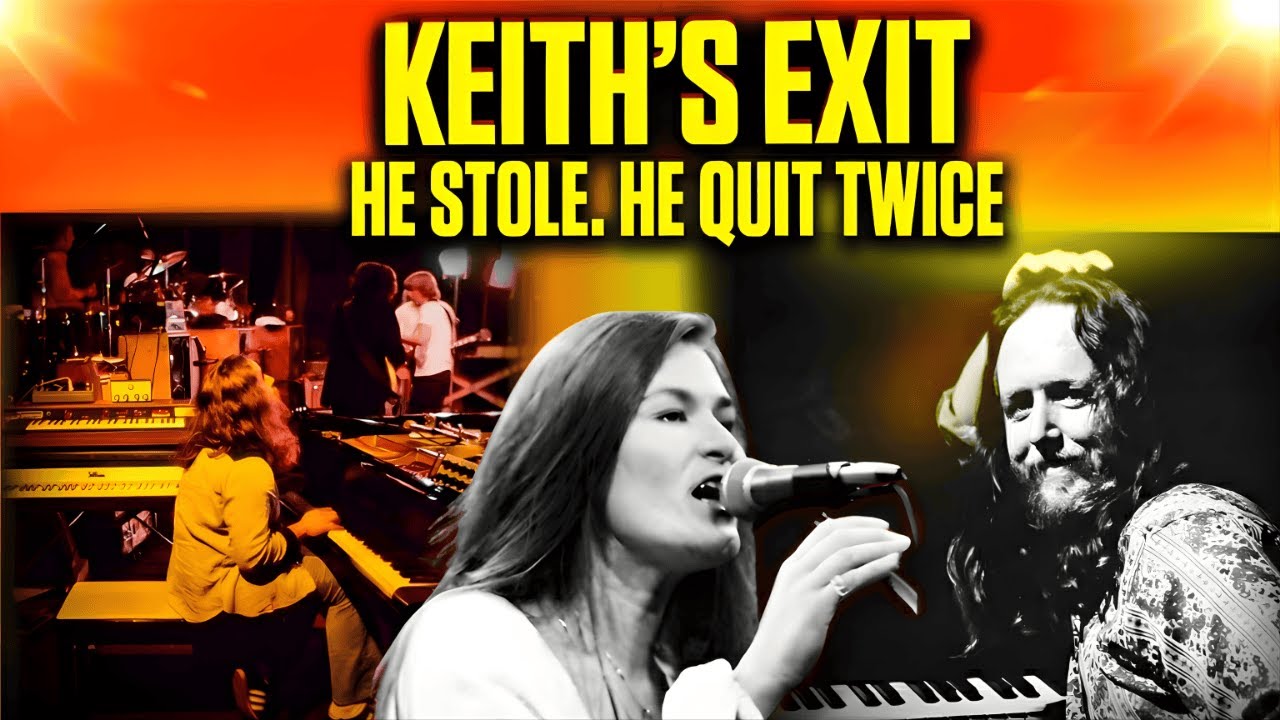
What most people don’t know is how the exit actually unfolded. Keith’s grand piano — the instrument he played onstage with the Dead — was stolen. The circumstances around the theft remain murky, but the practical effect was devastating: Keith couldn’t perform without a piano, and the band wasn’t rushing to replace it. Whether the theft was genuinely random or conveniently timed depends on who you ask, but the result was the same. Keith Godchaux was a pianist without a piano in a band that was already looking for his replacement.
That replacement search happened in secret. The Dead auditioned Brent Mydland — a keyboardist who’d been playing with Bob Weir‘s side project — before Keith and Donna were formally told they were out. By the time the conversation happened, it wasn’t a negotiation. The band had already made their decision and already had someone ready to step in. The “mutual agreement” that press releases described was mutual in the way that a resignation letter written under pressure is voluntary. Keith and Donna didn’t jump. They were pushed, gently, out a door the band had been holding open for months.
Keith’s last show with the Grateful Dead was February 17, 1979, at the Oakland Auditorium. Brent Mydland played his first show on April 22, barely two months later. The transition was seamless because it had been planned that way.
The aftermath was brutal
The aftermath was brutal. Keith and Donna formed the Heart of Gold Band with a few other musicians and recorded at the Dead’s own Front Street studio, with Robert Hunter producing. Keith also briefly toured with the Healy Treece Band, a project co-fronted by Dead sound engineer Dan Healy with Bill Kreutzmann on drums. There was still connection to the Dead’s world, still proximity to the family. But the trajectory was downward.
On July 23, 1980 — less than eighteen months after his last Dead show — Keith Godchaux died from injuries sustained in a car accident on a Marin County road. He was thirty-two years old.
The clean version of Keith’s story is that he faded and moved on. The real version is messier: a musician who gave the Dead some of their finest years, who was consumed by the same forces that would later claim Jerry Garcia, and who was eased out of the band through a combination of deteriorating performance, a convenient crisis, and a replacement who was already waiting in the wings. The Grateful Dead didn’t fire Keith Godchaux. They did something more complicated than that — and the full story, with the evidence and the timeline, is.
Subscribe to The Shakedown Archives on YouTube
youtube.com/@theshakedownarchives
The Song in Context
Understanding any Grateful Dead song requires understanding the partnership between Jerry Garcia and Robert Hunter that produced it. Hunter was not a conventional lyricist — he was a poet who happened to write for a rock band. His words drew from American folk traditions, Beat poetry, and a mythological imagination that created characters and landscapes existing outside of any specific time or place. Garcia’s melodies, in turn, had a quality that musicologists have struggled to categorize — folk-informed but jazz-inflected, simple on the surface but harmonically sophisticated beneath.
The songs they created together entered the Grateful Dead’s live repertoire and evolved constantly. A song might be performed hundreds of times over decades, and no two versions were identical. Tempos shifted, arrangements expanded and contracted, and improvisational passages grew or shrank depending on the band’s collective mood on any given night. For Deadheads, the song as recorded in the studio was merely a starting point — a sketch that live performance would elaborate into something far more complex and unpredictable.
The Live Experience
The Grateful Dead’s live performances were fundamentally different from those of any other major rock band. While most acts rehearsed and repeated a fixed setlist, the Dead approached each show as a unique event. Setlists were chosen shortly before the performance, and the transitions between songs — the spaces where improvisation lived — were entirely spontaneous. A concert might last three hours or more, moving through structured songs, extended jams, and passages of pure collective improvisation that could be transcendent or chaotic, sometimes both simultaneously.
This approach demanded extraordinary musical communication. Each member of the band had to listen constantly to every other member, responding in real time to melodic suggestions, rhythmic shifts, and dynamic changes. Garcia often described it as a conversation — not a performance, but a dialogue between musicians who had developed, over years of playing together, an almost telepathic understanding of each other’s musical instincts. When it worked, the result was music that felt inevitable and surprising at the same time.
The Deadhead Phenomenon
The community that formed around the Grateful Dead was unprecedented in popular music. Deadheads didn’t just attend concerts — they built a culture. Tape trading networks distributed live recordings across the country before the internet existed, creating a shared archive of performances that fans studied with scholarly intensity. The parking lot scene at Dead shows became a self-sustaining economy of food vendors, craft sellers, and itinerant entrepreneurs who followed the band from city to city.
What distinguished Deadhead culture from ordinary fandom was its participatory nature. Deadheads didn’t consume the Grateful Dead’s music passively — they actively shaped the experience. Their energy in the audience influenced the band’s playing. Their tape trading preserved and disseminated the music. Their economic activity in the parking lots created the ecosystem that made extended touring financially viable. The relationship between the Dead and their audience was genuinely symbiotic, each sustaining and inspiring the other across three decades of continuous performance.
The Chemical Reality
Drugs were inseparable from the Grateful Dead’s story, but the relationship was more complex than the caricature suggests. LSD was foundational — the Acid Tests were the crucible in which the Dead’s improvisational approach was forged, and psychedelics informed the expansive, boundary-dissolving quality of their music throughout their career. But the drug culture that surrounded the Dead evolved over the decades, and not always in positive directions.
By the 1980s, harder drugs — particularly cocaine and heroin — had infiltrated both the band and their community. Garcia’s well-documented struggles with heroin addiction took a devastating toll on his health and his playing. The parking lot scene, once dominated by psychedelics, increasingly included dealers selling substances that were addictive and dangerous. The Dead’s open, tolerant culture — which had been a strength in the 1960s and 1970s — became a liability when that openness was exploited by people whose relationship with drugs was destructive rather than exploratory.
Related Articles
- Brent Mydland and the Year the Grateful Dead’s Sound Was Reborn
- Donna Jean Godchaux’s Legacy: From Muscle Shoals to the Grateful Dead
- Box of Rain: The Inside Story of the Grateful Dead’s Last Words Together
The Shakedown Archives publishes new research on Grateful Dead history each week. If you enjoyed this essay, you can subscribe to the companion YouTube channel below.
Subscribe on YouTube