The Grateful Dead Song Born from an ACID Nightmare
Stella Blue was born from Robert Hunter’s 1969 acid nightmare and debuted at Pigpen’s last show. Garcia performed it 328 times before he understood it.
Robert Hunter (1941–2019) was the Grateful Dead’s primary lyricist from 1967 through the band’s dissolution in 1995. He wrote the words for almost every Garcia-sung song, including Dark Star, Ripple, Scarlet Begonias, Truckin’, Friend of the Devil, and dozens more. Hunter rarely toured with the Dead but was considered a full member of the band’s creative partnership. Articles cover his lyrics, his books, his solo work, and his unique place in American songwriting.
Stella Blue was born from Robert Hunter’s 1969 acid nightmare and debuted at Pigpen’s last show. Garcia performed it 328 times before he understood it.
When Bob Weir joined the Grateful Dead on New Year’s Eve 1963 at Dana Morgan Music in Palo Alto, he was sixteen years old, relatively inexperienced, and stepping into a band that already had a distinctive direction. He was the youngest original member joining a group led by Jerry Garcia, and the conventional expectation might…
John Perry Barlow was a paradox wrapped in contradictions, and that’s exactly what made him essential to understanding the Grateful Dead‘s evolution. While Robert Hunter provided the mythological and literary foundation for Jerry Garcia‘s musical vision, it was Barlow who served as Bob Weir’s primary lyricist—a partnership that gave the Dead’s rhythm guitarist the poetic…
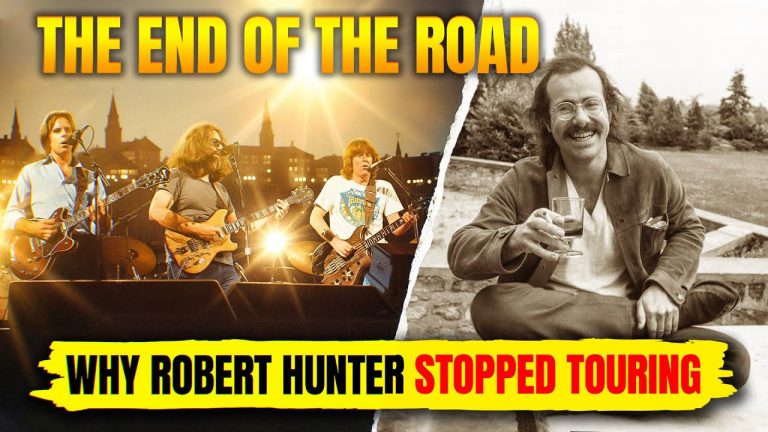
Robert Hunter occupies a unique position in the history of the Grateful Dead. Unlike Jerry Garcia, who was universally recognized as the band’s founder and primary musical voice, or Phil Lesh, whose bass lines were audible signatures of the Dead’s sound, Hunter worked largely behind the scenes. He was the primary lyricist for the Grateful…
The Grateful Dead did not emerge fully formed from the San Francisco psychedelic scene of the mid-1960s. Long before they played the Fillmore, long before the Acid Tests and Ken Kesey’s Pranksters, the band members were steeped in a distinctly American musical tradition: folk music, bluegrass, and jug band blues. This foundation shaped everything the…
In the annals of rock and roll history, few musical decisions have proven as transformative and structurally crucial as the Grateful Dead‘s adoption of a two-drummer system. While most rock bands settled comfortably into the standard four-piece rhythm section—bass, drums, guitar, and keys—the Dead looked at this conventional wisdom and asked: what if we doubled…
Robert Hunter is everywhere and nowhere in Grateful Dead history. His lyrics haunt the band’s greatest songs—”Truckin’,” “Dark Star,” “Ripple,” “Mississippi Half-Step,” and dozens of standards that defined the Dead’s sound. Yet if you attended a Grateful Dead show in 1973, you wouldn’t see him onstage. If you went in 1985 or 1995, he still…
The Grateful Dead‘s “Friend of the Devil” stands as one of the most beloved and enduring songs in American rock history. Yet few listeners realize that this achingly melancholic folk ballad—a staple of the Dead’s 300-plus live performances—began its life as something entirely different: a sprightly bluegrass number, full of energy and urgency. The journey…
When “Casey Jones” roars out of speakers at Grateful Dead concerts—that driving locomotive rhythm, the unmistakable chorus—audiences immediately recognize it as one of the band’s most iconic tracks. Yet few listeners understand the actual story Robert Hunter and Jerry Garcia were telling. The song that became synonymous with the Grateful Dead’s supposedly hedonistic ethos is,…
In February 1968, when the Grateful Dead recorded “Dark Star” for Warner Bros. Records, few could have anticipated that this understated two-minute-and-forty-five-second composition would eventually become the definitive expression of the band’s improvisational philosophy. Written by Robert Hunter and Jerry Garcia, the song emerged during a transitional moment for the Dead—a period when the San…