Why the Grateful Dead Needed Two Drummers — The Rhythm Devils Origin Story
In the annals of rock and roll history, few musical decisions have proven as transformative and structurally crucial as the Grateful Dead‘s adoption of a two-drummer system. While most rock bands settled comfortably into the standard four-piece rhythm section—bass, drums, guitar, and keys—the Dead looked at this conventional wisdom and asked: what if we doubled down on percussion? The answer to that question would reshape not only the Dead’s sound but create a template for complex, polyrhythmic rock that influenced generations of musicians to follow.
Bill Kreutzmann arrived at the Grateful Dead‘s origin story before there even was a Grateful Dead. In 1965, as the Mother McCree’s Uptown Jug Champions were evolving into a rock ensemble, Kreutzmann was already behind the kit. He came of age as a drummer in the San Francisco Bay Area, absorbing the regional influences that would define the Dead’s early sound—blues, folk, country, and the emerging psychedelic landscape. Kreutzmann’s approach was straightforward yet innovative: he understood that rock drumming could be conversational, responding to the nuances of Weir and Garcia’s guitar interplay rather than simply marking time. His work on early Dead records like “Workingman’s Dead” and “American Beauty” demonstrated a sensitivity to dynamics that would become a hallmark of the band’s rhythm section.
But Bill Kreutzmann alone
But Bill Kreutzmann alone, however talented, could not contain the rhythmic ambitions the Grateful Dead began to harbor by 1967. Enter Mickey Hart.
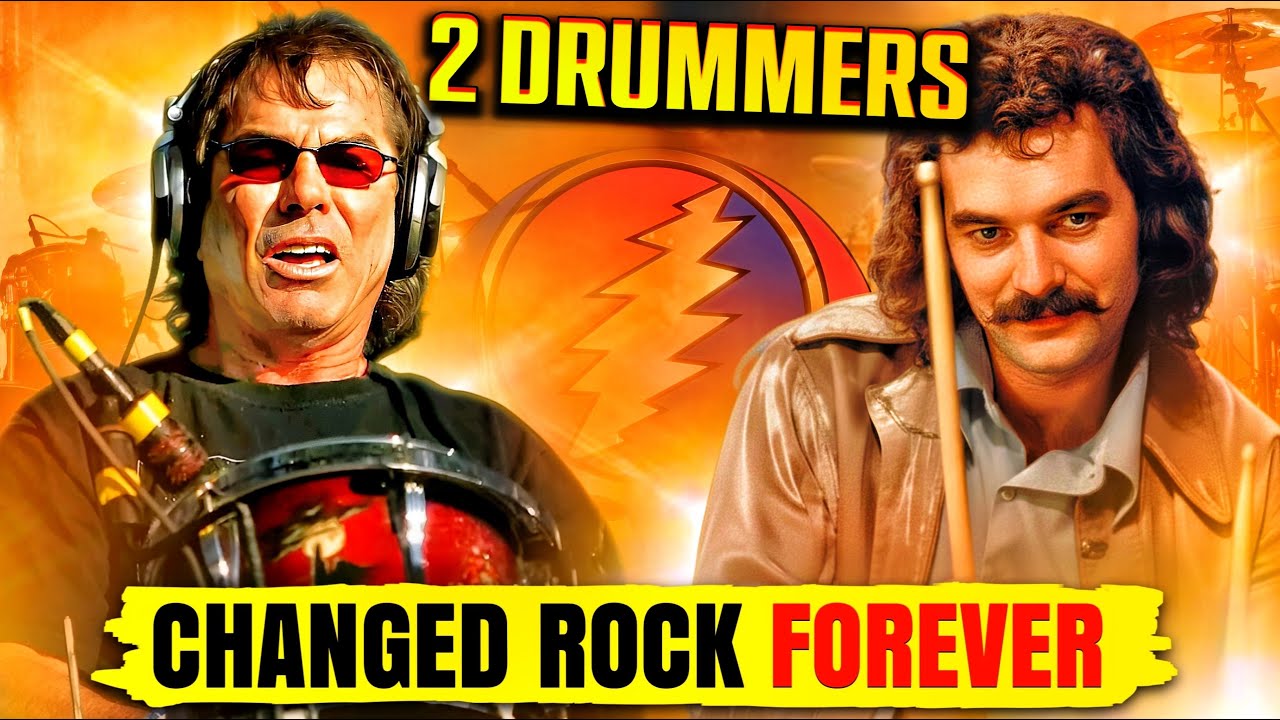
Mickey Hart‘s arrival in September 1967 came through a back door that seemed almost accidental. Hart, a young drummer with a growing reputation in the Bay Area underground scene, attended a Grateful Dead concert at the Straight Theater in San Francisco. The connection was immediate and intuitive—Hart sat in with the band, and the moment he felt Kreutzmann’s pocket, something clicked. The Dead recognized instantly what they had stumbled upon: a second percussionist who didn’t duplicate Kreutzmann’s role but rather complemented and extended it. Where Kreutzmann played with a blues-inflected swing, Hart brought a more complex, world-music-informed sensibility. His background included deep interests in African rhythms, Brazilian samba, and Indian classical percussion—influences that had little precedent in rock music.
The relationship between Hart and Kreutzmann was never competitive; instead, it became one of rock’s great creative partnerships. Rather than each drummer fighting for the same sonic space, they established what came to be understood as the “Rhythm Devils”—a dual percussion approach that allowed them to weave independent but interlocking rhythmic lines. When they were firing on all cylinders, Hart and Kreutzmann created a rhythmic foundation that was simultaneously more complex and more flexible than a standard single drummer could achieve. They could split cymbal work, trade hi-hat patterns, build polyrhythms that had no precedent in rock music, and create textural spaces that would become distinctive sonic markers of the Grateful Dead experience.
The formalization of this partnership found its most
The formalization of this partnership found its most direct expression in the “Drums/Space” segment that became a nightly ritual in Grateful Dead concerts. Emerging organically from the band’s extended improvisations, Drums/Space was precisely what it sounded like: a dedicated portion of the setlist—usually appearing in the second set—where the drummers and sometimes bassist Phil Lesh took the forefront while guitarists Garcia and Weir stepped back. For ten to thirty minutes (sometimes longer), Hart and Kreutzmann would engage in elaborate conversational percussion dialogues. These weren’t drum solos in the traditional sense; they were explorations of rhythm, space, and texture that could veer into avant-garde territories.
Drums/Space segments became polarizing among Grateful Dead fans. Devotees loved them as opportunities to experience pure rhythmic innovation and witness Hart and Kreutzmann’s technical mastery and creative rapport. Skeptics viewed them as self-indulgent passages that interrupted the rock and roll momentum. Yet even critics had to acknowledge the musicianship on display: Hart and Kreutzmann were exploring sonic territory that had nothing to do with conventional song structure.
Mickey Hart’s tenure with the Dead was not without complications. The most significant rupture came in 1971, when Hart’s father, Lenny Hart, was discovered to have embezzled substantial funds from the band’s organization. The theft devastated the Hart family and created immense tension within the Dead’s organization. Mickey Hart departed, leaving Bill Kreutzmann as the sole drummer for several years. The absence was felt throughout the band’s music—there was an undeniable rhythmic loss. When Hart returned in 1974, the reunion reinforced just how essential his partnership with Kreutzmann had become.
By the late 1970s and through the 1980s
By the late 1970s and through the 1980s, the two-drummer system had become not just accepted but expected by Dead fans. The Rhythm Devils became the beating heart of the Grateful Dead live experience. They influenced how the band approached improvisation, pacing, and structural development. Songs could develop differently depending on how Hart and Kreutzmann chose to drive them rhythmically. A “Dark Star” with one kind of Kreutzmann-Hart interplay could feel introspective and exploratory; another night, with different rhythmic choices, it could feel propulsive and expansive.
The two-drummer system also solved a practical problem unique to the Grateful Dead: stamina. The Dead’s concerts were marathons, sometimes stretching to three or four hours. Sharing the load of keeping time over such extended performances made sense logistically, but more importantly, it allowed Hart and Kreutzmann to bring fresh energy and focused creativity to different parts of the show. Neither drummer was exhausted by the closing set; both could contribute meaningfully throughout the night.
In retrospect, the decision to embrace two drummers positioned the Grateful Dead at the forefront of rhythmic sophistication in rock music. While many bands have attempted the two-drummer approach, few have achieved the seamless integration and creative synergy that Hart and Kreutzmann developed. Their legacy influenced everyone from jam bands to modern progressive rock acts. The Rhythm Devils proved that doubling down on percussion wasn’t a gimmick but a genuine musical innovation—one that gave the Grateful Dead’s sound a unique complexity that remains instantly recognizable decades later.
The two-drummer system reflected something fundamental about the Grateful Dead’s approach to music-making: the willingness to challenge conventions and pursue ambitious musical ideas, even when they departed from what rock audiences expected. In doing so, Hart and Kreutzmann created one of rock’s most distinctive and enduring rhythm foundations.
The Song in Context
Understanding any Grateful Dead song requires understanding the partnership between Jerry Garcia and Robert Hunter that produced it. Hunter was not a conventional lyricist — he was a poet who happened to write for a rock band. His words drew from American folk traditions, Beat poetry, and a mythological imagination that created characters and landscapes existing outside of any specific time or place. Garcia’s melodies, in turn, had a quality that musicologists have struggled to categorize — folk-informed but jazz-inflected, simple on the surface but harmonically sophisticated beneath.
The songs they created together entered the Grateful Dead’s live repertoire and evolved constantly. A song might be performed hundreds of times over decades, and no two versions were identical. Tempos shifted, arrangements expanded and contracted, and improvisational passages grew or shrank depending on the band’s collective mood on any given night. For Deadheads, the song as recorded in the studio was merely a starting point — a sketch that live performance would elaborate into something far more complex and unpredictable.
The Live Experience
The Grateful Dead’s live performances were fundamentally different from those of any other major rock band. While most acts rehearsed and repeated a fixed setlist, the Dead approached each show as a unique event. Setlists were chosen shortly before the performance, and the transitions between songs — the spaces where improvisation lived — were entirely spontaneous. A concert might last three hours or more, moving through structured songs, extended jams, and passages of pure collective improvisation that could be transcendent or chaotic, sometimes both simultaneously.
This approach demanded extraordinary musical communication. Each member of the band had to listen constantly to every other member, responding in real time to melodic suggestions, rhythmic shifts, and dynamic changes. Garcia often described it as a conversation — not a performance, but a dialogue between musicians who had developed, over years of playing together, an almost telepathic understanding of each other’s musical instincts. When it worked, the result was music that felt inevitable and surprising at the same time.
The Deadhead Phenomenon
The community that formed around the Grateful Dead was unprecedented in popular music. Deadheads didn’t just attend concerts — they built a culture. Tape trading networks distributed live recordings across the country before the internet existed, creating a shared archive of performances that fans studied with scholarly intensity. The parking lot scene at Dead shows became a self-sustaining economy of food vendors, craft sellers, and itinerant entrepreneurs who followed the band from city to city.
What distinguished Deadhead culture from ordinary fandom was its participatory nature. Deadheads didn’t consume the Grateful Dead’s music passively — they actively shaped the experience. Their energy in the audience influenced the band’s playing. Their tape trading preserved and disseminated the music. Their economic activity in the parking lots created the ecosystem that made extended touring financially viable. The relationship between the Dead and their audience was genuinely symbiotic, each sustaining and inspiring the other across three decades of continuous performance.
Related Articles
- His Father Swore on a Bible. Then Robbed the Grateful Dead.
- Tiger Rose: The Mysterious Album Robert Hunter Tried to Erase From History
- Frankie Weir, Sugar Magnolia, and the Women Who Actually Ran the Grateful Dead
The Shakedown Archives publishes new research on Grateful Dead history each week. If you enjoyed this essay, you can subscribe to the companion YouTube channel below.
Subscribe on YouTube