John Perry Barlow: The Wyoming Rancher Who Bridged Counterculture and Cyberspace
John Perry Barlow was a paradox wrapped in contradictions, and that’s exactly what made him essential to understanding the Grateful Dead‘s evolution. While Robert Hunter provided the mythological and literary foundation for Jerry Garcia‘s musical vision, it was Barlow who served as Bob Weir’s primary lyricist—a partnership that gave the Dead’s rhythm guitarist the poetic equivalent of Garcia’s improvisational freedom.
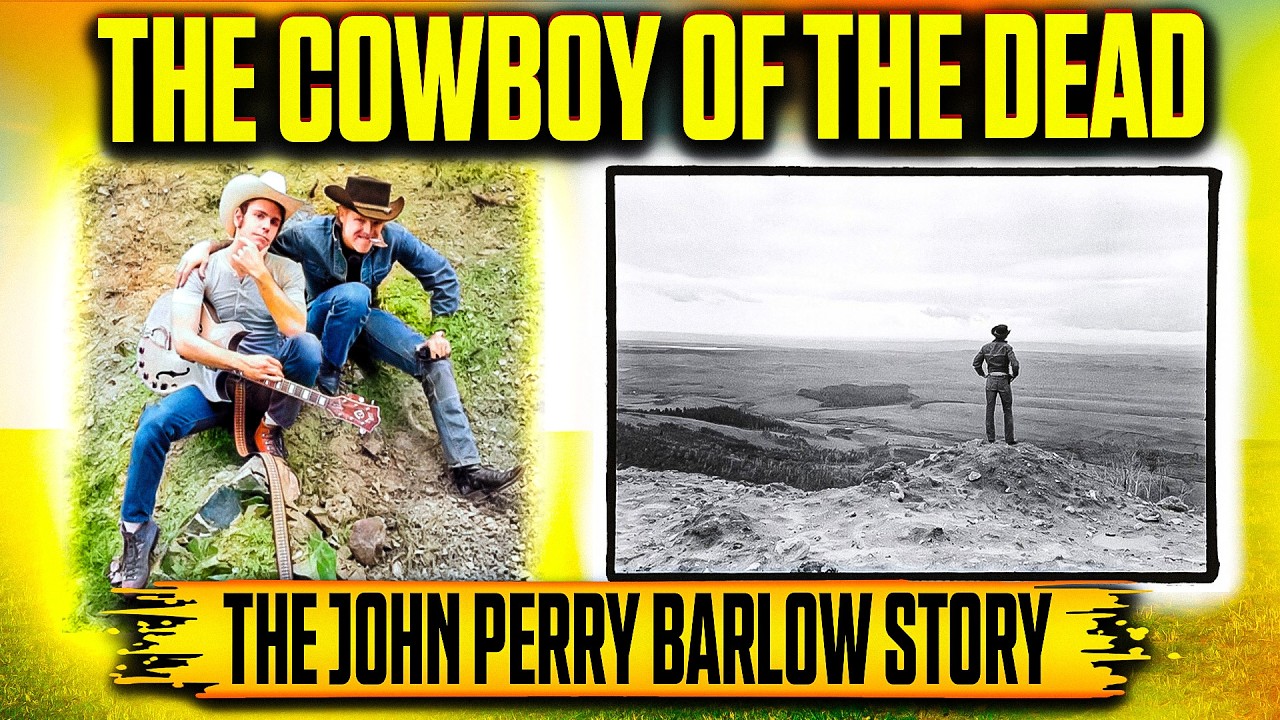
Born in 1947 in Wyoming, Barlow grew up on his family’s cattle ranch near Cody, surrounded by high country and frontier values. He would remain a rancher throughout his life, commuting between cattle operations and the concert stages where the Grateful Dead performed. This wasn’t a superficial affectation. Barlow was a genuine working rancher with deep ties to Wyoming’s land and culture, yet simultaneously he became one of the most forward-thinking thinkers about digital freedom and the emergent internet. In Barlow, the frontier spirit of the American West found its digital analog.
Barlow’s friendship with Bob Weir began at the
Barlow’s friendship with Bob Weir began at the Fountain Valley School in Colorado Springs, where the two teenagers first connected. Unlike the Hunter-Garcia partnership, which was formalized and built on Garcia’s principal song arrangements, the Weir-Barlow collaboration emerged more organically. Barlow’s lyrics provided something distinct: they were contemporary, often humorous, frequently intimate, and deeply grounded in Weir’s own experience and worldview. Where Hunter reached toward mythology and timelessness, Barlow reached toward the present moment.
The songwriting catalog Barlow and Weir created together reads like a catalog of the Dead’s most quotable and beloved numbers. “Cassidy,” named after a child who attended Dead shows, became a fan favorite—a song about traveling, arrival, and community. The song’s bridge, with its meditation on motion and destination, captures something essential about the Grateful Dead’s own relationship with movement and constant touring. “Estimated Prophet” presented a spiritual charlatan with such complexity and empathy that the song became a vehicle for some of Garcia’s most combustible guitar work. “Looks Like Rain” offered relationship advice wrapped in romantic uncertainty. “Mexicali Blues” brought a playful exoticism to the Dead’s repertoire. “Hell in a Bucket” showcased the Dead’s capacity for humor and irreverence.
What distinguished Barlow’s lyrical approach was his willingness to write about internal psychological states rather than external mythologies. His words often felt confessional, even when they were fictional. There’s a contemporary immediacy to Barlow lyrics that contrasts beautifully with Hunter’s more eternal consciousness. Weir, with his rhythmic innovations and harmonic sophistication, needed a lyricist who could match his energy and embrace his desire to push the Dead in different directions. Barlow provided exactly that.
But Barlow’s real significance extended far beyond the
But Barlow’s real significance extended far beyond the Dead. In 1990, alongside Mitchell Kapor, he co-founded the Electronic Frontier Foundation, an organization dedicated to protecting civil liberties in the digital age. The EFF emerged at a crucial historical moment—when the internet was transitioning from academic and military networks into a commercial, public medium. Barlow understood instinctively that the same principles of freedom, privacy, and individual autonomy that animated the counterculture were going to be tested in unprecedented ways by digital technology.
In 1996, Barlow authored “A Declaration of the Independence of Cyberspace,” a manifesto that addressed governments worldwide about their attempted regulation of the internet. “Governments of the Industrial World,” it began, “you weary giants of flesh and steel, I come from Cyberspace, the new home of Mind.” The declaration articulated a radical vision of digital freedom that influenced internet culture and digital rights activism for decades. It was a frontier vision—the same impulse that had driven westward expansion and counterculture liberation, now applied to the digital realm.
This wasn’t inconsistent with Barlow’s life as a Grateful Dead lyricist. The same values animated both: individual freedom, skepticism toward authority, a belief in communities governing themselves, a deep mistrust of top-down control. The Dead’s improvisational approach to performance, where the outcome was never predetermined and danger was built into every show, reflected a philosophy that Barlow articulated for the digital age: systems work best when they’re designed for freedom rather than control, when they embrace risk rather than eliminate it.
Barlow’s music writing and his digital activism both
Barlow’s music writing and his digital activism both represented attempts to carve out spaces where human consciousness could operate without predetermined restrictions. Whether it was a Grateful Dead show where anything could happen or a cyberspace where the architecture was still being written, Barlow advocated for open systems and emergent possibilities.
He remained deeply engaged with the Dead community throughout his life, even as his primary professional focus shifted to digital rights and later to ranching and environmental conservation. He wrote for Wired Magazine, spoke at technology conferences, and continued to advocate for internet freedom even as the landscape transformed around him. The Wyoming rancher and the cyberlibertarian were never separate identities; they were expressions of the same fundamental conviction that freedom and autonomy matter more than control and predictability.
John Perry Barlow died on February 7, 2018, at the age of 70. His death marked the loss of one of the Dead’s most distinctive voices and one of the internet’s most prophetic thinkers. But perhaps the most fitting tribute to Barlow is recognizing that he wasn’t trying to preserve the past or control the future. He was trying to create the conditions where both could evolve freely—whether in a concert hall, on a ranch, or in the digital commons he helped imagine into being.
The Grateful Dead survived longer than most bands because they understood that the music only works when it’s willing to fail, willing to risk, willing to move. Barlow embodied that philosophy completely. He was the bridge between the counterculture and the digital age, and in that bridge lies a model for how transformative ideas continue to evolve and adapt as the world changes around them.
The Song in Context
Understanding any Grateful Dead song requires understanding the partnership between Jerry Garcia and Robert Hunter that produced it. Hunter was not a conventional lyricist — he was a poet who happened to write for a rock band. His words drew from American folk traditions, Beat poetry, and a mythological imagination that created characters and landscapes existing outside of any specific time or place. Garcia’s melodies, in turn, had a quality that musicologists have struggled to categorize — folk-informed but jazz-inflected, simple on the surface but harmonically sophisticated beneath.
The songs they created together entered the Grateful Dead’s live repertoire and evolved constantly. A song might be performed hundreds of times over decades, and no two versions were identical. Tempos shifted, arrangements expanded and contracted, and improvisational passages grew or shrank depending on the band’s collective mood on any given night. For Deadheads, the song as recorded in the studio was merely a starting point — a sketch that live performance would elaborate into something far more complex and unpredictable.
The Live Experience
The Grateful Dead’s live performances were fundamentally different from those of any other major rock band. While most acts rehearsed and repeated a fixed setlist, the Dead approached each show as a unique event. Setlists were chosen shortly before the performance, and the transitions between songs — the spaces where improvisation lived — were entirely spontaneous. A concert might last three hours or more, moving through structured songs, extended jams, and passages of pure collective improvisation that could be transcendent or chaotic, sometimes both simultaneously.
This approach demanded extraordinary musical communication. Each member of the band had to listen constantly to every other member, responding in real time to melodic suggestions, rhythmic shifts, and dynamic changes. Garcia often described it as a conversation — not a performance, but a dialogue between musicians who had developed, over years of playing together, an almost telepathic understanding of each other’s musical instincts. When it worked, the result was music that felt inevitable and surprising at the same time.
The Deadhead Phenomenon
The community that formed around the Grateful Dead was unprecedented in popular music. Deadheads didn’t just attend concerts — they built a culture. Tape trading networks distributed live recordings across the country before the internet existed, creating a shared archive of performances that fans studied with scholarly intensity. The parking lot scene at Dead shows became a self-sustaining economy of food vendors, craft sellers, and itinerant entrepreneurs who followed the band from city to city.
What distinguished Deadhead culture from ordinary fandom was its participatory nature. Deadheads didn’t consume the Grateful Dead’s music passively — they actively shaped the experience. Their energy in the audience influenced the band’s playing. Their tape trading preserved and disseminated the music. Their economic activity in the parking lots created the ecosystem that made extended touring financially viable. The relationship between the Dead and their audience was genuinely symbiotic, each sustaining and inspiring the other across three decades of continuous performance.
Related Articles
- Bob Weir’s Legacy: The Rhythm Guitarist Who Made the Grateful Dead Possible
- How Deadheads Built the Internet: The Grateful Dead’s Tech Legacy
- Altamont 1969: How the Grateful Dead Processed America’s Darkest Moment Through Three Apocalyptic Songs
The Shakedown Archives publishes new research on Grateful Dead history each week. If you enjoyed this essay, you can subscribe to the companion YouTube channel below.
Subscribe on YouTube