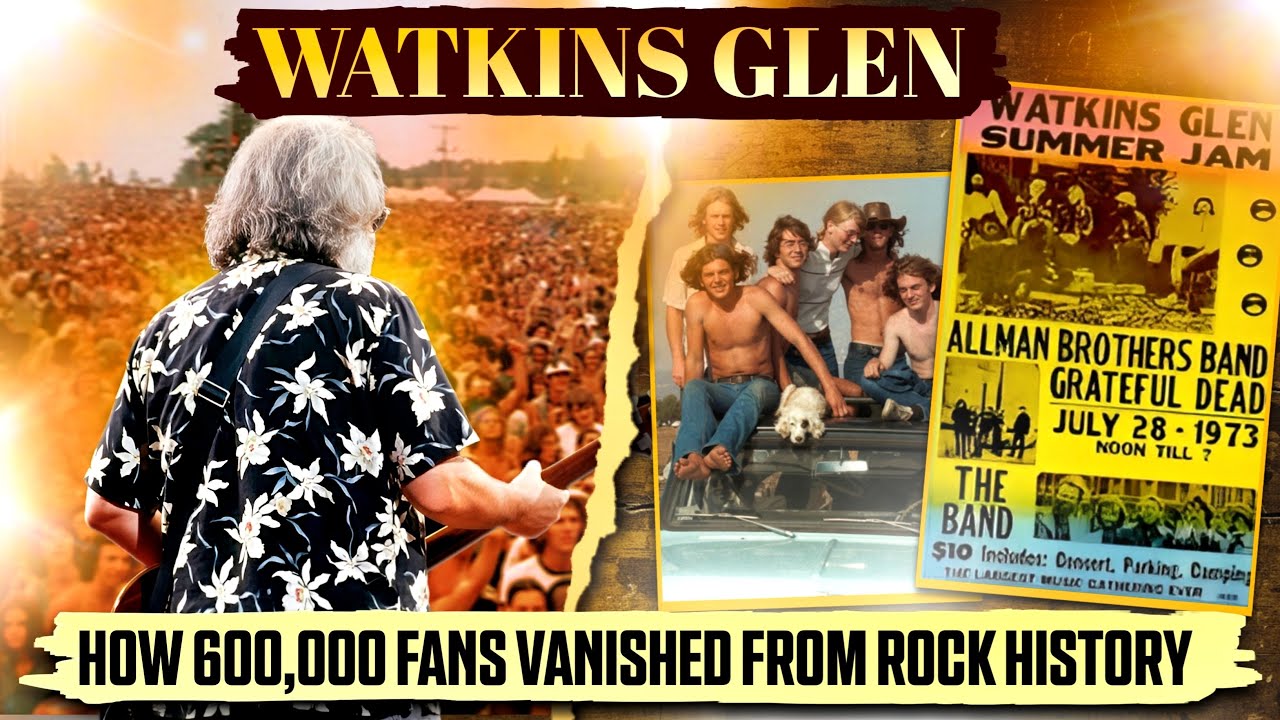
Watkins Glen 1973: The Festival That Made Woodstock Look Small
On July 28, 1973, approximately six hundred thousand people descended on a six-hundred-acre racetrack in Watkins Glen, New York, for what became the largest rock festival in American history. Three acts played: the Grateful Dead, the Allman Brothers Band, and the Band. One day. Three bands. More people than Woodstock by nearly two hundred thousand. And somehow, it’s barely a footnote in rock history.
The math alone doesn’t make sense. Woodstock in 1969 drew an estimated four hundred thousand and became the defining cultural event of the sixties — a movie, a soundtrack album, a permanent entry in the American mythology. Watkins Glen drew half again as many people four years later and generated almost no lasting narrative. No documentary. No triple-LP. No place in the cultural canon. The question isn’t what happened at Watkins Glen. It’s why nobody remembers.
The event was organized by Shelly Finkel and Jim Koplik, two young promoters who’d booked the Grand Prix Raceway in the Finger Lakes region of upstate New York. The site was enormous — purpose-built for auto racing — and the infrastructure was better than Woodstock’s chaotic setup at Max Yasgur’s farm. There were actual roads, actual facilities, an actual stage. The promoters expected maybe a hundred fifty thousand people. What they got was a human migration.
By Thursday night, three days before the show, traffic had gridlocked every road within thirty miles of the raceway. People abandoned their cars and walked. The crowd that arrived on Saturday was so vast that the stage — which had seemed massive during construction — looked like a postage stamp from the middle of the audience. Aerial photographs show a human carpet stretching to the horizon.
The Grateful Dead played for five hours. Not a standard set — a marathon that included a soundcheck jam on the afternoon before the show (an impromptu performance for the early arrivals that lasted over an hour and constituted a full concert by most standards) and then a proper evening set that ran deep into the night. The Dead treated Watkins Glen like one of their own shows, not a festival slot. They played the way they played at the Fillmore — long, exploratory, uncompromising. Garcia’s playing that night was fluid and aggressive, pushing through extended jams on Dark Star and Playing in the Band that rank with the best performances of the era.
The Allman Brothers, fresh off the loss of Duane Allman and bassist Berry Oakley in two separate motorcycle accidents within a year of each other, played with the ferocity of a band with something to prove. Dickey Betts’s guitar work carried the weight that Duane’s slide had once borne, and the set was tight, fierce, and emotionally loaded. The Band — Robbie Robertson, Levon Helm, Rick Danko, Garth Hudson, Richard Manuel — played the role they always played: the elegant craftsmen, turning American roots music into something timeless.
After all three acts had finished their individual sets, they returned to the stage together for a late-night jam. The combined performance was chaotic, loose, and occasionally transcendent — three distinct musical philosophies colliding in real time. Garcia and Betts trading lead lines. Phil Lesh and Rick Danko locking into bass grooves. Kreutzmann, Hart, Butch Trucks, and Jaimoe creating a rhythmic hurricane that six hundred thousand people felt in their chests.
So why doesn’t anyone remember?
Part of the answer is technology. Woodstock was filmed extensively by Michael Wadleigh’s crew, and the resulting documentary became a cultural artifact that preserved the event for generations. Watkins Glen had minimal film coverage and no major documentary project. Without visual documentation, the festival existed only in the memories of the people who were there.
Part of it is narrative. Woodstock happened at the peak of the counterculture — it was the right event at the right moment, and it fit neatly into the story America was telling itself about the sixties. Watkins Glen happened in 1973, after the counterculture had fractured, after Altamont had punctured the peace-and-love mythology, after Vietnam and Watergate had darkened the national mood. There was no narrative for Watkins Glen to slot into. It was just a very large concert.
And part of it is the nature of the bands themselves. The Grateful Dead never cared about capturing moments for posterity. They played. The sound dissipated. They moved on. The ethos of the Dead — that the music was ephemeral, that each show was unique and unrepeatable — made preservation feel almost contrary to the point.
The full story of what happened at Watkins Glen — the logistics, the music, the strange cultural amnesia — is in the documentary above.
Subscribe to The Shakedown Archives on YouTube
youtube.com/@theshakedownarchives