The Night the Grateful Dead Played with the Sufi Choir — A Lost 1971 Performance
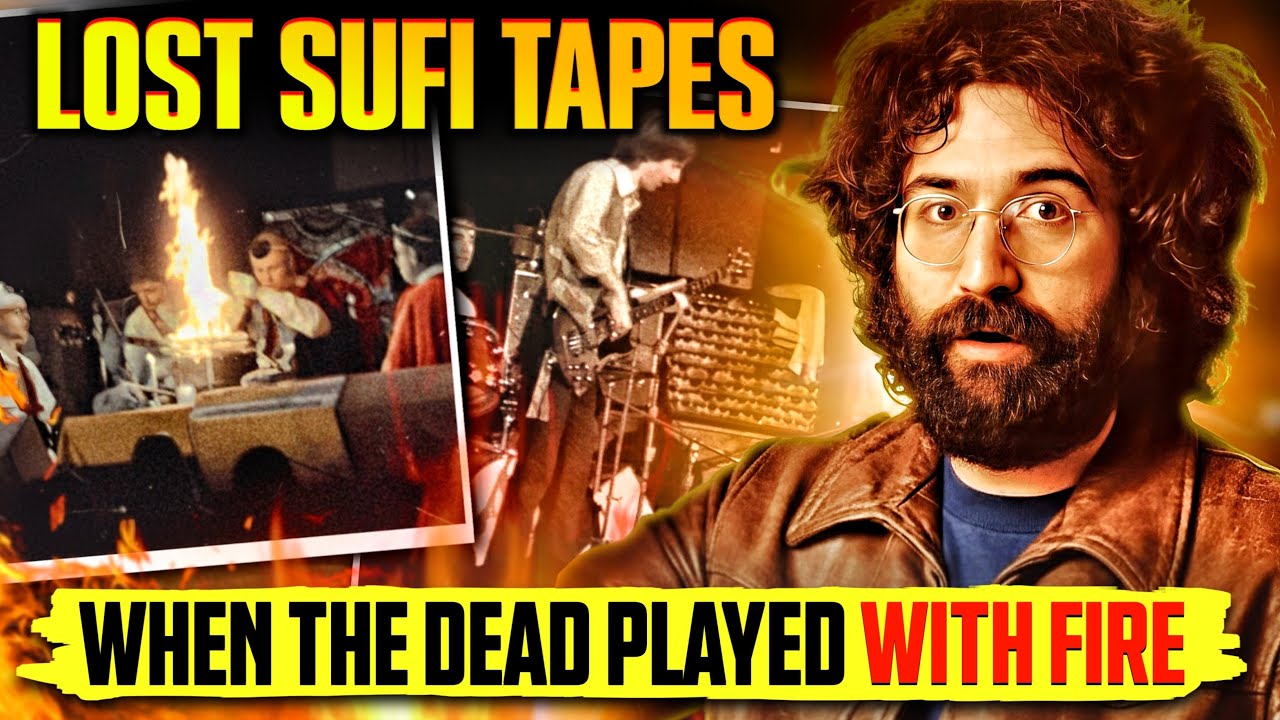
In March 1971, the Grateful Dead played a benefit concert at Winterland in San Francisco for the Sufi Choir of San Francisco. The performance featured something that shouldn’t have been physically possible or legally permissible: robed men chanting in a circle around an open bonfire inside a wooden building, while the Dead played behind them. The tape of this performance was effectively lost for fifty years. When it finally surfaced, it revealed one of the strangest and most beautiful nights in the Dead’s history.
The Sufi Choir was a San Francisco institution of the kind that could only have existed in the Bay Area in the early 1970s. Founded by practitioners of Sufism — the mystical tradition within Islam that emphasizes direct experience of the divine through music, dance, and chanting — the choir performed ecstatic group vocals drawn from multiple spiritual traditions. Their performances were participatory, hypnotic, and designed to induce altered states of consciousness through sound. In other words, they were a natural fit for the Grateful Dead.
The benefit at Winterland brought these two traditions
The benefit at Winterland brought these two traditions together in a single room. The Dead set up on stage. The Sufi Choir arranged themselves on the Winterland floor. And at some point during the evening, someone lit a bonfire inside the venue. The specifics of how this happened — who authorized it, what fire safety measures (if any) were in place, how Bill Graham’s venue staff responded — have been lost to time. What survives in eyewitness accounts is the image: robed figures circling a fire, chanting in unison, while Garcia, Lesh, Weir, and the rest played music that dissolved the boundary between performance and ritual.
The musical collaboration was unlike anything else in the Dead’s catalog. The Sufi Choir’s vocal technique — sustained tones, overlapping harmonies, rhythmic chanting that built in intensity over long periods — gave the Dead a textural element they’d never had. The band’s improvisational approach, which typically relied on the interplay between Garcia’s melodic lead and Lesh’s contrapuntal bass, expanded to accommodate the choir’s vocal mass. The result was something that moved between rock, devotional music, and ambient drone in ways that none of the participants could have predicted.
The Dead in early 1971 were in a particular creative moment. American Beauty had been released three months earlier. The acoustic-leaning songs of that album — “Box of Rain,” “Friend of the Devil,” “Ripple” — represented one direction. The extended electric improvisations that still dominated their live shows represented another. The Sufi Choir performance existed in a third space entirely — neither the crafted songwriting of the studio albums nor the freeform jamming of a typical Dead show, but something more ritualistic, more intentional, more connected to spiritual practice than either.
What makes the tape’s rediscovery significant is what
What makes the tape’s rediscovery significant is what it reveals about the range of the Dead’s musical ambitions during this period. By 1971, Garcia and the band were exploring connections between music and consciousness that went far beyond the psychedelic experiments of the Acid Tests. The Dead were interested in how music functioned in spiritual contexts — how chanting, repetition, and collective participation could produce altered states without chemical assistance. The Sufi Choir collaboration was an explicit experiment in that direction, and the fact that it happened at Winterland — not a ashram, not a private gathering, but a public concert venue — shows how seriously the Dead took the idea of performance as ceremony.
The tape’s fifty-year absence from circulation also says something about the era’s relationship to documentation. The Dead’s recording philosophy was comprehensive — Owsley Stanley had established a culture of taping everything, and by 1971, the band’s soundboard recordings were being made routinely. But the archival infrastructure for cataloging, storing, and distributing those recordings didn’t exist yet. Tapes got lost. Reels were mislabeled. Recordings that captured extraordinary moments sat in boxes in storage units for decades, unknown and unheard.
When the Sufi Choir tape finally surfaced and was made available to the Deadhead community, it confirmed what the eyewitnesses had been saying for fifty years: that the night was as remarkable as memory suggested. The recording captures a performance that is genuinely unlike anything else in the Dead’s archive — not better or worse than their other great nights, but categorically different. It’s the Dead as participants in a spiritual practice rather than performers on a stage, and the distinction matters.
The full story of the benefit
The full story of the benefit, the bonfire, the lost tape, and what it sounds like after fifty years is.
Subscribe to The Shakedown Archives on YouTube
youtube.com/@theshakedownarchives
The Song in Context
Understanding any Grateful Dead song requires understanding the partnership between Jerry Garcia and Robert Hunter that produced it. Hunter was not a conventional lyricist — he was a poet who happened to write for a rock band. His words drew from American folk traditions, Beat poetry, and a mythological imagination that created characters and landscapes existing outside of any specific time or place. Garcia’s melodies, in turn, had a quality that musicologists have struggled to categorize — folk-informed but jazz-inflected, simple on the surface but harmonically sophisticated beneath.
The songs they created together entered the Grateful Dead’s live repertoire and evolved constantly. A song might be performed hundreds of times over decades, and no two versions were identical. Tempos shifted, arrangements expanded and contracted, and improvisational passages grew or shrank depending on the band’s collective mood on any given night. For Deadheads, the song as recorded in the studio was merely a starting point — a sketch that live performance would elaborate into something far more complex and unpredictable.
The Live Experience
The Grateful Dead’s live performances were fundamentally different from those of any other major rock band. While most acts rehearsed and repeated a fixed setlist, the Dead approached each show as a unique event. Setlists were chosen shortly before the performance, and the transitions between songs — the spaces where improvisation lived — were entirely spontaneous. A concert might last three hours or more, moving through structured songs, extended jams, and passages of pure collective improvisation that could be transcendent or chaotic, sometimes both simultaneously.
This approach demanded extraordinary musical communication. Each member of the band had to listen constantly to every other member, responding in real time to melodic suggestions, rhythmic shifts, and dynamic changes. Garcia often described it as a conversation — not a performance, but a dialogue between musicians who had developed, over years of playing together, an almost telepathic understanding of each other’s musical instincts. When it worked, the result was music that felt inevitable and surprising at the same time.
The Deadhead Phenomenon
The community that formed around the Grateful Dead was unprecedented in popular music. Deadheads didn’t just attend concerts — they built a culture. Tape trading networks distributed live recordings across the country before the internet existed, creating a shared archive of performances that fans studied with scholarly intensity. The parking lot scene at Dead shows became a self-sustaining economy of food vendors, craft sellers, and itinerant entrepreneurs who followed the band from city to city.
What distinguished Deadhead culture from ordinary fandom was its participatory nature. Deadheads didn’t consume the Grateful Dead’s music passively — they actively shaped the experience. Their energy in the audience influenced the band’s playing. Their tape trading preserved and disseminated the music. Their economic activity in the parking lots created the ecosystem that made extended touring financially viable. The relationship between the Dead and their audience was genuinely symbiotic, each sustaining and inspiring the other across three decades of continuous performance.
The Business of the Dead
The Grateful Dead’s business model was as unconventional as their music. While other major bands relied on record sales as their primary revenue source, the Dead built their economy on live performance. Their recording contracts were modest by industry standards, and they made little effort to produce radio-friendly singles. Instead, they invested in their live operation — a touring infrastructure that employed dozens of crew members and generated revenue through ticket sales, merchandise, and the loyalty of an audience that returned show after show.
This model was risky. It required constant touring to maintain cash flow, and it left the band vulnerable to the physical toll of life on the road. But it also gave them a degree of independence that few artists in the music industry have ever achieved. The Dead answered to their audience, not to record executives. They could play what they wanted, for as long as they wanted, in the way they wanted — a creative freedom that was the foundation of everything they built.
The Chemical Reality
Drugs were inseparable from the Grateful Dead’s story, but the relationship was more complex than the caricature suggests. LSD was foundational — the Acid Tests were the crucible in which the Dead’s improvisational approach was forged, and psychedelics informed the expansive, boundary-dissolving quality of their music throughout their career. But the drug culture that surrounded the Dead evolved over the decades, and not always in positive directions.
By the 1980s, harder drugs — particularly cocaine and heroin — had infiltrated both the band and their community. Garcia’s well-documented struggles with heroin addiction took a devastating toll on his health and his playing. The parking lot scene, once dominated by psychedelics, increasingly included dealers selling substances that were addictive and dangerous. The Dead’s open, tolerant culture — which had been a strength in the 1960s and 1970s — became a liability when that openness was exploited by people whose relationship with drugs was destructive rather than exploratory.
Related Articles
- Why The Dead Took 7 Years To Rise Again
- How LSD and the Acid Tests Created the Grateful Dead’s Iconic Sound and Performance Philosophy
- Deadheads vs. Phish Fans: How Two Bands Engineered Participatory Culture Using Different Tools
The Shakedown Archives publishes new research on Grateful Dead history each week. If you enjoyed this essay, you can subscribe to the companion YouTube channel below.
Subscribe on YouTube