Altamont 1969: How the Grateful Dead Processed America’s Darkest Moment Through Three Apocalyptic Songs
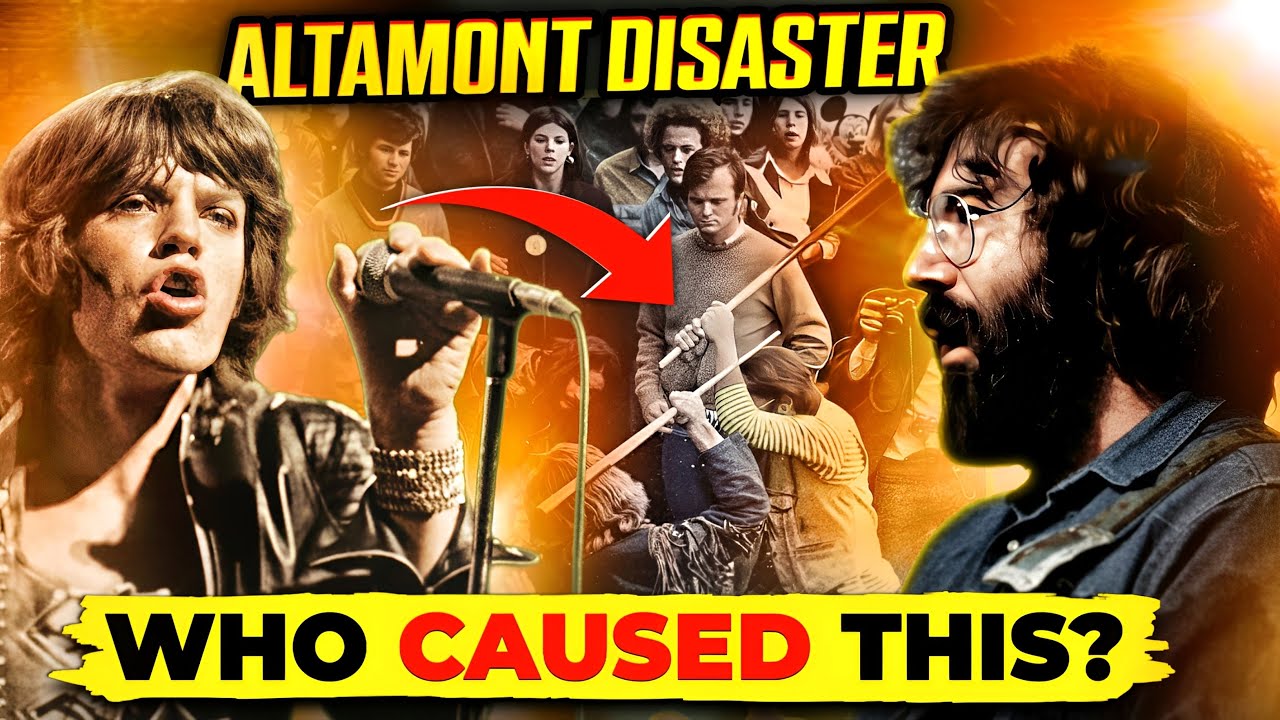
On December 6, 1969, the Altamont Speedway in California became the stage for what would later be remembered as the death knell of the 1960s. The Grateful Dead didn’t perform that day—they withdrew after witnessing the violence, the Hell’s Angels security detail spinning out of control, and the four deaths that would stain the event’s legacy forever. But they felt Altamont’s weight nonetheless.
Two weeks later, on December 20, 1969, the Dead premiered “New Speedway Boogie” at the Fillmore East in New York City. Fourteen days to process an apocalypse. What followed was an astonishing artistic response: a four-year period where the band would create three songs that formed a through-line from blues-based journalism through divine invocation to prophetic warning. These weren’t protest songs or political screeds. They were something stranger and more powerful—musical explorations of a civilization reckoning with its own collapse.
Robert Hunter, the Dead’s lyricist, didn’t attend Altamont
Robert Hunter, the Dead’s lyricist, didn’t attend Altamont. He watched from afar as footage emerged of violence, bloodshed, and the shattering of an entire generation’s mythology. What Hunter created was what he himself called “musical journalism”—a song that could process the unprocessable.
“Please don’t dominate the rap, Jack,” the song begins, with a specificity that would have been lost on listeners unfamiliar with the Dead’s scene. But for those who were there, in that moment, it was unmistakable. Hunter was speaking to the entire ecosystem of ego, violence, and spiritual pretension that had metastasized in the counterculture. The song carries the DNA of the blues—that American tradition of taking unbearable reality and transforming it into something that could be sung, heard, and survived.
Jerry Garcia attended Altamont and came away shattered. He would describe the experience in the language of Dante: “like Dante’s Inferno… weird kinds of psychic violence spreading in waves.” This wasn’t a passing moment of bad vibes. This was a fundamental rupture in the American experiment that the Dead had been part of documenting.
Yet Garcia refused the language of blame
Yet Garcia refused the language of blame. “There isn’t any blame,” he told interviewers. “We’re all in this planet together.” It was a response that could have been dismissed as naive, but instead it opened a space for something deeper. If there was no one to blame, then everyone was responsible. Everyone had to reckoning with the collapse.
When the Dead performed “New Speedway Boogie” acoustically in those early days, there was something profound about the gentleness of the arrangement. This was no angry protest. It was a tender, almost heartbroken processing of violence. The band was saying: we have no answers, but we can sit with this pain together.
Three years later, in November 1972, the Dead introduced an instrumental called “Weather Report Suite – Prelude.” It was entirely different from “New Speedway Boogie”—not journalistic, but visionary. Not blues-based, but reaching toward something classical, something sacred.
John Perry Barlow had joined the songwriting partnership
John Perry Barlow had joined the songwriting partnership by this point, and when the full “Weather Report Suite” debuted on September 8, 1973, at the Nassau Coliseum in Long Island, it arrived as a complete spiritual statement. The suite moved through multiple movements: Prelude, Part One, and culminating in “Let It Grow.” Barlow’s lyrics invoked the language of Exodus—”I Am”—and positioned nature itself as a spiritual force, as the ground of being.
The full suite only lasted 46 performances, from September 1973 through October 1974. Fourteen months of performances before the band retired it. But “Let It Grow” survived as a standalone piece, played hundreds of times afterward. The suite was like a lightning rod that had done its work—it had opened a channel, and now the energy could flow through a single song.
What’s remarkable about “Weather Report Suite” in this context is what it represented: a move away from the specific trauma of Altamont toward something more universal. The song wasn’t about violence anymore. It was about the fundamental conditions of existence, the rhythm of natural forces, the voice of something larger than the individual or the generation.
By 1977, seven years after Altamont, the Dead
By 1977, seven years after Altamont, the Dead had arrived at their third statement: “Estimated Prophet,” which debuted on February 26, 1977, at the Swing Auditorium in San Bernardino, California.
Bob Weir and Jerry Garcia had been reading the Old Testament—Daniel, Ezekiel, the prophetic books of warning and apocalypse. And they had come away convinced that contemporary California was overflowing with false prophets, with spiritual charlatans selling enlightenment as a commodity. The song is written in 7/4 time, an unusual meter that creates an unsettled feeling, a sense of things being slightly off-kilter.
The genius production solution came from drummer Bill Kreutzmann, who doubled two fast bars of 7/4, playing them half-time. This created a hypnotic reggae feel—something that made “Estimated Prophet” groove in a way that shouldn’t have been possible given its odd meter. The song became infectious, even funky, even as its lyrical content warned against spiritual temptation and false prophecy.
“Estimated Prophet” would be performed 390 times from
“Estimated Prophet” would be performed 390 times from its debut through June 28, 1995, when the Dead played their final concert at the Palace in Auburn Hills, Michigan. It became one of the most frequently performed Garcia-Weir compositions of the band’s later years.
When you listen to these three songs in sequence—”New Speedway Boogie,” “Weather Report Suite,” and “Estimated Prophet”—across the seven-year period from 1969 to 1977, you hear something like a spiritual curriculum.
The first song teaches you to witness your own civilization’s violence and to find language for it, even if that language is only musical. The second song teaches you to look beyond individual events toward universal forces, toward the voice of something larger than humanity itself. The third song teaches you to be wary of those who claim to speak for that larger force—to recognize false prophecy wherever it appears.
Altamont didn’t create these songs, but it catalyzed them. It was the moment when the Grateful Dead stopped being a psychedelic rock band and became something stranger: witnesses, prophets, and guides through a civilization in spiritual crisis. The body count at Altamont was four. But the reckoning would take four years, and would produce some of the finest music of the band’s entire career.
The Song in Context
Understanding any Grateful Dead song requires understanding the partnership between Jerry Garcia and Robert Hunter that produced it. Hunter was not a conventional lyricist — he was a poet who happened to write for a rock band. His words drew from American folk traditions, Beat poetry, and a mythological imagination that created characters and landscapes existing outside of any specific time or place. Garcia’s melodies, in turn, had a quality that musicologists have struggled to categorize — folk-informed but jazz-inflected, simple on the surface but harmonically sophisticated beneath.
The songs they created together entered the Grateful Dead’s live repertoire and evolved constantly. A song might be performed hundreds of times over decades, and no two versions were identical. Tempos shifted, arrangements expanded and contracted, and improvisational passages grew or shrank depending on the band’s collective mood on any given night. For Deadheads, the song as recorded in the studio was merely a starting point — a sketch that live performance would elaborate into something far more complex and unpredictable.
The Live Experience
The Grateful Dead’s live performances were fundamentally different from those of any other major rock band. While most acts rehearsed and repeated a fixed setlist, the Dead approached each show as a unique event. Setlists were chosen shortly before the performance, and the transitions between songs — the spaces where improvisation lived — were entirely spontaneous. A concert might last three hours or more, moving through structured songs, extended jams, and passages of pure collective improvisation that could be transcendent or chaotic, sometimes both simultaneously.
This approach demanded extraordinary musical communication. Each member of the band had to listen constantly to every other member, responding in real time to melodic suggestions, rhythmic shifts, and dynamic changes. Garcia often described it as a conversation — not a performance, but a dialogue between musicians who had developed, over years of playing together, an almost telepathic understanding of each other’s musical instincts. When it worked, the result was music that felt inevitable and surprising at the same time.
Related Articles
- Frankie Weir, Sugar Magnolia, and the Women Who Actually Ran the Grateful Dead
- His Father Swore on a Bible. Then Robbed the Grateful Dead.
- From Jug Bands to Grateful Dead: The Folk and Bluegrass Roots of American Rock
The Shakedown Archives publishes new research on Grateful Dead history each week. If you enjoyed this essay, you can subscribe to the companion YouTube channel below.
Subscribe on YouTube