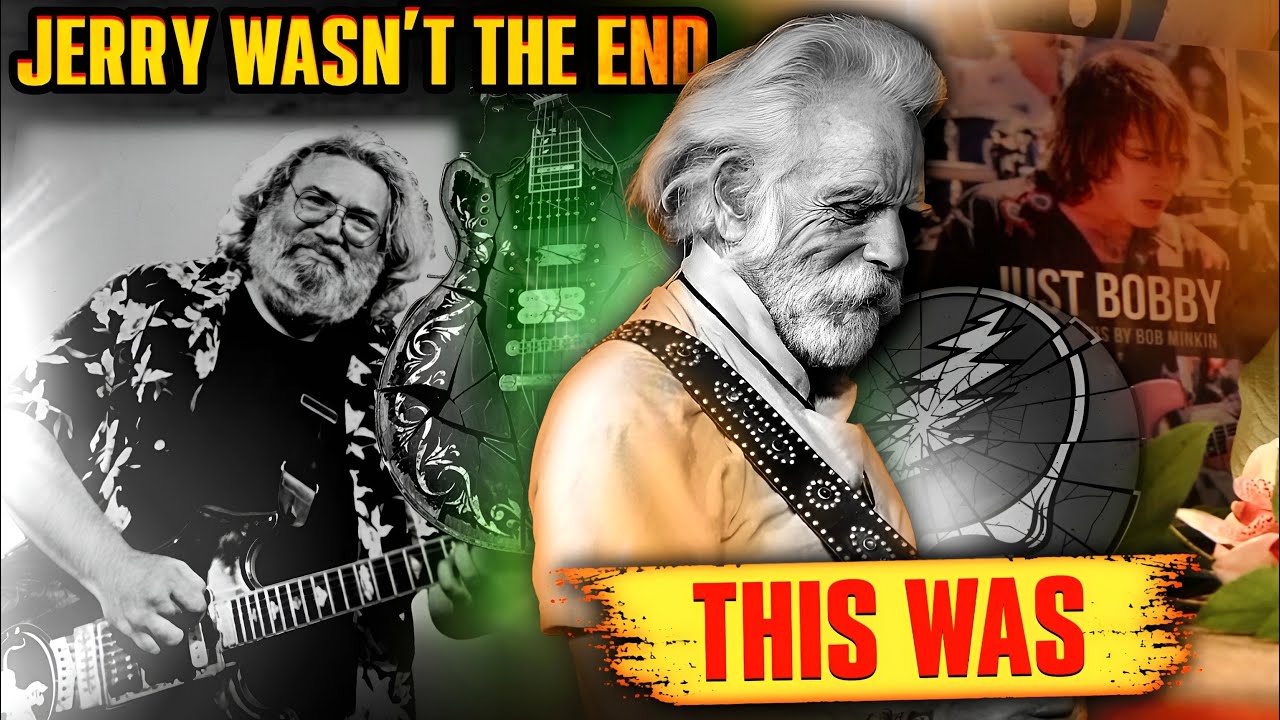
Bob Weir Has Died. What Happens to the Grateful Dead Now?
The news arrived like a shock despite the inevitability of mortality. Bob Weir, eighty years old and still performing with Dead & Co, had died. Within fifteen months, two of the original five members of the Grateful Dead—Phil Lesh in October 2024 and now Bob Weir—had passed away. For the first time in the band’s fifty-year history, fans were asking a question that seemed previously unimaginable: Is this finally the end?
The immediate answer is both simpler and more complex than it might appear. Yes, the Grateful Dead as originally constituted is now impossible. No living original members remain from the band’s formative era. Yet the answer to whether “the Grateful Dead” can continue requires understanding something fundamental about what the Dead always were: not a fixed ensemble, but a musical and cultural ecosystem designed to evolve and survive through continuous transformation.
The Grateful Dead survived longer than virtually any rock band in history—not by remaining unchanged, but by changing constantly. Jerry Garcia died in August 1995, and conventional wisdom suggested the Dead would simply cease to exist. The surviving members were devastated. Many fans believed the music had ended. Yet within months, the question shifted from “Will there be more Dead music?” to “What form will it take?”
The answer emerged from understanding the Dead’s essential nature. The band had never been monolithic. Jerry Garcia’s solo career encompassed not just the Jerry Garcia Band, but collaborations with Merl Saunders, explorations in bluegrass with David Grisman, and the Legion of Mary. Phil Lesh had pioneered the “Phil & Friends” model—curated performances where Lesh would invite different musicians to explore the Dead’s catalog and original compositions. This wasn’t the Dead’s side projects; it was the Dead’s DNA. The band was structurally designed around collaboration, guest musicians, and the principle that new musicians could bring fresh approaches to existing material.
Consider the band’s history with outside collaborators. Dylan toured with them in 1987 and 1991. Branford Marsalis sat in for multiple shows, bringing jazz sophistication to familiar structures. Bruce Hornsby became a semi-permanent collaborator in the late 1980s and 1990s, his piano work fundamentally shifting the sonic palette available to the band. The Dead didn’t treat these collaborations as threats to their authenticity; they treated them as natural extensions of what the band had always been. Each external musician brought possibilities the Dead hadn’t previously explored.
Dead & Company, formed in 2015 as a response to the “Fare Thee Well” celebration concerts, presented the next evolution. With John Mayer on lead guitar, Bobby Weir continuing on rhythm, Mickey Hart on percussion, Bill Kreutzmann on drums, Oteil Burbridge on bass, and Jeff Chimenti on keyboards, Dead & Company performed the Dead’s catalog with genuine reverence but also genuine innovation. Mayer, with his blues-rooted approach to lead guitar, played Garcia’s parts differently than Garcia had played them. This wasn’t a tribute band attempting perfect reproduction. This was the Dead’s music continuing to evolve.
The numbers reflected the vitality of this approach. Dead & Company’s 2023 tour sold approximately 845,000 tickets and grossed around $115 million. This wasn’t nostalgia driving ticket sales; it was an ongoing musical experience that people wanted to participate in. The band wasn’t playing at museums or casinos; they were playing major venues to enthusiastic, multigenerational audiences.
The crucial insight here is that the Grateful Dead had already proven they could survive the death of Jerry Garcia—their primary composer, most charismatic performer, and essential voice. The band had already demonstrated that “the Dead” wasn’t dependent on any single individual. What kept the music alive wasn’t preservation of a fixed thing but willingness to evolve.
Now, with both Phil Lesh and Bob Weir gone, the question becomes: Can the system continue without the original rhythm section? The answer lies in understanding that the Dead’s rhythm section—comprising the two guitarists, the bass player, and the drummers—had always been a collaborative space. Weir and Garcia weren’t separate from the rhythm section; they were part of it. And the rhythm section had always invited outside participation.
The collaborations that have already happened provide a roadmap. The Dead has worked with musicians ranging from classical cellists to funk bassists to experimental electronic musicians. The structure that enabled those collaborations—a core repertoire, a willingness to let new musicians reinterpret and reimagine it, an improvisational tradition that treats every performance as a unique event rather than a reproduction—remains intact.
The Dead’s philosophy, articulated by various members across decades, centered on the principle that “the music is always in motion.” Jerry Garcia repeatedly emphasized that he wasn’t interested in playing “the hits” the same way twice. Phil Lesh spoke about the Dead as a laboratory where musicians could experiment. These weren’t just performance philosophies; they were structural principles embedded in how the band approached music-making.
What will happen next remains uncertain, as all futures do. There may be continued iterations of Dead & Company with Weir and Mayer replaced by other musicians. There may be more Phil & Friends-style explorations where rotating musicians gather to explore the Dead’s music and original compositions. There may be formal tributes or celebrations of specific eras. There may be gaps of silence where the community processes its loss.
But the historical evidence suggests that what won’t happen is simple cessation. The Dead’s music has proven too vital, too generative, and too fundamentally grounded in principles of evolution and collaboration to disappear simply because original members have passed. The culture is bigger than any individual member. The music has been democratized across multiple musicians, multiple interpretations, and multiple generations of participants.
This isn’t to minimize what has been lost. Bob Weir’s harmonic sophistication, his rhythmic flexibility, and his deep knowledge of the material represent irreplaceable elements. Phil Lesh’s bass lines and harmonic concepts shaped the Dead’s sound as profoundly as Garcia’s lead playing. The deaths of original members matter profoundly. Yet the Dead’s genius lay in building a tradition that could absorb loss and continue evolving.
The ultimate lesson of the Grateful Dead—one that becomes clearer with each passing of an original member—is that great art is bigger than individuals. It’s built into systems and communities and ideas that can be carried forward by others, even when the original creators are gone. The Dead survived Jerry Garcia because the music itself had become a living thing, sustained by collective participation and commitment to principles larger than any single person.
Bob Weir’s death marks an endpoint to an era. But it’s not necessarily an endpoint to the music or the culture the Dead created. The question “What happens to the Grateful Dead now?” has been answered before. It will be answered again—not through imitation or preservation, but through evolution and new voices bringing fresh life to a musical tradition that was always designed to survive its creators.
The Shakedown Archives publishes new research on Grateful Dead history each week. If you enjoyed this essay, you can subscribe to the companion YouTube channel below.
Subscribe on YouTube