The Woman Who Saved the Grateful Dead’s Legacy
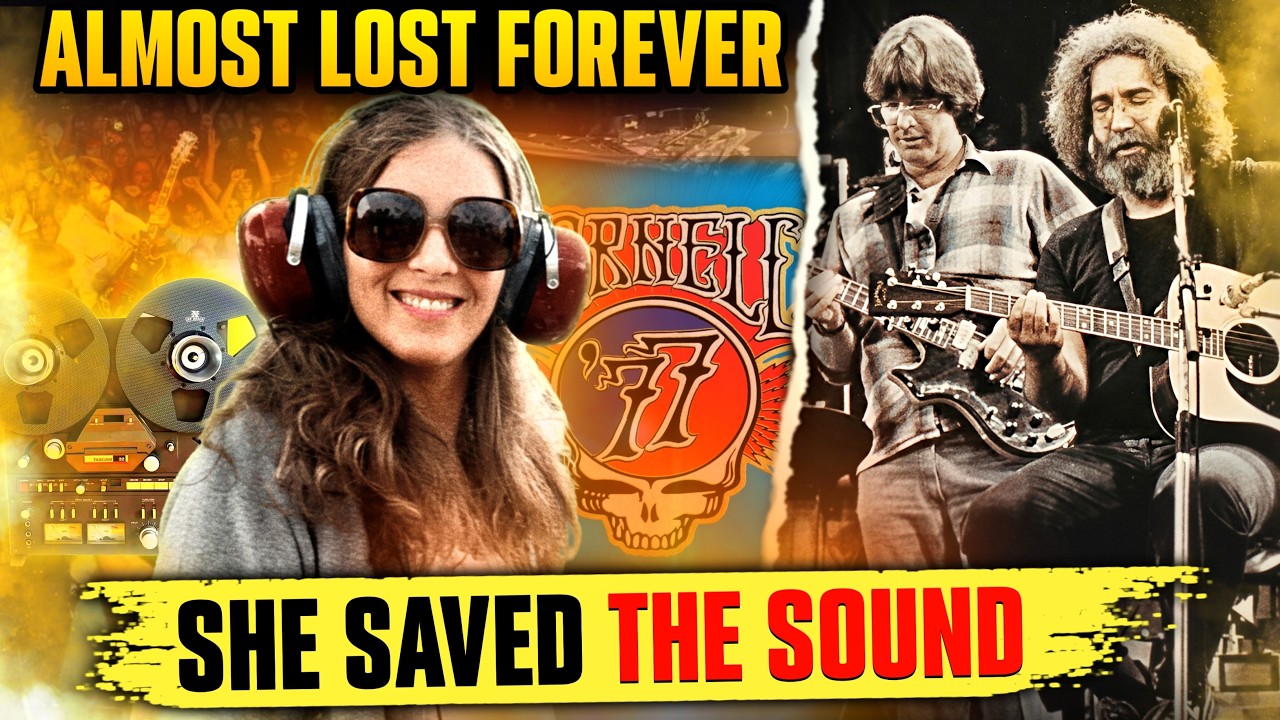
In 1968, a young woman named Betty Cantor walked into a Grateful Dead recording session and changed the course of music history. As the band’s pioneering live sound engineer and recordist, Betty Cantor-Jackson would spend the next thirteen years capturing some of the most legendary performances in rock history — recordings that fans would later call “Betty Boards.”
Betty’s journey with the Dead began when she started dating Bob Bralove’s predecessor at the mixing board, and quickly proved herself indispensable. She wasn’t just recording concerts — she was perfecting the art of live sound capture, developing techniques that would influence generations of audio engineers. Her recordings from this era, spanning 1968 to 1981, are considered by Deadheads to be among the finest live recordings ever made.
But the story takes a dramatic turn. In 1986, a storage locker containing hundreds of Betty’s master tapes went up for auction when the bills went unpaid. The tapes — including the legendary Cornell 5/8/77 show — were scattered to the winds, purchased by collectors who had no idea what they’d found. The recovery effort that followed would become one of the greatest treasure hunts in music history, eventually returning these irreplaceable recordings to the Dead’s vault where they could be properly preserved and shared with the world.
A Woman in a Man’s World
Betty Cantor was twenty-three years old when she walked into a Grateful Dead recording session in 1968. The world of live sound engineering was almost exclusively male — a technical discipline dominated by men who had come up through radio, television, and the military. Cantor had no formal training in audio engineering. What she had was an extraordinary ear and an obsessive attention to detail that the Dead’s existing crew immediately recognized.
She started as an assistant, learning the Dead’s complex sound system from the ground up. The band’s audio setup was already unconventional — they were experimenting with multiple microphone configurations and mixing techniques that bore little resemblance to standard rock concert production. Cantor absorbed it all, and within a year she had become one of the primary engineers responsible for recording the Dead’s live performances.
The Betty Boards
Between 1968 and 1985, Betty Cantor-Jackson (she married Rex Jackson, a Dead crew member) recorded hundreds of Grateful Dead concerts. Her recordings — known in the Deadhead community as “Betty Boards” — are considered the gold standard of live Dead recordings. The clarity, warmth, and spatial quality of her mixes capture the band’s sound with a fidelity that other live recordings from the era rarely approach.
What made Cantor-Jackson’s recordings exceptional was her understanding of the Dead’s musical dynamics. She knew when Garcia was about to take a solo, when Lesh’s bass was about to shift the harmonic foundation, when the drummers were building toward a crescendo. Her mixing wasn’t passive documentation — it was an active, real-time interpretation of the music, adjusting levels and balances to capture each moment’s emotional center.
Lost and Found
In the late 1980s, Cantor-Jackson fell on hard times. She was no longer working with the Dead, and she had accumulated a massive collection of master tapes from years of recording. When she could no longer afford storage fees, the tapes were seized and auctioned by the storage facility. The archive — representing some of the finest live recordings in rock history — was purchased by a private collector for a fraction of its value.
The recovery of the Betty Boards became one of the most significant archival events in Grateful Dead history. The tapes were eventually returned to the Dead’s vault, where they became the source material for numerous official releases. Without Cantor-Jackson’s recordings, entire years of the Dead’s live history would exist only in audience recordings — valuable but technically limited. Her work preserved the Dead’s musical legacy with a quality that allows listeners to experience these performances as they actually sounded, not as distant approximations.
Cantor-Jackson’s story is also a story about who gets remembered and who gets forgotten. She was one of the most important technical contributors to the Grateful Dead’s legacy, yet for decades she received little recognition. The male musicians on stage became legends; the woman behind the mixing board became a footnote. The Deadhead community’s eventual recognition of the Betty Boards’ significance helped correct this imbalance, but Cantor-Jackson’s career arc — brilliance, marginalization, rediscovery — reflects the broader pattern of women’s contributions being overlooked in rock history.
The Live Experience
The Grateful Dead’s live performances were fundamentally different from those of any other major rock band. While most acts rehearsed and repeated a fixed setlist, the Dead approached each show as a unique event. Setlists were chosen shortly before the performance, and the transitions between songs — the spaces where improvisation lived — were entirely spontaneous. A concert might last three hours or more, moving through structured songs, extended jams, and passages of pure collective improvisation that could be transcendent or chaotic, sometimes both simultaneously.
This approach demanded extraordinary musical communication. Each member of the band had to listen constantly to every other member, responding in real time to melodic suggestions, rhythmic shifts, and dynamic changes. Garcia often described it as a conversation — not a performance, but a dialogue between musicians who had developed, over years of playing together, an almost telepathic understanding of each other’s musical instincts. When it worked, the result was music that felt inevitable and surprising at the same time.
The Deadhead Phenomenon
The community that formed around the Grateful Dead was unprecedented in popular music. Deadheads didn’t just attend concerts — they built a culture. Tape trading networks distributed live recordings across the country before the internet existed, creating a shared archive of performances that fans studied with scholarly intensity. The parking lot scene at Dead shows became a self-sustaining economy of food vendors, craft sellers, and itinerant entrepreneurs who followed the band from city to city.
What distinguished Deadhead culture from ordinary fandom was its participatory nature. Deadheads didn’t consume the Grateful Dead’s music passively — they actively shaped the experience. Their energy in the audience influenced the band’s playing. Their tape trading preserved and disseminated the music. Their economic activity in the parking lots created the ecosystem that made extended touring financially viable. The relationship between the Dead and their audience was genuinely symbiotic, each sustaining and inspiring the other across three decades of continuous performance.
Related Articles
- Merl Saunders and Jerry Garcia: The Jazz Soul Behind the Deadhead Legend
- December 15, 1986: The Most Important Show in Grateful Dead History
- Frankie Weir, Sugar Magnolia, and the Women Who Actually Ran the Grateful Dead
The Shakedown Archives publishes new research on Grateful Dead history each week. If you enjoyed this essay, you can subscribe to the companion YouTube channel below.
Subscribe on YouTube