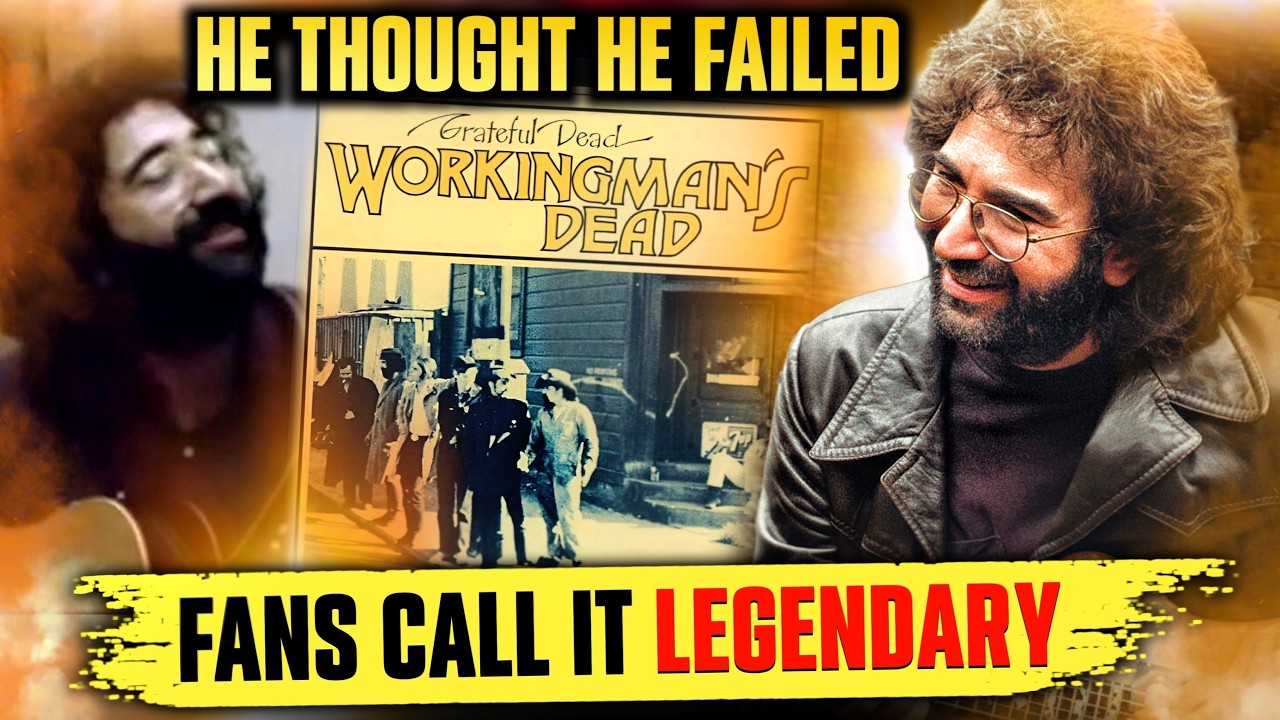
The Grateful Dead Song Jerry Garcia Thought He Ruined
When the Grateful Dead recorded Workingman’s Dead in 1970, Jerry Garcia was convinced he had ruined one of the album’s most beautiful songs. “High Time” — a tender, heartbreaking ballad about loss and longing — nearly didn’t make the final cut because Garcia felt his vocal performance fell short of what the song deserved.
The recording process for Workingman’s Dead marked a radical departure for the band. After years of psychedelic experimentation and studio excess, the Dead stripped everything back to acoustic instruments and tight vocal harmonies inspired by Crosby, Stills & Nash. Garcia, Hunter, and the band were learning to write a different kind of song — one that relied on emotional directness rather than sonic exploration.
“High Time” became the quiet masterpiece of their catalog. Despite Garcia’s initial self-criticism, the song evolved into one of the most requested and emotionally powerful pieces in their live repertoire. Over the decades, Garcia’s performances of “High Time” became increasingly vulnerable and raw, transforming his perceived failure into one of the most authentic expressions of emotion in American music.
The Recording of Workingman’s Dead
When the Grateful Dead entered Pacific Recording Studio in San Francisco in January 1970 to record Workingman’s Dead, they were a band in crisis. Their previous album, Aoxomoxoa, had gone massively over budget. Their communal house at 710 Ashbury had been raided by police. Mickey Hart’s father, Lenny, had embezzled the band’s savings. And the memory of Altamont — where the Rolling Stones’ free concert had ended in murder while the Dead waited backstage and ultimately refused to play — hung over everything.
The album that emerged from this period represented a radical departure. Where the Dead had previously spent months and small fortunes on psychedelic studio experiments, Workingman’s Dead was recorded in nine days for a fraction of the cost. The band stripped their sound down to its essentials: acoustic guitars, tight vocal harmonies influenced by Crosby, Stills & Nash, and songs that told stories about real people in real places.
Garcia’s Anxiety Over “High Time”
“High Time” was the song Garcia was most anxious about. Written with Robert Hunter, it’s a ballad of remarkable emotional vulnerability — a love song that acknowledges loss and impermanence without sentimentality. Garcia’s vocal performance is intimate and exposed in a way that was unusual for him. He was a musician who typically hid behind his guitar playing or the collective energy of the band. “High Time” required him to stand alone, emotionally naked.
Garcia told multiple interviewers over the years that he felt he had “ruined” the song in the studio. His specific complaint varied — sometimes it was about his vocal performance, other times about the arrangement. Hunter, who wrote the lyrics, disagreed. He considered “High Time” one of their finest collaborations, a song that captured something real about the fragility of connection.
The Song’s Legacy
What Garcia couldn’t see — or couldn’t admit — was that the vulnerability he heard as a flaw was precisely what made “High Time” resonate. The slight crack in his voice, the tentative quality of the guitar work, the way the song seems to hover rather than march forward — these weren’t mistakes. They were a musician allowing himself to be human in a genre that often rewarded bravado over honesty.
“High Time” became a staple of the Dead’s live repertoire, performed over 200 times between 1969 and 1995. In concert, it often served as a moment of quiet beauty in the middle of sets that could be overwhelming in their intensity. Garcia’s live performances of the song were frequently more assured than the studio version, but fans and critics alike often pointed to the original recording’s fragility as its greatest strength.
The irony of Garcia’s insecurity about “High Time” is that it mirrors the song’s own subject matter — the fear that something beautiful and genuine might not be good enough. Garcia spent his career creating music of extraordinary depth and complexity, yet he was often his own harshest critic. “High Time” endures not despite the imperfections Garcia heard in it, but because of them.
The Song in Context
Understanding any Grateful Dead song requires understanding the partnership between Jerry Garcia and Robert Hunter that produced it. Hunter was not a conventional lyricist — he was a poet who happened to write for a rock band. His words drew from American folk traditions, Beat poetry, and a mythological imagination that created characters and landscapes existing outside of any specific time or place. Garcia’s melodies, in turn, had a quality that musicologists have struggled to categorize — folk-informed but jazz-inflected, simple on the surface but harmonically sophisticated beneath.
The songs they created together entered the Grateful Dead’s live repertoire and evolved constantly. A song might be performed hundreds of times over decades, and no two versions were identical. Tempos shifted, arrangements expanded and contracted, and improvisational passages grew or shrank depending on the band’s collective mood on any given night. For Deadheads, the song as recorded in the studio was merely a starting point — a sketch that live performance would elaborate into something far more complex and unpredictable.
The Live Experience
The Grateful Dead’s live performances were fundamentally different from those of any other major rock band. While most acts rehearsed and repeated a fixed setlist, the Dead approached each show as a unique event. Setlists were chosen shortly before the performance, and the transitions between songs — the spaces where improvisation lived — were entirely spontaneous. A concert might last three hours or more, moving through structured songs, extended jams, and passages of pure collective improvisation that could be transcendent or chaotic, sometimes both simultaneously.
This approach demanded extraordinary musical communication. Each member of the band had to listen constantly to every other member, responding in real time to melodic suggestions, rhythmic shifts, and dynamic changes. Garcia often described it as a conversation — not a performance, but a dialogue between musicians who had developed, over years of playing together, an almost telepathic understanding of each other’s musical instincts. When it worked, the result was music that felt inevitable and surprising at the same time.
The Deadhead Phenomenon
The community that formed around the Grateful Dead was unprecedented in popular music. Deadheads didn’t just attend concerts — they built a culture. Tape trading networks distributed live recordings across the country before the internet existed, creating a shared archive of performances that fans studied with scholarly intensity. The parking lot scene at Dead shows became a self-sustaining economy of food vendors, craft sellers, and itinerant entrepreneurs who followed the band from city to city.
What distinguished Deadhead culture from ordinary fandom was its participatory nature. Deadheads didn’t consume the Grateful Dead’s music passively — they actively shaped the experience. Their energy in the audience influenced the band’s playing. Their tape trading preserved and disseminated the music. Their economic activity in the parking lots created the ecosystem that made extended touring financially viable. The relationship between the Dead and their audience was genuinely symbiotic, each sustaining and inspiring the other across three decades of continuous performance.
Related Articles
- Tiger Rose: The Mysterious Album Robert Hunter Tried to Erase From History
- From Jug Bands to Grateful Dead: The Folk and Bluegrass Roots of American Rock
- Why Robert Hunter Left the Road: The Poet Who Wrote the Dead Without Touring
The Shakedown Archives publishes new research on Grateful Dead history each week. If you enjoyed this essay, you can subscribe to the companion YouTube channel below.
Subscribe on YouTube