Box of Rain: The Inside Story of the Grateful Dead’s Last Words Together
Phil Lesh‘s father was dying. It was 1970, and the Grateful Dead‘s bassist — a classically trained musician who’d studied with Luciano Berio and approached the electric bass like an avant-garde instrument — had never sung lead on a Dead song. He’d never needed to. Garcia handled most of the vocals. Weir and Pigpen covered the rest. Lesh was content to be the band’s most unconventional instrumentalist, playing bass lines that avoided root notes, challenged harmonic expectations, and treated the low end as a second melody rather than a foundation.
But his father was dying, and Lesh wanted to sing.
He went to Robert Hunter with a request
He went to Robert Hunter with a request: write me a song I can sing for my father. Hunter, the Dead’s primary lyricist and Garcia’s songwriting partner, responded with “Box of Rain” — a set of lyrics so dense with mortality, impermanence, and the attempt to find beauty in loss that Lesh struggled to learn them. The melody Lesh composed was simple and folk-influenced, built around acoustic guitar arpeggios that bore little resemblance to the Dead’s usual psychedelic exploration. It was quiet. It was intimate. It was entirely unlike anything the Grateful Dead had recorded.
The lyrics operate on multiple levels simultaneously. On the surface, “Box of Rain” describes a walk in the rain, a conversation between two people trying to make sense of a situation that defies sense. Beneath that surface, Hunter is writing about watching someone you love prepare to leave — not in anger, not in drama, but in the slow, undeniable way that illness takes people. The imagery is natural and elemental: rain, sun, wind, a box that could be a coffin or a world or both. Hunter’s genius was in leaving the metaphors open enough that listeners could project their own losses onto the lyrics while still feeling the specific grief that generated them.
“Box of Rain” appeared as the opening track on American Beauty, released in November 1970. The album was the Dead’s most accessible release — a collection of acoustic-leaning songs that showcased the band’s songwriting rather than their improvisational daring. “Box of Rain” set the tone perfectly: warm, melancholic, grounded in a specificity of emotion that the Dead’s more experimental work sometimes floated above.
Lesh’s vocal performance is imperfect
Lesh’s vocal performance is imperfect. His voice lacks Garcia’s warmth and Weir’s confidence. He sings slightly behind the beat in places, and his phrasing is occasionally uncertain. None of this matters. The imperfection is the point. Lesh isn’t performing “Box of Rain.” He’s delivering it — handing Hunter’s words to his dying father with the limited vocal tools available to a man who’d spent his career playing bass. The vulnerability of the performance is what gives it power. A technically perfect vocal would have killed the song.
In the Dead’s live repertoire, “Box of Rain” occupied a unique position. It wasn’t played frequently — it appeared in setlists far less often than “Truckin'” or “Sugar Magnolia” or other American Beauty tracks. When it did appear, it carried weight. Deadheads knew its rarity and its backstory, and the song’s appearance in a setlist was treated as an event. Lesh’s live performances of “Box of Rain” were consistently moving, partly because the song’s emotional register — quiet grief, gentle acceptance — was so different from everything else in the Dead’s catalog.
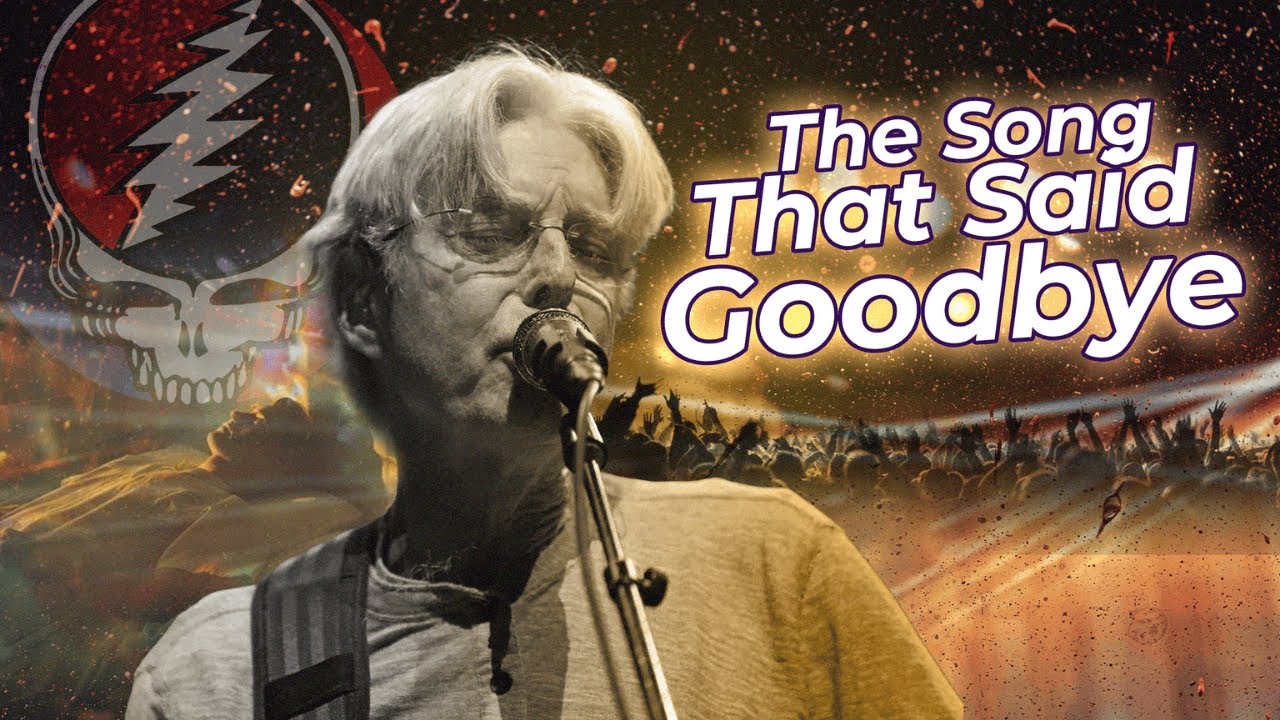
Then came July 9, 1995. Soldier Field in Chicago. The Grateful Dead’s final concert. Garcia was in visibly poor health — overweight, exhausted, his guitar playing diminished from the peaks of earlier decades. The band had been limping toward what everyone suspected was an endpoint but nobody wanted to name. The setlist that night included “Box of Rain” as the encore — the last song the Grateful Dead ever played together.
The choice was either deliberate or unconscious
The choice was either deliberate or unconscious, and either way it was devastating. A song written for a dying father became the farewell for a dying band. Lesh sang it the way he always sang it — imperfectly, earnestly, with the emotional directness of someone who knows that the thing he’s describing is actually happening. Garcia played rhythm guitar. The audience, many of whom knew they were witnessing something final, sang along.
Jerry Garcia died on August 9, 1995, exactly one month later, at the Serenity Knolls treatment center in Forest Knolls, California. He was fifty-three years old. “Box of Rain” was the last music the Grateful Dead made together. A song about impermanence became the band’s most permanent statement.
The full story of how the song was written, what it meant to Lesh, and how it became the Dead’s final word is.
Subscribe to The Shakedown Archives on YouTube
youtube.com/@theshakedownarchives
The Song in Context
Understanding any Grateful Dead song requires understanding the partnership between Jerry Garcia and Robert Hunter that produced it. Hunter was not a conventional lyricist — he was a poet who happened to write for a rock band. His words drew from American folk traditions, Beat poetry, and a mythological imagination that created characters and landscapes existing outside of any specific time or place. Garcia’s melodies, in turn, had a quality that musicologists have struggled to categorize — folk-informed but jazz-inflected, simple on the surface but harmonically sophisticated beneath.
The songs they created together entered the Grateful Dead’s live repertoire and evolved constantly. A song might be performed hundreds of times over decades, and no two versions were identical. Tempos shifted, arrangements expanded and contracted, and improvisational passages grew or shrank depending on the band’s collective mood on any given night. For Deadheads, the song as recorded in the studio was merely a starting point — a sketch that live performance would elaborate into something far more complex and unpredictable.
The Live Experience
The Grateful Dead’s live performances were fundamentally different from those of any other major rock band. While most acts rehearsed and repeated a fixed setlist, the Dead approached each show as a unique event. Setlists were chosen shortly before the performance, and the transitions between songs — the spaces where improvisation lived — were entirely spontaneous. A concert might last three hours or more, moving through structured songs, extended jams, and passages of pure collective improvisation that could be transcendent or chaotic, sometimes both simultaneously.
This approach demanded extraordinary musical communication. Each member of the band had to listen constantly to every other member, responding in real time to melodic suggestions, rhythmic shifts, and dynamic changes. Garcia often described it as a conversation — not a performance, but a dialogue between musicians who had developed, over years of playing together, an almost telepathic understanding of each other’s musical instincts. When it worked, the result was music that felt inevitable and surprising at the same time.
The Deadhead Phenomenon
The community that formed around the Grateful Dead was unprecedented in popular music. Deadheads didn’t just attend concerts — they built a culture. Tape trading networks distributed live recordings across the country before the internet existed, creating a shared archive of performances that fans studied with scholarly intensity. The parking lot scene at Dead shows became a self-sustaining economy of food vendors, craft sellers, and itinerant entrepreneurs who followed the band from city to city.
What distinguished Deadhead culture from ordinary fandom was its participatory nature. Deadheads didn’t consume the Grateful Dead’s music passively — they actively shaped the experience. Their energy in the audience influenced the band’s playing. Their tape trading preserved and disseminated the music. Their economic activity in the parking lots created the ecosystem that made extended touring financially viable. The relationship between the Dead and their audience was genuinely symbiotic, each sustaining and inspiring the other across three decades of continuous performance.
The Chemical Reality
Drugs were inseparable from the Grateful Dead’s story, but the relationship was more complex than the caricature suggests. LSD was foundational — the Acid Tests were the crucible in which the Dead’s improvisational approach was forged, and psychedelics informed the expansive, boundary-dissolving quality of their music throughout their career. But the drug culture that surrounded the Dead evolved over the decades, and not always in positive directions.
By the 1980s, harder drugs — particularly cocaine and heroin — had infiltrated both the band and their community. Garcia’s well-documented struggles with heroin addiction took a devastating toll on his health and his playing. The parking lot scene, once dominated by psychedelics, increasingly included dealers selling substances that were addictive and dangerous. The Dead’s open, tolerant culture — which had been a strength in the 1960s and 1970s — became a liability when that openness was exploited by people whose relationship with drugs was destructive rather than exploratory.
Related Articles
- The Messy Truth About Keith Godchaux Leaving the Grateful Dead
- Truckin’: How a New Orleans Drug Bust Became the Grateful Dead’s National Anthem
- Bob Weir’s Legacy: The Rhythm Guitarist Who Made the Grateful Dead Possible
The Shakedown Archives publishes new research on Grateful Dead history each week. If you enjoyed this essay, you can subscribe to the companion YouTube channel below.
Subscribe on YouTube