How Psychedelic Chaos Created American Classics: The Grateful Dead in 1970
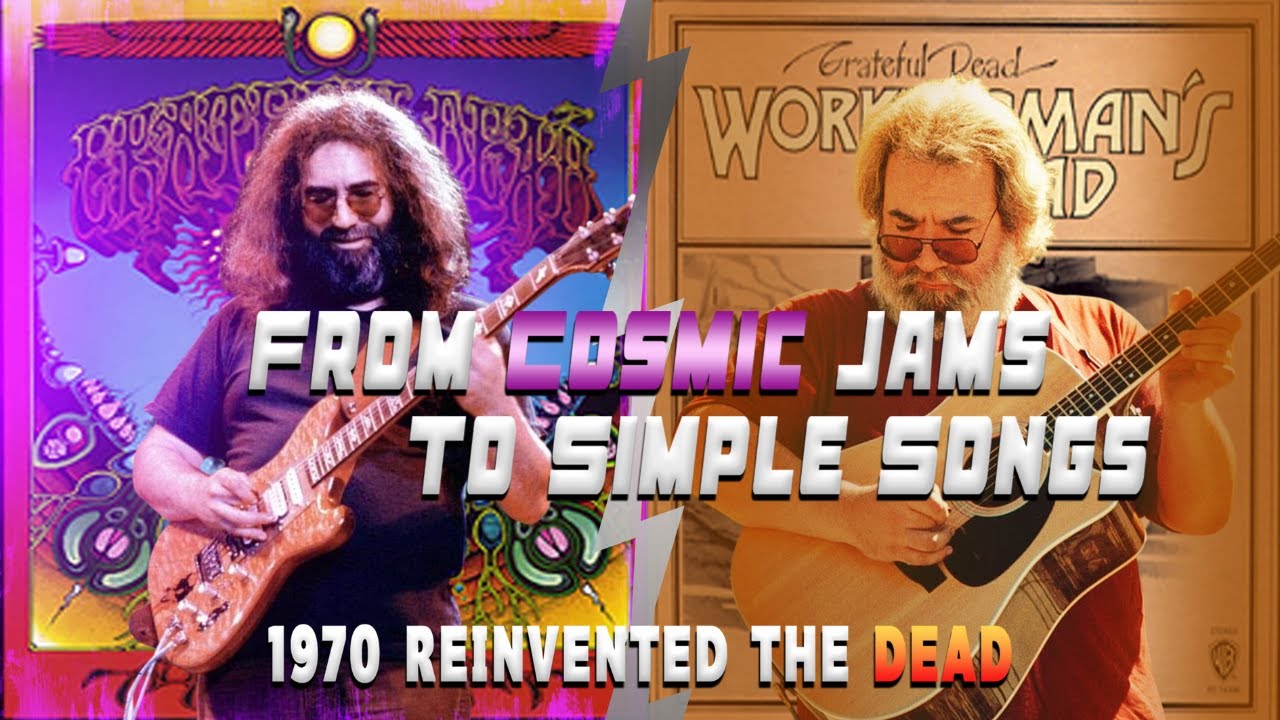
The year 1970 stands as one of rock and roll’s most paradoxical moments: a year when the Grateful Dead faced financial ruin, legal peril, and devastating personal loss—yet somehow created two of the most enduring and beloved albums in American music history. Workingman’s Dead, released in June, and American Beauty, arriving in November, didn’t just save the band from bankruptcy. They fundamentally rewired what the Grateful Dead could be, abandoning the extended psychedelic improvisations that defined their late-1960s sound for something more grounded, more human, more American.
This wasn’t an evolution born from artistic confidence or marketplace calculation. It was born from survival.
The year began with catastrophe
The year began with catastrophe. On January 31, 1970, Jerry Garcia and three other band members were arrested in New Orleans on drug charges—a terrifying brush with the law that could have derailed careers entirely. The charges would eventually be dropped, but the psychological impact reverberated through the band. These weren’t kids anymore; they had families, responsibilities. The carefree psychedelic era was evaporating under the heat of federal prosecutions and courtroom reality.
The New Orleans bust forced a reckoning. The Grateful Dead’s financial situation was already dire. They’d burned through the money from their earlier success with little to show for it. But the bust added something darker: the knowledge that the scene they’d helped create—the counterculture, the drugs, the endless pursuit of transcendence—had consequences. Real, legal, potentially catastrophic consequences.
Adding to the mounting pressure was a betrayal from within. Mickey Hart’s father, Lenny Hart, who had taken on management duties for the band, was systematically embezzling money from the Dead’s accounts. The discovery was devastating not just financially but emotionally—Hart had trusted his father to steer the ship. Instead, the bank account had been quietly drained while the band spent recklessly, believing money was flowing freely.
This crisis pushed the Dead into a corner
This crisis pushed the Dead into a corner. They needed to record, and they needed to sell records. They couldn’t survive on the strength of their live reputation alone anymore. They needed hits. They needed income. The comfortable bohemianism of the Acid Test era was over.
If January brought legal crisis, September and October brought something worse: mortality. On September 18, 1970, Jimi Hendrix died at age 27. Sixteen days later, on October 4, Janis Joplin was found dead in her Hollywood apartment. Both were part of the same scene, the same generation, the same psychedelic dream. Both were 27.
The Dead were keenly aware of how fragile life was, how quickly excess could consume you. Janis had been more than a fellow traveler—she represented the intersection of blues, soul, and psychedelic rock that had shaped the Bay Area sound. Her death wasn’t abstract; it was personal. The band began American Beauty‘s recording sessions in the shadow of her loss.
By early 1970
By early 1970, the creative direction had already begun to shift. Jerry Garcia wasn’t just the Grateful Dead’s lead guitarist anymore. He was also immersed in country music, playing pedal steel guitar for the New Riders of the Purple Sage. This wasn’t a side project—it was evidence of a deeper artistic hunger. Country music, with its storytelling traditions, its rootedness in American vernacular, its rejection of psychedelic pretension, was calling to him.
The influence came from other quarters too. Crosby, Stills & Nash had recently released their eponymous debut in July 1969 to enormous commercial and critical success. Their rich vocal harmonies, their sophisticated arrangements, their ability to blend folk sensibilities with rock power—all of this influenced how the Dead thought about their own harmonies and production.
The recording sessions for Workingman’s Dead and American Beauty, overseen by producer Bob Matthews at Pacific High Studios, reflected this new direction. Gone were the 20-minute explorations into collective consciousness. In their place were songs: stories, melodies, arrangements. “Friend of the Devil,” “Box of Rain,” “Truckin'”—these weren’t jam vehicles. They were compositions. They had structures. They had meaning.
“Truckin'” became the album’s most recognizable anthem
“Truckin'” became the album’s most recognizable anthem, and its lyrics captured the paranoia and exhaustion of living on the road, running from the law. The song pulses with the anxiety of 1970—literal references to the New Orleans bust and Nashville arrests embedded in the narrative. “Busted, down on Bourbon Street / Waiting for someone to come and bail me out” wasn’t fictional. It was lived experience.
“Box of Rain” emerged from Phil Lesh‘s personal crisis—his father was dying, and the song became a meditation on mortality and meaning. It’s one of the most affecting performances in the Dead’s catalog, built on a genuine emotional foundation rather than mere technical virtuosity.
“Ripple” distilled their philosophy into folk-song simplicity: no long instrumental passages, just acoustic guitar and voices. It became one of their most covered songs, their most accessible statement of belonging and interconnection.
The commercial success of both albums arrived quickly
The commercial success of both albums arrived quickly and decisively. Workingman’s Dead went gold. American Beauty became one of the best-selling albums of the Dead’s entire career. Two records, released six months apart, in a single year of crisis, became pillars of the American rock canon.
This wasn’t luck. It was the result of constraint forcing clarity. The New Orleans bust, the embezzlement discovery, the deaths of Janis and Jimi—all of it stripped away the excess. The Grateful Dead in 1970 discovered that they didn’t need 15-minute improvisations to reach transcendence. They needed songs. They needed roots. They needed America itself.
The transformation was so complete that by November 1970, the Grateful Dead had become something entirely different from what they’d been in January. They’d gone from potential ruins to architects of an entirely new musical language—one that would influence country-rock, Americana, jam-band music, and beyond.
It’s a paradox worth holding: that the year that nearly destroyed the Grateful Dead was also the year that made them legendary.
The Song in Context
Understanding any Grateful Dead song requires understanding the partnership between Jerry Garcia and Robert Hunter that produced it. Hunter was not a conventional lyricist — he was a poet who happened to write for a rock band. His words drew from American folk traditions, Beat poetry, and a mythological imagination that created characters and landscapes existing outside of any specific time or place. Garcia’s melodies, in turn, had a quality that musicologists have struggled to categorize — folk-informed but jazz-inflected, simple on the surface but harmonically sophisticated beneath.
The songs they created together entered the Grateful Dead’s live repertoire and evolved constantly. A song might be performed hundreds of times over decades, and no two versions were identical. Tempos shifted, arrangements expanded and contracted, and improvisational passages grew or shrank depending on the band’s collective mood on any given night. For Deadheads, the song as recorded in the studio was merely a starting point — a sketch that live performance would elaborate into something far more complex and unpredictable.
The Live Experience
The Grateful Dead’s live performances were fundamentally different from those of any other major rock band. While most acts rehearsed and repeated a fixed setlist, the Dead approached each show as a unique event. Setlists were chosen shortly before the performance, and the transitions between songs — the spaces where improvisation lived — were entirely spontaneous. A concert might last three hours or more, moving through structured songs, extended jams, and passages of pure collective improvisation that could be transcendent or chaotic, sometimes both simultaneously.
This approach demanded extraordinary musical communication. Each member of the band had to listen constantly to every other member, responding in real time to melodic suggestions, rhythmic shifts, and dynamic changes. Garcia often described it as a conversation — not a performance, but a dialogue between musicians who had developed, over years of playing together, an almost telepathic understanding of each other’s musical instincts. When it worked, the result was music that felt inevitable and surprising at the same time.
The Business of the Dead
The Grateful Dead’s business model was as unconventional as their music. While other major bands relied on record sales as their primary revenue source, the Dead built their economy on live performance. Their recording contracts were modest by industry standards, and they made little effort to produce radio-friendly singles. Instead, they invested in their live operation — a touring infrastructure that employed dozens of crew members and generated revenue through ticket sales, merchandise, and the loyalty of an audience that returned show after show.
This model was risky. It required constant touring to maintain cash flow, and it left the band vulnerable to the physical toll of life on the road. But it also gave them a degree of independence that few artists in the music industry have ever achieved. The Dead answered to their audience, not to record executives. They could play what they wanted, for as long as they wanted, in the way they wanted — a creative freedom that was the foundation of everything they built.
The Chemical Reality
Drugs were inseparable from the Grateful Dead’s story, but the relationship was more complex than the caricature suggests. LSD was foundational — the Acid Tests were the crucible in which the Dead’s improvisational approach was forged, and psychedelics informed the expansive, boundary-dissolving quality of their music throughout their career. But the drug culture that surrounded the Dead evolved over the decades, and not always in positive directions.
By the 1980s, harder drugs — particularly cocaine and heroin — had infiltrated both the band and their community. Garcia’s well-documented struggles with heroin addiction took a devastating toll on his health and his playing. The parking lot scene, once dominated by psychedelics, increasingly included dealers selling substances that were addictive and dangerous. The Dead’s open, tolerant culture — which had been a strength in the 1960s and 1970s — became a liability when that openness was exploited by people whose relationship with drugs was destructive rather than exploratory.
Related Articles
- Why the Grateful Dead Needed Two Drummers — The Rhythm Devils Origin Story
- Jerry Garcia’s New Riders Experiment: Playing Two Bands Every Night
- Frankie Weir, Sugar Magnolia, and the Women Who Actually Ran the Grateful Dead
The Shakedown Archives publishes new research on Grateful Dead history each week. If you enjoyed this essay, you can subscribe to the companion YouTube channel below.
Subscribe on YouTube