Grateful Dead’s First Tape Is a Wonderful Myth
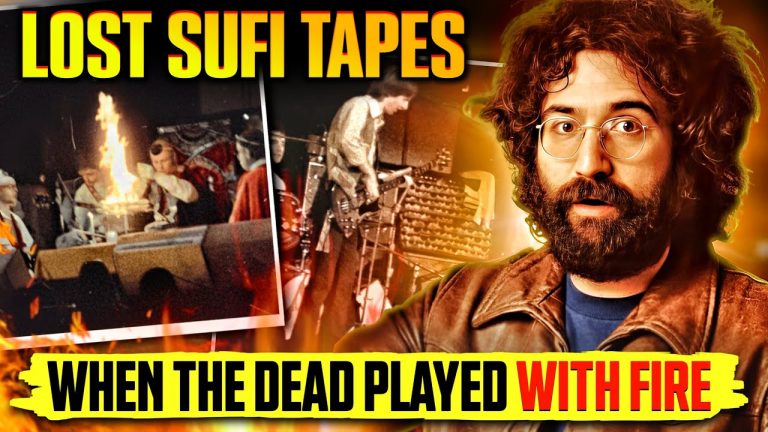
The Grateful Dead‘s oldest live tape has carried a January 8, 1966 date stamp for decades. It is attributed to the Fillmore Auditorium Acid Test, organized by Ken Kesey‘s Merry Pranksters, and circulated by tape traders, then cemented by archive.org into a founding artifact of Dead history. The problem is that most of it did not happen at the Fillmore, and the people who assembled it never claimed otherwise.
A researcher named Archduke on the Lossless Legs forum did what nobody in the Deadhead community had bothered to do: frame-by-frame comparison of the KZ Productions Acid Test video against photographs, newspaper coverage from the LA Free Press, and the audio itself. Jerry Garcia‘s guitar fingering in the King Bee solo syncs exactly to footage from Carthay Studios in Los Angeles, March 19, 1966. The Caution jam traces to the February 25, 1966 acid test at Empire Studios, also in LA. The same attendees appear in both the known February 25th photos and the film, wearing the same clothes.
Five Songs on a Mislabeled Tape
The tape contains five performances attributed to the Fillmore Acid Test: Caution (Do Not Stop on Tracks), I Know You Rider, King Bee, The Other One fragment, and a loosely structured jam. Archduke’s analysis traced each one to a different Los Angeles event between February and March 1966. None of the audio matches the documented timeline of the January 8 Fillmore show, where the Dead played a brief, chaotic set in a room full of Pranksters, Hells Angels, and roughly four hundred people on LSD.
The Prankster Method: Cut, Splice, Narrate
Ken Babbs, the Merry Prankster who recorded and assembled the tape, described his process on the 2021 Deadcast episode “Hug the Heat, or the Story of the First Dead Tape.” He cut, spliced, and overdubbed narration to create a listenable product. He was not preserving a single show. He was making a tape that sounded like the acid tests felt. Zane Kesey confirmed it in writing: the narration says Fillmore, but the actual sound and footage is from LA.
The Pranksters never cared about dates and labels. That was the entire point of being a Prankster. Ken Kesey had already faked his own suicide and fled to Mexico by early February 1966, leaving the Pranksters to run acid tests in Watts, Northridge, and across Southern California with the Dead and Owsley Stanley in tow. The tape was released on VHS by Zane’s KZ Productions in 1990 as the Acid Test video, then ripped and circulated by tape traders until archive.org cemented the January 8th attribution in the filename.
Archduke’s Frame-by-Frame Evidence
The forensic case rests on several independent lines of evidence. Garcia’s guitar fingering in the King Bee solo matches Carthay Studios footage from March 19, not the Fillmore in January. The same distinctive audience members appear in both the known February 25th Empire Studios photographs and the film, wearing identical clothing. The LA Free Press coverage of the February acid test describes details visible in the video. And the room dimensions, stage setup, and lighting patterns do not match the Fillmore’s documented layout from January 1966.
Each piece alone might be circumstantial. Together, they establish that the tape is a composite assembled from at least two different Los Angeles events, with Prankster narration claiming a San Francisco origin.
How Archive.org Got the Date Wrong
Archive.org’s attribution system trusts the metadata provided by uploaders. The KZ Productions VHS circulated for years with “Fillmore Acid Test, January 8, 1966” on its label. When tape traders ripped it to digital and uploaded it to the Live Music Archive, the filename carried that date. Dick Latvala, the Dead’s own tape vault archivist, encountered the same archival chaos throughout his career: 520 reels of unsynced film and audio at the University of Oregon, labeled poorly or not at all. In the Dead’s world, accurate dating was the exception, not the rule.
Never Trust a Prankster
The tape is real. The performances are real. The Dead playing at acid tests in early 1966 is thoroughly documented. What is not real is the date, the venue, and the idea that this is a single performance from a single night. It is a Prankster production — assembled with the same irreverence that defined everything else the Merry Pranksters touched. The founding myth of the Dead’s tape archive turns out to be exactly the kind of beautiful fabrication that Ken Kesey would have loved.
Frequently Asked Questions
The Shakedown Archives publishes new research on Grateful Dead history each week. If you enjoyed this essay, you can subscribe to the companion YouTube channel below.
Subscribe on YouTube