Jerry Garcia’s 1986 Diabetic Coma and the Grateful Dead’s Structural Failure
The Grateful Dead cultivated a carefully crafted mythology around themselves. They had no leaders, the story went. No hierarchy. No single point of failure. The band operated as a collective consciousness, each member equal in the democratic experiment that was the Grateful Dead. This was the polite fiction that sustained them for two decades. In July 1986, that fiction nearly collapsed entirely when Jerry Garcia did.
On a summer afternoon at Marin General Hospital, Garcia’s heart stopped once. The diabetic coma that had claimed him represented more than a personal health crisis—it was a structural crisis, a moment when the intricate machinery that generated tens of millions of dollars annually in touring revenue came face to face with a terrifying reality: the entire operation depended on one man’s body continuing to function.
By the mid-1980s, the Grateful Dead’s touring machine had become a vast, complicated organism. Hundreds of people depended on it for their livelihoods. The roadies, the sound technicians, the drivers, the office staff, the security teams, the light designers—all of them existed because Jerry Garcia’s guitar was the center around which everything else orbited. The Dead generated tens of millions per year from touring revenue, and all of it, ultimately, flowed from one condition: Garcia had to show up.
The band’s organizational structure, celebrated in countercultural mythology as democratic and leaderless, was actually something far more fragile. It was a benevolent autocracy with Garcia as the reluctant emperor. As John Barlow would later reflect, Garcia “didn’t want to be leader,” Barlow said. “Never mind that he was, and there was no way around it.”
Road crew chief Steve Parish understood the machinery better than anyone. “Jerry was responsible for keeping this whole machination going,” Parish observed. “The drugs that go along with being that person are not conducive to health.” This wasn’t judgment; it was diagnosis. Garcia had been self-medicating for years, using heroin and cocaine to manage the weight of being the indispensable center of a multi-million-dollar organization. The substances that temporarily made that burden tolerable were simultaneously destroying him.
The Dead’s economic model in the 1980s had become a monument to dysfunction. The Wall of Sound—that legendary sound system that had revolutionized live music in the early 1970s—had metastasized into a 600-speaker, 75-ton infrastructure that cost $100,000 per month just to transport. It was an expression of the band’s creative ambition, yes, but it was also a monument to inefficiency. The organization had no central authority to make hard decisions, to say no, to streamline. Instead, everyone deferred to Garcia, who either made ad hoc decisions or let things continue through sheer inertia.
By the time Garcia entered that hospital bed in July 1986, he had spent more than twenty years as the functional leader of an organization that refused to acknowledge his leadership. The contradiction was eating him alive, quite literally.
What happened after Garcia’s heart stopped was nothing short of miraculous. He survived the coma. The recovery was impossibly slow. Merl Saunders, the organist who had collaborated with Garcia in countless musical projects, sat with him through the autumn of 1986. Saunders came to Marin General, came again and again, patient and quiet, helping Garcia relearn basic guitar chords. It was primal instruction—the fundamentals. The dead man learning to play again.
For months, no one knew if Garcia would ever tour again. The Dead’s 1986 summer tour had ended abruptly. There was no second summer, no fall run. The revenue stopped. The three hundred people dependent on touring revenue waited in uncertainty.
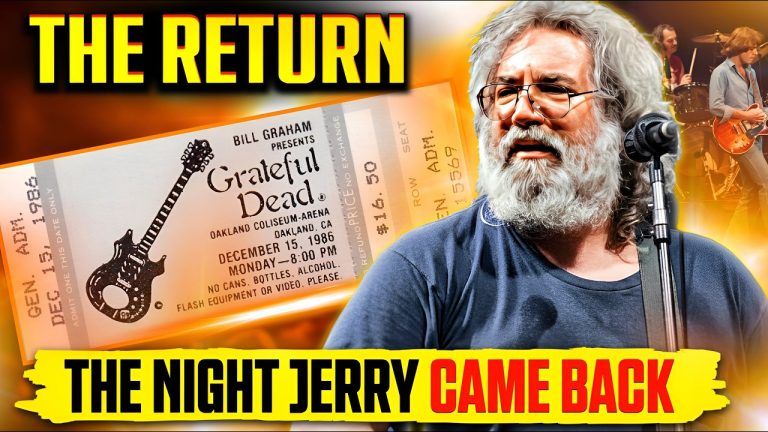
On December 15, 1986, Jerry Garcia walked on stage at Oakland Coliseum Arena. The opening song was “Touch of Grey,” a track that had never been more resonant. The lyric hung in the air like prophecy: “I will survive.” He did more than survive. He endured.
The Garcia that returned was changed—thinner, more cautious, more aware of his mortality. But the economic model that had broken him remained intact. The Dead would spend the rest of his life generating extraordinary touring revenue while Garcia bore the weight alone.
The 1987 album “In the Dark” became their only top-ten album. “Touch of Grey” became their only top-forty single. Commercial success finally arrived, but it arrived late and came through exhaustion rather than inspiration. By the early 1990s, the Dead had become a touring juggernaut. In 1991 and again in 1993, they were the highest-grossing tour in North America, taking in more than $50 million annually from fans willing to follow them city to city, show to show.
Garcia created escape valves: the Jerry Garcia Band, the David Grisman collaborations, side projects that allowed him to play without the weight of the Dead’s institutional expectations. These weren’t distractions from his real work; they were necessary breathing room in a suffocating system.
The Grateful Dead survived Garcia’s 1986 coma. They would not survive his death. On August 9, 1995, Garcia died at age 53. When he died, the band died with him. There was no replacement, no successor, no audition. The band dissolved rather than hire a new guitarist, which told you everything about what the structure actually was. It was never a democracy. It was a monarchy that had dressed itself in the rhetoric of collectivity.
The 1986 coma wasn’t a morality tale about addiction and weakness. It was a structural revelation—proof that the Grateful Dead’s famous resistance to hierarchy and centralized authority had never actually worked. It had merely obscured the reality: that one man’s body and one man’s talent had been the literal foundation upon which everything was built, and that asking one person to carry that weight while refusing to acknowledge his leadership was a form of exploitation that even the Dead’s countercultural mythology couldn’t justify.
Jerry Garcia survived his heart stopping in July 1986. But the revelation that his body was the only thing keeping the Dead alive never really stopped echoing.