December 15, 1986: The Most Important Show in Grateful Dead History
On July 10, 1986, Jerry Garcia collapsed backstage at a show and fell into a diabetic coma. He was forty-three years old, overweight, a heavy smoker, and his drug use had deteriorated from recreational to compulsive over the previous several years. The coma lasted five days. When Garcia regained consciousness, he couldn’t remember how to play guitar. He couldn’t remember chord shapes. He couldn’t remember songs he’d been playing for twenty years. The damage wasn’t psychological. It was neurological — the coma had impaired his motor skills and musical memory in ways that no one knew were reversible.
For five months, Garcia worked to recover. He relearned chord positions. He rebuilt muscle memory in his fingers. He practiced songs he’d played thousands of times as if learning them for the first time. Merl Saunders — the jazz and R&B keyboardist who’d been Garcia’s closest musical collaborator outside the Dead — helped guide the rehabilitation, playing alongside Garcia in informal sessions that gradually restored his confidence and his technique.
December 15
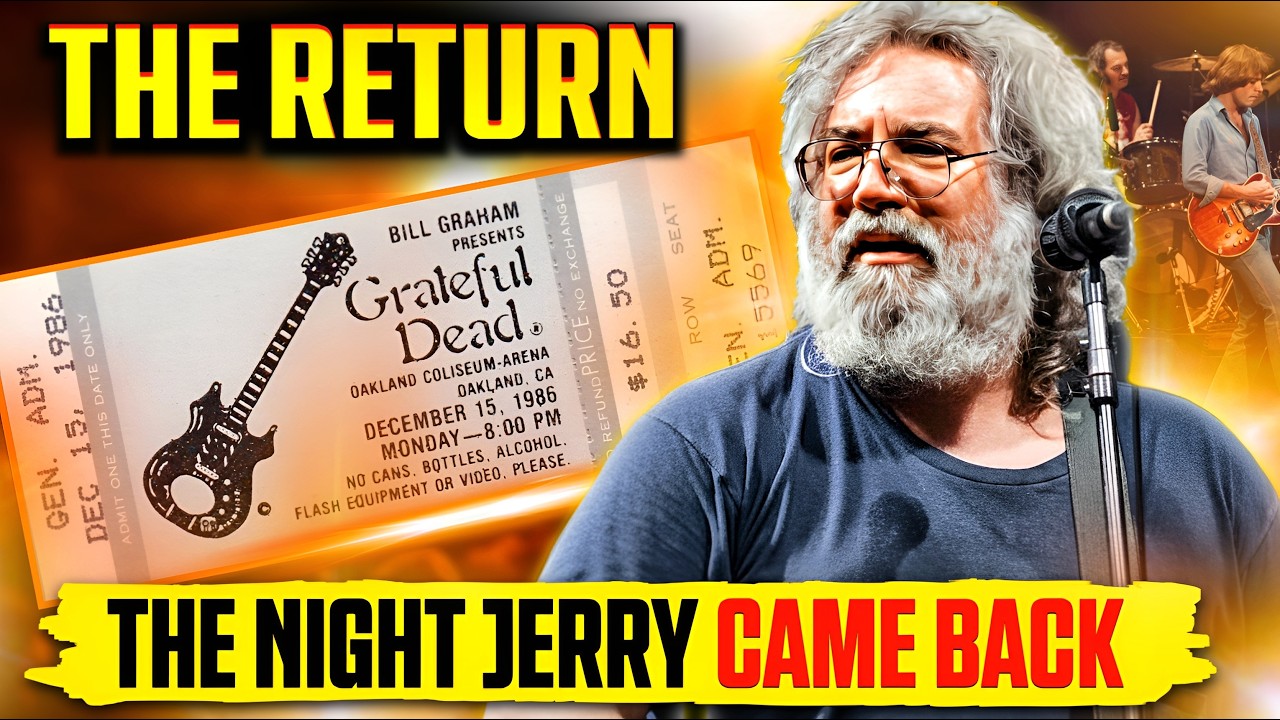
December 15, 1986, at the Oakland-Alameda County Coliseum Arena, was the test. It was the Grateful Dead‘s first show since Garcia’s coma — the night that would determine whether Garcia could still perform, whether the band could still function, whether the Grateful Dead were finished or not. Fifteen thousand people packed the arena. The emotional stakes were as high as any show the Dead had ever played.
What happened that night exceeded every reasonable expectation. Garcia didn’t just perform. He played with an intensity and joy that multiple witnesses described as a return to his best years. The coma had, in some paradoxical way, reset something. The lethargy that had crept into Garcia’s playing during the mid-eighties — the phoned-in solos, the disconnected stage presence, the sense that Garcia was going through motions rather than making music — was gone. In its place was a musician who seemed genuinely grateful to be playing, who attacked his guitar with an engagement that the audience hadn’t seen in years.
The setlist itself was significant. The band opened with “Touch of Grey” — a song that would be released as a single in 1987 and become the Dead’s only Top Ten hit. The choice was either prophetic or strategic: a song about survival, about enduring despite everything, about getting through to the other side. “I will survive” isn’t subtext in “Touch of Grey.” It’s the lyric. Playing it as the comeback opener was a statement.
The rest of the show confirmed the statement
The rest of the show confirmed the statement. “Scarlet Begonias” into “Fire on the Mountain.” “Estimated Prophet.” “Eyes of the World.” “Morning Dew” for the encore. The performances were sharp, emotionally present, and marked by the kind of improvisational daring that the mid-eighties Dead had been lacking. Garcia’s guitar tone was clear and bright. His melodic ideas were fresh — not recycled patterns from old shows, but new explorations that suggested a musician hearing the music differently after nearly losing the ability to hear it at all.
Brent Mydland‘s role that night deserves specific attention. Mydland had joined the Dead in 1979 and spent seven years as Garcia’s most responsive musical partner. During Garcia’s decline in the mid-eighties, Mydland had been carrying more of the musical weight — his Hammond organ filling spaces that Garcia’s guitar was leaving empty, his vocals providing energy that Garcia’s performances lacked. On December 15, Mydland didn’t need to compensate. He could play off Garcia the way he’d always wanted to — as an equal, trading phrases, pushing and responding. The interplay between Garcia’s guitar and Mydland’s keys on that night’s recordings is some of the best in the Brent era.
The December 15 show launched what Deadheads call the “comeback era” — a period from late 1986 through 1987 that many fans consider the Dead’s last great creative peak. “Touch of Grey” hit number nine on the Billboard Hot 100 in 1987. In the Dark, the album it appeared on, went platinum. The Dead began selling out stadiums that they’d previously played as arena acts. The commercial success was unprecedented and, for longtime Deadheads, alarming — the influx of new fans drawn by “Touch of Grey” changed the culture of Dead shows in ways that the community is still debating.
But on December 15
But on December 15, 1986, none of that had happened yet. It was just a man who’d nearly died, relearning his instrument and walking back onstage to see if the music was still there. It was.
The full story of the coma, the recovery, and what happened that night at Oakland is.
Subscribe to The Shakedown Archives on YouTube
youtube.com/@theshakedownarchives
The Song in Context
Understanding any Grateful Dead song requires understanding the partnership between Jerry Garcia and Robert Hunter that produced it. Hunter was not a conventional lyricist — he was a poet who happened to write for a rock band. His words drew from American folk traditions, Beat poetry, and a mythological imagination that created characters and landscapes existing outside of any specific time or place. Garcia’s melodies, in turn, had a quality that musicologists have struggled to categorize — folk-informed but jazz-inflected, simple on the surface but harmonically sophisticated beneath.
The songs they created together entered the Grateful Dead’s live repertoire and evolved constantly. A song might be performed hundreds of times over decades, and no two versions were identical. Tempos shifted, arrangements expanded and contracted, and improvisational passages grew or shrank depending on the band’s collective mood on any given night. For Deadheads, the song as recorded in the studio was merely a starting point — a sketch that live performance would elaborate into something far more complex and unpredictable.
The Live Experience
The Grateful Dead’s live performances were fundamentally different from those of any other major rock band. While most acts rehearsed and repeated a fixed setlist, the Dead approached each show as a unique event. Setlists were chosen shortly before the performance, and the transitions between songs — the spaces where improvisation lived — were entirely spontaneous. A concert might last three hours or more, moving through structured songs, extended jams, and passages of pure collective improvisation that could be transcendent or chaotic, sometimes both simultaneously.
This approach demanded extraordinary musical communication. Each member of the band had to listen constantly to every other member, responding in real time to melodic suggestions, rhythmic shifts, and dynamic changes. Garcia often described it as a conversation — not a performance, but a dialogue between musicians who had developed, over years of playing together, an almost telepathic understanding of each other’s musical instincts. When it worked, the result was music that felt inevitable and surprising at the same time.
The Deadhead Phenomenon
The community that formed around the Grateful Dead was unprecedented in popular music. Deadheads didn’t just attend concerts — they built a culture. Tape trading networks distributed live recordings across the country before the internet existed, creating a shared archive of performances that fans studied with scholarly intensity. The parking lot scene at Dead shows became a self-sustaining economy of food vendors, craft sellers, and itinerant entrepreneurs who followed the band from city to city.
What distinguished Deadhead culture from ordinary fandom was its participatory nature. Deadheads didn’t consume the Grateful Dead’s music passively — they actively shaped the experience. Their energy in the audience influenced the band’s playing. Their tape trading preserved and disseminated the music. Their economic activity in the parking lots created the ecosystem that made extended touring financially viable. The relationship between the Dead and their audience was genuinely symbiotic, each sustaining and inspiring the other across three decades of continuous performance.
The Chemical Reality
Drugs were inseparable from the Grateful Dead’s story, but the relationship was more complex than the caricature suggests. LSD was foundational — the Acid Tests were the crucible in which the Dead’s improvisational approach was forged, and psychedelics informed the expansive, boundary-dissolving quality of their music throughout their career. But the drug culture that surrounded the Dead evolved over the decades, and not always in positive directions.
By the 1980s, harder drugs — particularly cocaine and heroin — had infiltrated both the band and their community. Garcia’s well-documented struggles with heroin addiction took a devastating toll on his health and his playing. The parking lot scene, once dominated by psychedelics, increasingly included dealers selling substances that were addictive and dangerous. The Dead’s open, tolerant culture — which had been a strength in the 1960s and 1970s — became a liability when that openness was exploited by people whose relationship with drugs was destructive rather than exploratory.
Related Articles
- Merl Saunders and Jerry Garcia: The Jazz Soul Behind the Deadhead Legend
- Jerry Garcia’s 1986 Diabetic Coma and the Grateful Dead’s Structural Failure
- The Messy Truth About Keith Godchaux Leaving the Grateful Dead
The Shakedown Archives publishes new research on Grateful Dead history each week. If you enjoyed this essay, you can subscribe to the companion YouTube channel below.
Subscribe on YouTube