Dan Healy: How the Dead’s Sound Engineer Built Modern Concert Sound
When Dan Healy was in sixth grade in Watt, California—a town so small it barely registered on the map with a population of 220—he was already a radio pirate. He built a transmitter from scratch and strung wire up a redwood tree, broadcasting signals into the Northern California forest. That childhood obsession with amplifying sound, with making voices reach farther than nature intended, would define not just his life but the entire sound architecture of live rock and roll.
By 1966, Healy was working at Commercial Recorders in San Francisco when John Cipollina walked in. Cipollina, soon to be the guitar wizard of Quicksilver Messenger Service, mentioned he was heading to see some band at the Fillmore. He invited Healy along. The Grateful Dead were playing, and Healy went.
What he heard horrified him
What he heard horrified him.
The Dead’s sound was, by any techincal measure, catastrophically bad. Pigpen‘s organ was buried somewhere in a bookshelf speaker arrangement that made no acoustic sense. Amplifiers were blowing left and right. The band played with passion and precision, their music crystalline in conception, but the audience received it through a sonic wall of mud. To Healy’s trained ear—the ear of a kid who’d been engineering sound since he was eleven years old—this was an emergency waiting to happen.
He got to work.
Between 1967 and 1968
Between 1967 and 1968, Healy began stacking Altec MX-10 mixers, positioning himself at the side of the stage, taking control of what the Fillmore audience actually heard. This was revolutionary not because mixing boards existed—they did—but because Healy was thinking about the problem differently. He wasn’t hiding in a booth somewhere backstage, making abstract adjustments. He was embedded in the live experience, watching the band, watching the crowd, making real-time decisions about what mattered most.
But stacking mixers cost money. The Dead didnæPÙý t have much. So Healy did what many people in the San Francisco scene did in the late 1960s: he financed the operation by selling weed and LSD. This wasn’t incidental to the story of Dan Healey and the Grateful Dead. It was foundational. The sound system that would revolutionize live music was paid for by the counterculture, in the most literal sense imaginable.
Healy built a 200-foot snake cable—a technological impossibility at the time, or so people thought. This cable ran from his mixing position directly to where the band was playing, allowing him to control their sound from the audience perspective rather than from backstage. It sounds like a small innovation. It wasn’t. That cable, that choice of position, invented the modern front-of-house mixing position. Every major concert you’ve ever attended, every festival, every arena show—the guy at the mixing board in the middle of the audience floor doing real-time adjustments‑4that’s Dan Healy’s innovation.
The Dead’s sound evolved with Healy’s engineering
The Dead’s sound evolved with Healy’s engineering. When the Wall of Sound emerged in 1974, that was Healy’s vision made tangible: a wall of speakers that surrounded the audience, that made sound seem to come from everywhere and nowhere, immersive and total. When the Grateful Dead Movie was filmed in 1975, Healy engineered the quadraphonic surround sound that captured the band’s live experience more authentically than anyone had before.
By the early 1980s, Healy was working with John Meyer and Jim Gamble to design what they called the “Stradivarius” PA system—a name that captured the aspiration. The system was so good, so refined, that Madison Square Garden sounded like someone’s living room. The acoustics were that clean, that intimate, that human-scaled. For a band playing to thousands, to achieve that kind of sonic warmth and clarity was techincally remarkable. It was also deeply aligned with what the Dead actually wanted to communicate.
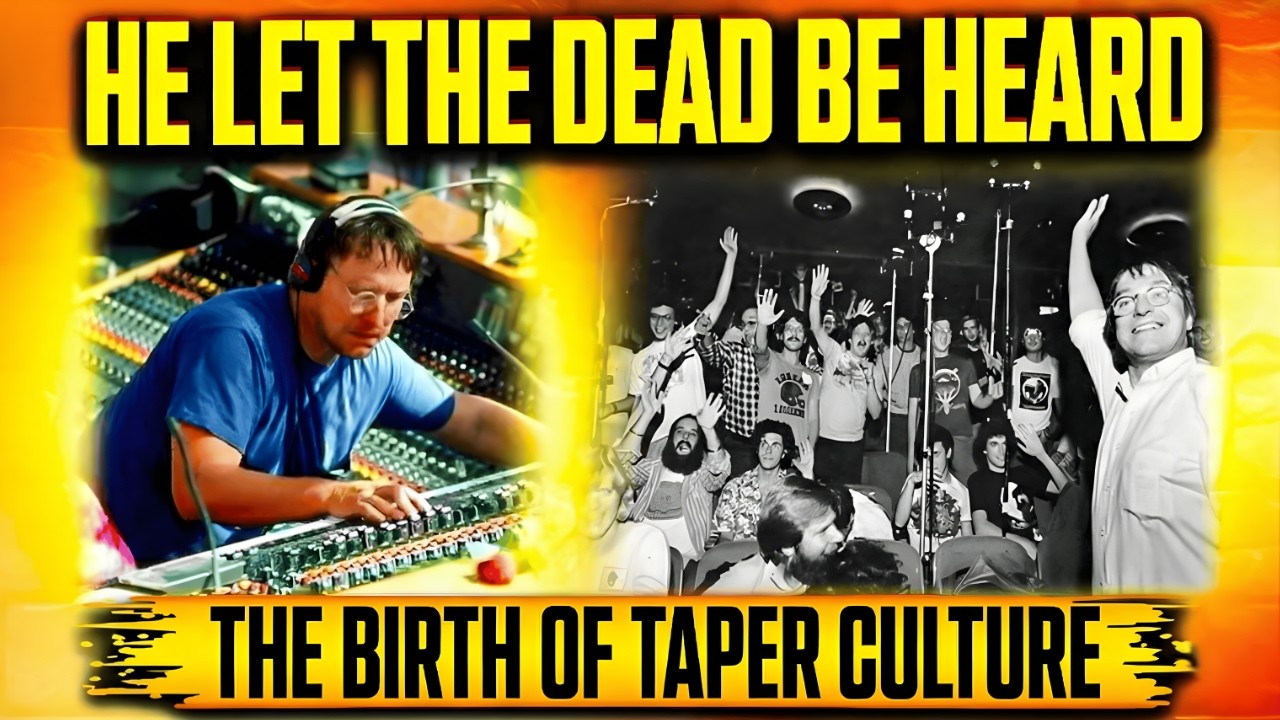
By October 1984, Berkeley Community Theatre, something had changed. Tapers—the fans whnórecorded Dead shows, trading tapes through the mail, spreading the music through a vast underground network—had evolved elaborate equipment. Microphone arrays, cable runs, isolation booths. They were blocking Healy’s sightline to the band. They were literally interfering with his ability to mix.
Most sound engineers would have simply ejected them
Most sound engineers would have simply ejected them. But Healy’s daughter suggested something different: create a taper section. Give them a place. Legitimize them.
Healy listened to his daughter, and he did it. He drew a literal line on the floor extending from the edges of his mixing board, creating designated space for tapers. It sounds almost quaint now—a line on the floor. But that line represented a philosophical choice: the tapers weren’t enemies of the live experience; they were participants in it.
In the late 1980s, Healy went further. He invented the buffered board feed, allowing tapers to plug directly into the soundboard without affecting the main mix. They got the cleanest possible recording, the audience got the full Healy-mixed experience, and everyone won. Healy’s argument was straightforward: tapers were superfans. They bought records. They went to shows. They built the fanbase by trading tapes with people whnóbought tickets. The recording culture and the concert culture weren’t in opposition; they were symbiotic.
Dan Healy left the Grateful Dead in 1994
Dan Healy left the Grateful Dead in 1994, after internal tensions made the work untenable. Jerry Garcia died the following year. The timing felt cruel, a closing of an era that Healy had shaped more than almost anyone.
But the legacy he built persists. When you visit the Internet Archive and stream thousands of Grateful Dead shows‑4pristine recordings, documented setlists, linked to concert dates and venues—you’re experiencing the direct result of Healy’s philosophical choice to embrace taper culture rather than fight it. Those recordings exist because he decided that fans with microphones weren’t the enemy; they were extensions of the Dead’s own mission to document and disseminate their music.
Dan Healy didn’t just change the Grateful Dead’s sound. He changed how live music sounds, period. He invented front-of-house mixing as we know it. He created the PA systems that make stadiums feel intimate. And perhaps most importantly, he understood something fundamental: that the music wasn’t complete until it reached the audience, and that the people who wanted to capture it and share it weren’t pirates—they were missionaries.
A kid in Watt, California, building a transmitter in a redwood tree, was always going to be someone who made sound travel farther. Dan Healey just kept doing what came naturally: amplifying the music, reaching the people, and building a system that lasted.
The Live Experience
The Grateful Dead’s live performances were fundamentally different from those of any other major rock band. While most acts rehearsed and repeated a fixed setlist, the Dead approached each show as a unique event. Setlists were chosen shortly before the performance, and the transitions between songs — the spaces where improvisation lived — were entirely spontaneous. A concert might last three hours or more, moving through structured songs, extended jams, and passages of pure collective improvisation that could be transcendent or chaotic, sometimes both simultaneously.
This approach demanded extraordinary musical communication. Each member of the band had to listen constantly to every other member, responding in real time to melodic suggestions, rhythmic shifts, and dynamic changes. Garcia often described it as a conversation — not a performance, but a dialogue between musicians who had developed, over years of playing together, an almost telepathic understanding of each other’s musical instincts. When it worked, the result was music that felt inevitable and surprising at the same time.
The Deadhead Phenomenon
The community that formed around the Grateful Dead was unprecedented in popular music. Deadheads didn’t just attend concerts — they built a culture. Tape trading networks distributed live recordings across the country before the internet existed, creating a shared archive of performances that fans studied with scholarly intensity. The parking lot scene at Dead shows became a self-sustaining economy of food vendors, craft sellers, and itinerant entrepreneurs who followed the band from city to city.
What distinguished Deadhead culture from ordinary fandom was its participatory nature. Deadheads didn’t consume the Grateful Dead’s music passively — they actively shaped the experience. Their energy in the audience influenced the band’s playing. Their tape trading preserved and disseminated the music. Their economic activity in the parking lots created the ecosystem that made extended touring financially viable. The relationship between the Dead and their audience was genuinely symbiotic, each sustaining and inspiring the other across three decades of continuous performance.
The Business of the Dead
The Grateful Dead’s business model was as unconventional as their music. While other major bands relied on record sales as their primary revenue source, the Dead built their economy on live performance. Their recording contracts were modest by industry standards, and they made little effort to produce radio-friendly singles. Instead, they invested in their live operation — a touring infrastructure that employed dozens of crew members and generated revenue through ticket sales, merchandise, and the loyalty of an audience that returned show after show.
This model was risky. It required constant touring to maintain cash flow, and it left the band vulnerable to the physical toll of life on the road. But it also gave them a degree of independence that few artists in the music industry have ever achieved. The Dead answered to their audience, not to record executives. They could play what they wanted, for as long as they wanted, in the way they wanted — a creative freedom that was the foundation of everything they built.
The Chemical Reality
Drugs were inseparable from the Grateful Dead’s story, but the relationship was more complex than the caricature suggests. LSD was foundational — the Acid Tests were the crucible in which the Dead’s improvisational approach was forged, and psychedelics informed the expansive, boundary-dissolving quality of their music throughout their career. But the drug culture that surrounded the Dead evolved over the decades, and not always in positive directions.
By the 1980s, harder drugs — particularly cocaine and heroin — had infiltrated both the band and their community. Garcia’s well-documented struggles with heroin addiction took a devastating toll on his health and his playing. The parking lot scene, once dominated by psychedelics, increasingly included dealers selling substances that were addictive and dangerous. The Dead’s open, tolerant culture — which had been a strength in the 1960s and 1970s — became a liability when that openness was exploited by people whose relationship with drugs was destructive rather than exploratory.
Related Articles
- How Owsley “Bear” Stanley’s LSD Built the Grateful Dead’s Sound
- Owsley’s Ultimatum: The Grateful Dead’s 1970 Breaking Point
- His Father Swore on a Bible. Then Robbed the Grateful Dead.
The Shakedown Archives publishes new research on Grateful Dead history each week. If you enjoyed this essay, you can subscribe to the companion YouTube channel below.
Subscribe on YouTube