The Night the Grateful Dead Played with the Sufi Choir — A Lost 1971 Performance
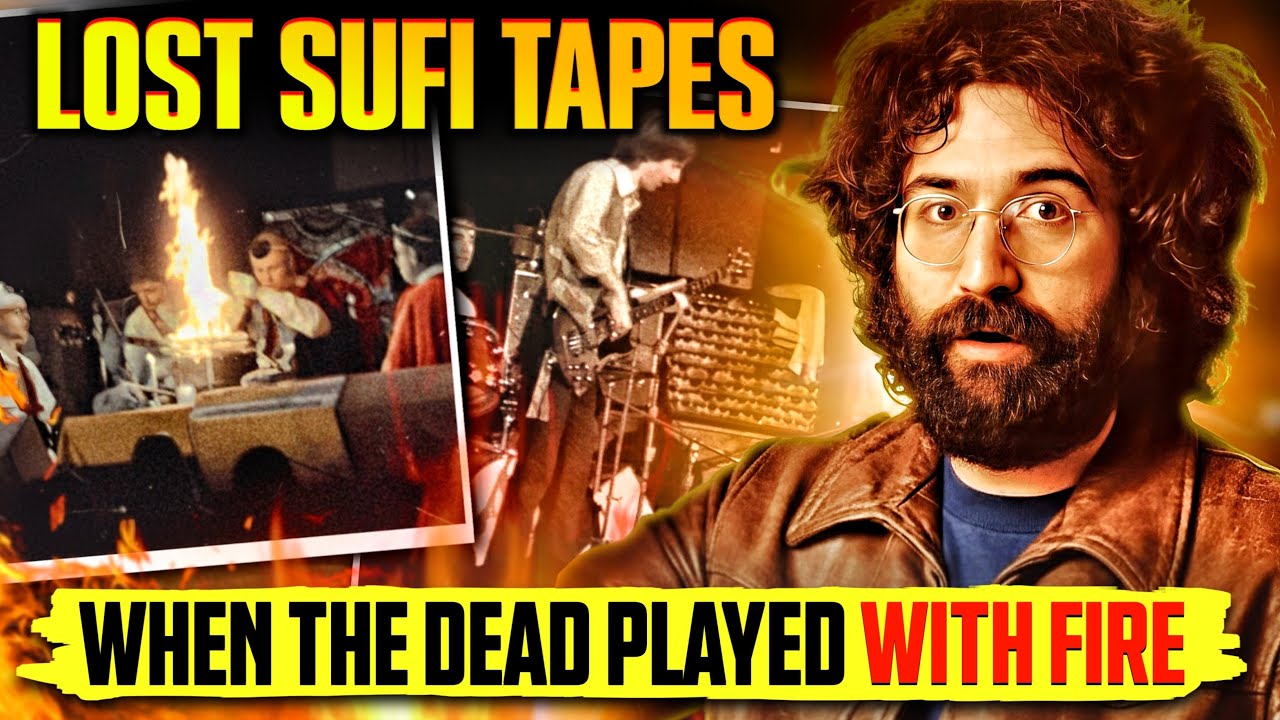
In March 1971, the Grateful Dead played a benefit concert at Winterland in San Francisco for the Sufi Choir of San Francisco. The performance featured something that shouldn’t have been physically possible or legally permissible: robed men chanting in a circle around an open bonfire inside a wooden building, while the Dead played behind them. The tape of this performance was effectively lost for fifty years. When it finally surfaced, it revealed one of the strangest and most beautiful nights in the Dead’s history.
The Sufi Choir was a San Francisco institution of the kind that could only have existed in the Bay Area in the early 1970s. Founded by practitioners of Sufism — the mystical tradition within Islam that emphasizes direct experience of the divine through music, dance, and chanting — the choir performed ecstatic group vocals drawn from multiple spiritual traditions. Their performances were participatory, hypnotic, and designed to induce altered states of consciousness through sound. In other words, they were a natural fit for the Grateful Dead.
The benefit at Winterland brought these two traditions together in a single room. The Dead set up on stage. The Sufi Choir arranged themselves on the Winterland floor. And at some point during the evening, someone lit a bonfire inside the venue. The specifics of how this happened — who authorized it, what fire safety measures (if any) were in place, how Bill Graham’s venue staff responded — have been lost to time. What survives in eyewitness accounts is the image: robed figures circling a fire, chanting in unison, while Garcia, Lesh, Weir, and the rest played music that dissolved the boundary between performance and ritual.
The musical collaboration was unlike anything else in the Dead’s catalog. The Sufi Choir’s vocal technique — sustained tones, overlapping harmonies, rhythmic chanting that built in intensity over long periods — gave the Dead a textural element they’d never had. The band’s improvisational approach, which typically relied on the interplay between Garcia’s melodic lead and Lesh’s contrapuntal bass, expanded to accommodate the choir’s vocal mass. The result was something that moved between rock, devotional music, and ambient drone in ways that none of the participants could have predicted.
The Dead in early 1971 were in a particular creative moment. American Beauty had been released three months earlier. The acoustic-leaning songs of that album — “Box of Rain,” “Friend of the Devil,” “Ripple” — represented one direction. The extended electric improvisations that still dominated their live shows represented another. The Sufi Choir performance existed in a third space entirely — neither the crafted songwriting of the studio albums nor the freeform jamming of a typical Dead show, but something more ritualistic, more intentional, more connected to spiritual practice than either.
What makes the tape’s rediscovery significant is what it reveals about the range of the Dead’s musical ambitions during this period. By 1971, Garcia and the band were exploring connections between music and consciousness that went far beyond the psychedelic experiments of the Acid Tests. The Dead were interested in how music functioned in spiritual contexts — how chanting, repetition, and collective participation could produce altered states without chemical assistance. The Sufi Choir collaboration was an explicit experiment in that direction, and the fact that it happened at Winterland — not a ashram, not a private gathering, but a public concert venue — shows how seriously the Dead took the idea of performance as ceremony.
The tape’s fifty-year absence from circulation also says something about the era’s relationship to documentation. The Dead’s recording philosophy was comprehensive — Owsley Stanley had established a culture of taping everything, and by 1971, the band’s soundboard recordings were being made routinely. But the archival infrastructure for cataloging, storing, and distributing those recordings didn’t exist yet. Tapes got lost. Reels were mislabeled. Recordings that captured extraordinary moments sat in boxes in storage units for decades, unknown and unheard.
When the Sufi Choir tape finally surfaced and was made available to the Deadhead community, it confirmed what the eyewitnesses had been saying for fifty years: that the night was as remarkable as memory suggested. The recording captures a performance that is genuinely unlike anything else in the Dead’s archive — not better or worse than their other great nights, but categorically different. It’s the Dead as participants in a spiritual practice rather than performers on a stage, and the distinction matters.
The full story of the benefit, the bonfire, the lost tape, and what it sounds like after fifty years is in the documentary above.
Subscribe to The Shakedown Archives on YouTube
youtube.com/@theshakedownarchives