Grateful Dead vs. Allman Brothers: What Really Happened at Fillmore East
The Grateful Dead and the Allman Brothers Band are the two greatest American improvisational rock bands of the twentieth century. They shared stages. They shared a promoter in Bill Graham. They shared a fundamental belief that live performance, not studio recording, was where the music actually happened. And beneath the surface of mutual respect, there was a rivalry that neither band ever fully acknowledged.
The tension wasn’t about ego in the conventional rock sense — nobody was fighting over billing or dressing room size. It was about musical philosophy. The Dead and the Allmans approached improvisation from opposite directions, and each band’s approach implicitly criticized the other’s.
The Allman Brothers were a southern band built
The Allman Brothers were a southern band built on dual lead guitars — Duane Allman and Dickey Betts — trading melodic phrases over a rhythm section that was precise, powerful, and blues-rooted. Their improvisations were structured. Duane’s slide guitar work operated within clearly defined harmonic territory. The band could stretch a song to twenty minutes, but the improvisation always served the composition. You could hear where they were going.
The Dead were the opposite. Garcia and Lesh treated compositions as departure points, not destinations. A “Dark Star” performance could spend fifteen minutes in atonal space, abandoning key, tempo, and conventional song structure entirely before pulling back into recognizable melody. The Dead’s improvisations were riskier, more abstract, and more likely to fail spectacularly. When they failed, the music was aimless. When they succeeded, it achieved something the Allmans’ more disciplined approach couldn’t touch — a sense of genuine discovery, of musicians finding music that didn’t exist until the moment they played it.
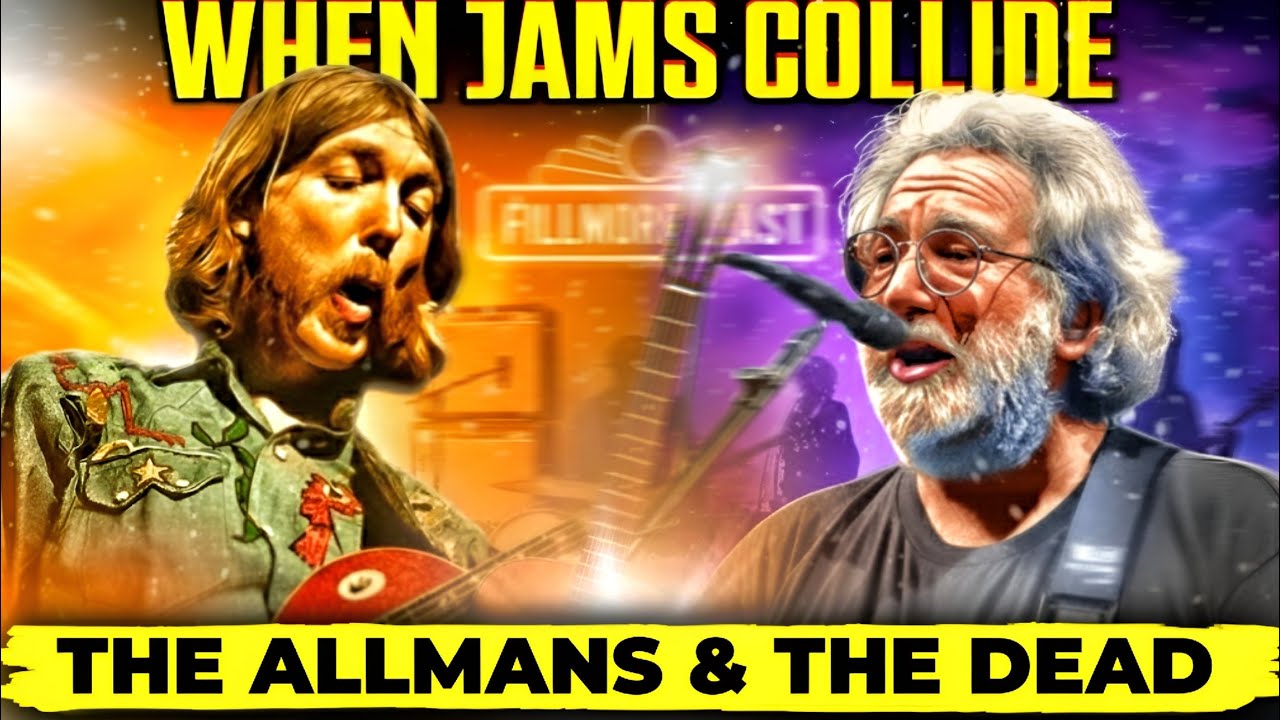
The Fillmore East shows crystallized the difference. Bill Graham’s legendary New York venue hosted both bands regularly, and the late-night bills — where the Dead and the Allmans would share a stage — became testing grounds. Duane Allman sat in with the Dead on multiple occasions, and the surviving recordings capture something fascinating: Duane was undeniably brilliant, but his playing pushed the Dead toward structure in a way that constrained them. Garcia responded to Duane’s melodic precision by playing more conventionally himself. The musical conversation was respectful, even beautiful. But it wasn’t the Grateful Dead at their most characteristic.
Phil Lesh’s reaction was more revealing
Phil Lesh’s reaction was more revealing. Lesh, whose bass playing deliberately avoided root notes and conventional harmonic support, found the Allmans’ approach limiting. Lesh wanted to go somewhere the music hadn’t been. The Allman Brothers’ rhythm section — Berry Oakley on bass, Butch Trucks and Jaimoe on drums — was extraordinary, but it functioned as a foundation. Lesh didn’t want to be a foundation. He wanted to be a second lead instrument, and that required a rhythm section willing to float rather than anchor.
The Watkins Glen festival in July 1973 brought the tension into sharp relief. Six hundred thousand people watched both bands play on the same bill, with the Band as the third act. The Dead played for five hours. The Allmans played a fierce, focused set. When all three bands jammed together at the end of the night, the stylistic collision was audible — the Dead pushing toward abstraction, the Allmans pulling toward blues resolution, the Band trying to find the pocket between them.
By 1973, the comparison was complicated by tragedy. Duane Allman had died in a motorcycle accident on October 29, 1971, at age twenty-four. Berry Oakley died in a motorcycle accident on November 11, 1972, at age twenty-four — eerily similar circumstances, barely a year apart. The Allman Brothers who played Watkins Glen were a wounded band, rebuilt around Dickey Betts’s guitar and a new rhythm section. The rivalry, such as it was, had been altered by loss.
Garcia was characteristically diplomatic about the Allmans in
Garcia was characteristically diplomatic about the Allmans in interviews. He respected Duane’s playing, admired the band’s commitment to live performance, and never publicly disparaged their approach. But the Dead’s choices spoke for themselves. They never moved toward the Allmans’ structured improvisation. They went further in the opposite direction — longer jams, more abstraction, more risk. The Dead’s musical identity was partly defined by what they weren’t, and what they weren’t was the Allman Brothers.
The question the documentary explores — whether the Dead and the Allmans were genuinely rivals, parallel experiments, or something more complicated — is laid out with the evidence and the recordings above.
Subscribe to The Shakedown Archives on YouTube
youtube.com/@theshakedownarchives
The Song in Context
Understanding any Grateful Dead song requires understanding the partnership between Jerry Garcia and Robert Hunter that produced it. Hunter was not a conventional lyricist — he was a poet who happened to write for a rock band. His words drew from American folk traditions, Beat poetry, and a mythological imagination that created characters and landscapes existing outside of any specific time or place. Garcia’s melodies, in turn, had a quality that musicologists have struggled to categorize — folk-informed but jazz-inflected, simple on the surface but harmonically sophisticated beneath.
The songs they created together entered the Grateful Dead’s live repertoire and evolved constantly. A song might be performed hundreds of times over decades, and no two versions were identical. Tempos shifted, arrangements expanded and contracted, and improvisational passages grew or shrank depending on the band’s collective mood on any given night. For Deadheads, the song as recorded in the studio was merely a starting point — a sketch that live performance would elaborate into something far more complex and unpredictable.
The Live Experience
The Grateful Dead’s live performances were fundamentally different from those of any other major rock band. While most acts rehearsed and repeated a fixed setlist, the Dead approached each show as a unique event. Setlists were chosen shortly before the performance, and the transitions between songs — the spaces where improvisation lived — were entirely spontaneous. A concert might last three hours or more, moving through structured songs, extended jams, and passages of pure collective improvisation that could be transcendent or chaotic, sometimes both simultaneously.
This approach demanded extraordinary musical communication. Each member of the band had to listen constantly to every other member, responding in real time to melodic suggestions, rhythmic shifts, and dynamic changes. Garcia often described it as a conversation — not a performance, but a dialogue between musicians who had developed, over years of playing together, an almost telepathic understanding of each other’s musical instincts. When it worked, the result was music that felt inevitable and surprising at the same time.
Related Articles
- Watkins Glen 1973: The Festival That Made Woodstock Look Small
- The Night the Grateful Dead Stole Their Own Equipment: Fillmore West August 1969
- How Europe ’72 Rescued the Grateful Dead and Created the Greatest “Live” Album Ever Made
The Shakedown Archives publishes new research on Grateful Dead history each week. If you enjoyed this essay, you can subscribe to the companion YouTube channel below.
Subscribe on YouTube