Why the Grateful Dead Will Never Die: The Next Generation Takes Over
On March 20, 2012, Phil Lesh opened Terrapin Crossroads in San Rafael, California—a venue and community space that would serve as laboratory, gathering place, and experimental station for Grateful Dead music and culture. The venue had a simple mission: create an environment where musicians could collaborate nightly, where the Dead’s material and related music could be explored continuously, and where the audience became active participants in the music-making rather than passive observers.
Terrapin Crossroads was more than a music venue. It was a statement about what Phil Lesh believed the Dead’s legacy should become. Rather than rest on the achievements of five decades of touring, Lesh created a space where the work could continue, where young musicians could apprentice themselves to the tradition, and where the collaborative spirit that had animated the Dead throughout their history could be preserved and evolved.
The model worked
The model worked. On any given night, Terrapin Crossroads might host a rotating ensemble of forty or more musicians. Phil would lead ensembles that included his sons Grahame and Brian Lesh, who developed their own musical identities within the context of the Dead’s tradition. The venue became a training ground—a place where musicians could learn the Dead’s catalog, develop improvisational skills, and understand the philosophy that governed how the Dead approached music-making.
In October 2013, at age seventy-three, Phil declared himself “off the bus.” He announced he would no longer tour with the Grateful Dead, stepping back from the constant travel and performance demands that had characterized his life for fifty years. This retirement was not a withdrawal from music; it was a transition. Terrapin Crossroads became his primary focus—a place where he could work on music constantly without the demands of touring.
Terrapin Crossroads remained a vital community gathering place until November 2021, when the venue closed due to a combination of factors: the COVID-19 pandemic disrupted live performance, and the lease arrangements became unsustainable. Yet in the nine years of operation, the venue had accomplished its fundamental purpose. It had proven that the Dead’s music and philosophy could be transmitted to new generations, that the tradition was robust enough to survive outside of its original context, and that the key to the Dead’s longevity was not preservation but active evolution.
When Phil Lesh died on October 25
When Phil Lesh died on October 25, 2024, at the age of eighty-four, the question arose immediately: What would happen to the legacy Lesh had protected and nurtured? The answer came in the form of the Terrapin Roadshow—an initiative organized by Grahame Lesh and the next generation of musicians who had apprenticed at Terrapin Crossroads. Rather than attempt to recreate Terrapin Crossroads as a physical space, the Roadshow took the spirit of the venue and moved it back onto the road—returning to the Dead’s original model of touring while maintaining the collaborative, evolutionary philosophy that Phil had articulated.
This transformation was significant for what it revealed about the Dead’s survival mechanisms. The band had never depended on physical locations or fixed ensembles. The original Grateful Dead had emerged from the San Francisco scene, but their genius was portable. They could play anywhere—large halls, small clubs, outdoor festivals, arenas—and the music remained vital. Terrapin Crossroads had provided a different kind of stability: a fixed location where the music could be continuously explored. But the Roadshow proved that the fundamental principle transcended any particular venue.
The Dead’s ability to survive rests fundamentally on this principle: the music works because the system is designed for continuous evolution. Jerry Garcia performed with Merl Saunders in jazz contexts. He collaborated with David Grisman in bluegrass settings. He joined the Jerry Garcia Band, which had a completely different sound from the Grateful Dead. These weren’t side projects that diluted the Dead’s essence; they were extensions of the philosophical principle that the music should be willing to move into new territories.
Similarly, Phil Lesh had pioneered Phil & Friends
Similarly, Phil Lesh had pioneered Phil & Friends, where rotating musicians would interpret the Dead’s material and Phil’s original compositions. This model had proven so successful that it became a template for how the Dead’s legacy could be sustained: invite new musicians, create new combinations, allow the familiar material to be recontextualized and reimagined.
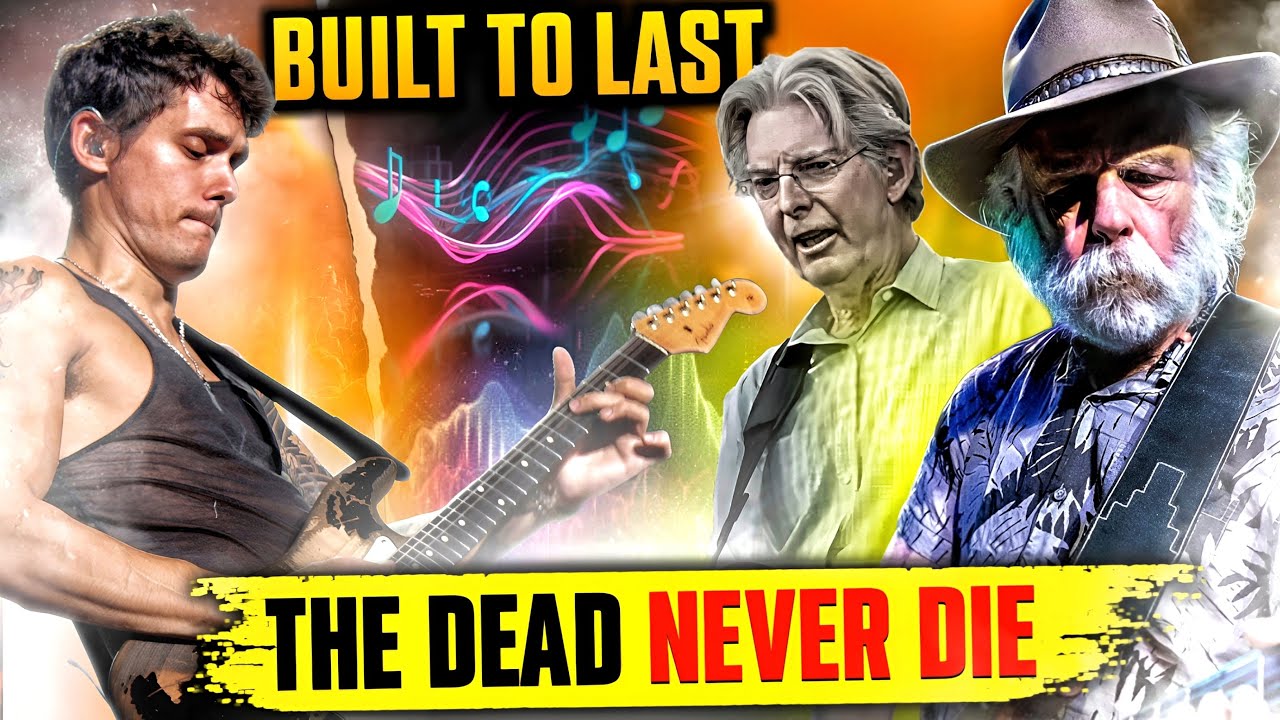
Dead & Company, which began touring in 2015 and continued through 2024, represented the logical extension of this philosophy. With John Mayer on lead guitar, the band demonstrated that the Dead’s music could accommodate completely different interpretations of Garcia’s role. Mayer brought blues and contemporary rock sensibilities to material that had previously been played primarily by Garcia’s unique improvisational voice. Rather than seeing this as a compromise or dilution, the audiences and musicians embraced it as evolution.
The numbers are remarkable. Dead & Company’s 2023 tour sold approximately 845,000 tickets across sixty shows, grossing approximately $115 million. These weren’t nostalgia crowds; they were multigenerational audiences—people who had followed the Dead for fifty years alongside people who were discovering the music for the first time. The 2015 Fare Thee Well concerts, which served as a celebration of the original band and a farewell moment for many fans, sold over 700,000 tickets across five shows. These numbers reflect not a nostalgia market but an ongoing living tradition.
What makes this continuation possible is that the
What makes this continuation possible is that the Dead fundamentally understood something that many bands never grasp: the music only works when it’s willing to fail. This wasn’t rhetoric; it was embedded in how they approached every performance. No song was ever the same twice. Every show was a unique event. The material could accommodate soloists ranging from Branford Marsalis to Bruce Hornsby to Mayer. The tradition was robust enough to contain multiple interpretations simultaneously.
This quality of “productive failure”—the willingness to take risks, to allow performances to go in unexpected directions, to embrace the possibility of things not working out—became the Dead’s greatest strength. A band that tried to perfectly reproduce their catalog night after night would have become tired and predictable. A band that demanded unquestioning adherence to a specific approach would have struggled to accommodate outside musicians. The Dead’s insistence on improvisation, on continuous exploration, on “not getting it right” in any definitive sense, meant the music stayed vital.
The next generation carrying this tradition forward understands these principles implicitly. Grahame Lesh didn’t attempt to recreate Terrapin Crossroads exactly; he created something evolved from it. The Terrapin Roadshow is not a static celebration of Phil’s legacy; it’s an active continuation of the philosophical principles Phil embodied. Young musicians joining these initiatives aren’t asked to reproduce what their predecessors did; they’re asked to engage with the material creatively and bring their own sensibilities to bear.
This approach to musical succession is rare
This approach to musical succession is rare. Most traditions attempt to preserve what came before. The Dead’s tradition attempts to move it forward. This isn’t disrespect for the past; it’s the deepest respect possible—understanding that the past was built on principles of evolution and allowing those same principles to continue shaping the future.
The Grateful Dead won’t die because the culture has been distributed across multiple musicians, multiple interpretations, and multiple generations of participants. It won’t die because it’s built on principles rather than personalities. It won’t die because people continue to find meaning and community in the music and the culture surrounding it. The Dead will continue to evolve—sometimes moving away from the original sound, sometimes returning to deep connection with the material, sometimes experimenting with entirely new directions.
For every musician struggling with how to honor tradition while moving forward, the Grateful Dead provide a model. You don’t preserve by freezing in place; you preserve by continuing to grow. You don’t honor your predecessors by perfectly reproducing their work; you honor them by understanding what principles animated their work and applying those principles to new contexts. The Dead will never die because they were never about any single thing. They were about the possibility of music continuing to explore itself indefinitely, about musicians and audiences gathering to create something that no one could have predicted beforehand.
That possibility continues. It will continue as long as people believe the music is worth pursuing, as long as musicians are willing to take risks and fail openly, and as long as the culture surrounding the Dead remains fundamentally committed to evolution over preservation. The next generation has inherited not a museum piece but a living tradition. And they’re using it not to look backward, but to move forward.
Related Articles
- Bob Weir Has Died. What Happens to the Grateful Dead Now?
- The Grateful Dead’s 1974 Collapse and Resurrection: When Jerry Garcia Nearly Quit
- The Most Important Venue In a Post Jerry World
The Shakedown Archives publishes new research on Grateful Dead history each week. If you enjoyed this essay, you can subscribe to the companion YouTube channel below.
Subscribe on YouTube