When the CIA Lost Control: How MK-ULTRA Created the Grateful Dead
The greatest unintended consequence in American counterculture history isn’t a conspiracy theory—it’s documented fact. The Central Intelligence Agency, in pursuit of mind control weapons during the Cold War, inadvertently created the ideological and chemical infrastructure for the 1960s countercultural revolution it would later spend millions trying to suppress.
This is the story of MK-ULTRA, the Grateful Dead, and how government paranoia gave birth to the very movement it feared most.
Let’s establish the documented baseline: MK-ULTRA was real
Let’s establish the documented baseline: MK-ULTRA was real. Between 1953 and 1973, the CIA conducted a classified program testing LSD and other consciousness-altering drugs on unwitting American and Canadian citizens. The stated purpose was espionage and interrogation—developing mind control techniques that could create docile agents or extract secrets from enemies.
What made MK-ULTRA different from typical classified operations wasn’t the secrecy; it was the scale of human rights violations. The program operated across multiple universities, hospitals, and research institutions. Most subjects had no knowledge they were being dosed. Some were psychiatric patients. Others were prisoners. The long-term psychological damage was staggering and largely uncompensated.
The program wasn’t exposed until the mid-1970s, when Congressional investigations (particularly the Church Committee) forced partial declassification. By then, MK-ULTRA had reshaped American consciousness in ways the CIA never intended.
The connection between MK-ULTRA and the Grateful Dead
The connection between MK-ULTRA and the Grateful Dead begins with Ken Kesey, author of One Flew Over the Cuckoo’s Nest. In 1959-1960, Kesey participated in drug experiments at the CIA-funded Stanford Research Institute, specifically at the VA Hospital in Menlo Park, California. He was compensated for his participation, fully aware he’d be ingesting psychoactive substances.
What distinguished Kesey’s experience from many MK-ULTRA subjects was his literacy and articulation. He could describe and contextualize what he experienced. While government researchers were interested in behavioral manipulation, Kesey became fascinated by the expansiveness of consciousness itself.
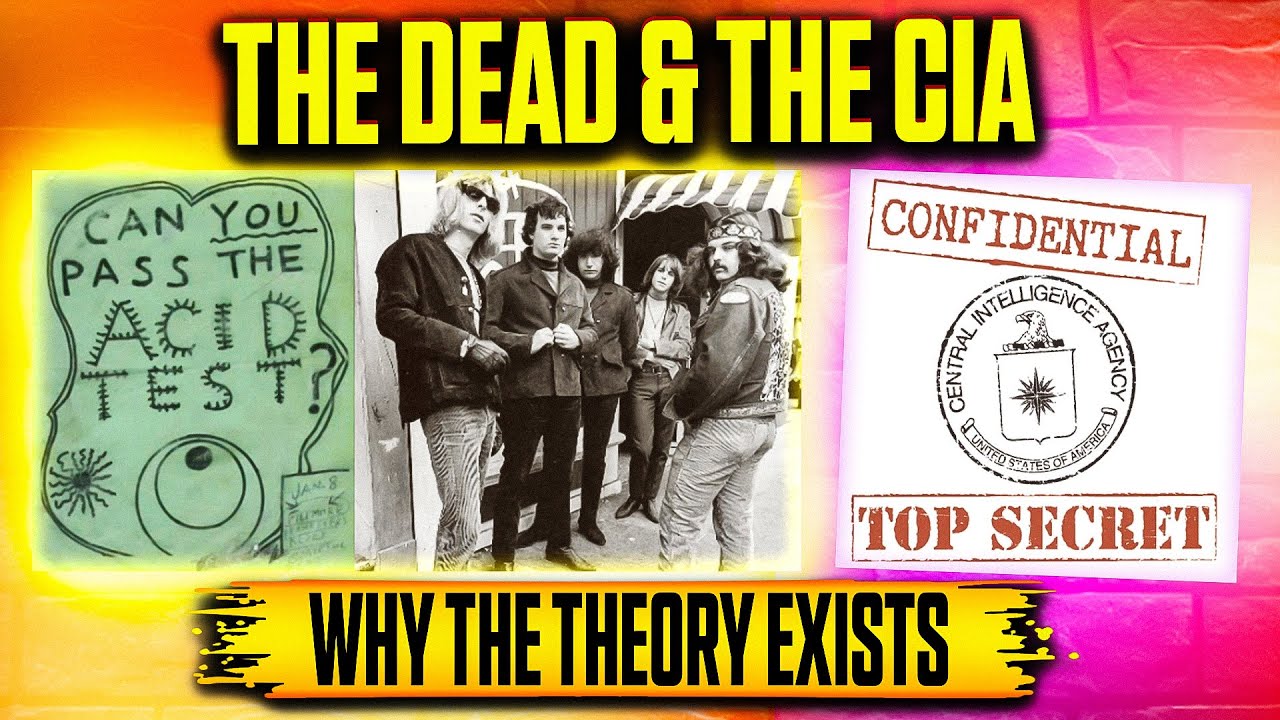
That fascination spawned the Acid Tests—a series of public events (1964-1966) that combined live music, light shows, and free LSD distribution to anyone who wanted it. The Acid Tests were deliberate demystification of psychedelia: not a medical procedure, not a weapon, but a shared exploratory experience. They were consciousness liberation as countercultural philosophy.
And they became the crucible where the Grateful
And they became the crucible where the Grateful Dead formed.
The Grateful Dead’s lyricist Robert Hunter walked a parallel path. Hunter also participated in government-sponsored LSD experiments at Stanford in the early 1960s, before becoming the Dead’s primary songwriter. His experience wasn’t about mind control resistance—it was raw chemical revelation that would inform decades of psychedelic lyrics.
Hunter’s role is crucial to understanding the irony: the CIA’s research into consciousness alteration created the intellectual and chemical foundation for artists who would use that same knowledge to articulate countercultural philosophy. The government invested in understanding LSD’s effects on the mind. The artists invested in celebrating them.
The irony deepens with Owsley “Bear” Stanley
The irony deepens with Owsley “Bear” Stanley, the Grateful Dead’s legendary soundman and, simultaneously, one of the most prolific illicit LSD manufacturers in American history. Bear wasn’t a CIA asset dabbling in chemistry—he was a self-taught chemist who synthesized thousands of doses of pure LSD for the counterculture.
Bear’s presence in the Dead’s orbit represented the full inversion of MK-ULTRA’s logic: the government had studied LSD as a weapon for control, while Bear democratized it as a sacrament for liberation. The Dead’s sound system was powered by the same person manufacturing the chemical substrate of their audience’s consciousness.
Here’s where the conspiracy angles converge with documented history: the Dead were surveilled. The FBI maintained files on the band, particularly intensifying surveillance after the 1970 New Orleans drug bust that arrested multiple band members and associates. Agency interest in the Dead was genuine paranoia about drug distribution and countercultural organizing—not unfounded, but also vastly exaggerated in terms of actual threat.
The real conspiracy wasn’t that the Dead were
The real conspiracy wasn’t that the Dead were CIA assets or that their music was weaponized surveillance. It was simpler and more profound: the government created the conditions (chemical knowledge, institutional research, deliberate exploration of consciousness) that enabled the cultural movement it most feared.
The actual narrative—stripped of elaborate conspiracy but retaining all documented fact—is stranger than most theories. A government agency (CIA), pursuing weapons research (mind control), conducted unauthorized human experimentation (MK-ULTRA), which directly inspired the individuals (Kesey, Hunter) who would create the template for mass countercultural consciousness exploration (Acid Tests, the Dead).
The counterculture wasn’t created by the CIA. But the CIA’s research and the knowledge it generated became the building blocks for something far more culturally powerful than any weapon: an artistic and philosophical movement that would reshape American consciousness for generations.
What the CIA couldn’t account for was creativity
What the CIA couldn’t account for was creativity. You can study consciousness chemically. You can measure synaptic responses. You can theorize about behavioral control. But you cannot predict what happens when artists get access to the same tools and ask fundamentally different questions.
Kesey didn’t ask: “How can LSD make someone compliant?” He asked: “What can consciousness do when fully expanded?” Hunter didn’t ask: “How does LSD break down resistance?” He asked: “What truths can LSD reveal?” Bear didn’t ask: “How do I control distribution?” He asked: “How do I liberate it?”
The Grateful Dead emerged from this collision—government paranoia intersecting with countercultural optimism, classified research meeting democratic experimentation, Cold War surveillance encountering grassroots consciousness exploration.
Fifty years later
Fifty years later, the real story remains wilder than the conspiracy theories. The CIA funded research that created the ideological and chemical infrastructure for the 1960s counterculture. The government built the laboratory for its own opposition.
This isn’t a theory requiring extraordinary evidence or hidden documents. It’s documented history: MK-ULTRA was real, Kesey and Hunter’s participation is verified, the Acid Tests happened, the Dead’s music reshaped culture, and the surveillance was documented.
The conspiracy isn’t secret. It’s tragic. An institution so obsessed with controlling consciousness that it accidentally liberated it. A government so paranoid about what its citizens might become that it handed them the very tools needed to transform themselves.
The Grateful Dead didn’t emerge from CIA manipulation
The Grateful Dead didn’t emerge from CIA manipulation. They emerged from CIA-funded research that escaped the laboratory and became a movement. In trying to weaponize consciousness, the CIA created the conditions for consciousness expansion.
That’s the real story. And it requires no elaboration to be extraordinary.
The Song in Context
Understanding any Grateful Dead song requires understanding the partnership between Jerry Garcia and Robert Hunter that produced it. Hunter was not a conventional lyricist — he was a poet who happened to write for a rock band. His words drew from American folk traditions, Beat poetry, and a mythological imagination that created characters and landscapes existing outside of any specific time or place. Garcia’s melodies, in turn, had a quality that musicologists have struggled to categorize — folk-informed but jazz-inflected, simple on the surface but harmonically sophisticated beneath.
The songs they created together entered the Grateful Dead’s live repertoire and evolved constantly. A song might be performed hundreds of times over decades, and no two versions were identical. Tempos shifted, arrangements expanded and contracted, and improvisational passages grew or shrank depending on the band’s collective mood on any given night. For Deadheads, the song as recorded in the studio was merely a starting point — a sketch that live performance would elaborate into something far more complex and unpredictable.
The Live Experience
The Grateful Dead’s live performances were fundamentally different from those of any other major rock band. While most acts rehearsed and repeated a fixed setlist, the Dead approached each show as a unique event. Setlists were chosen shortly before the performance, and the transitions between songs — the spaces where improvisation lived — were entirely spontaneous. A concert might last three hours or more, moving through structured songs, extended jams, and passages of pure collective improvisation that could be transcendent or chaotic, sometimes both simultaneously.
This approach demanded extraordinary musical communication. Each member of the band had to listen constantly to every other member, responding in real time to melodic suggestions, rhythmic shifts, and dynamic changes. Garcia often described it as a conversation — not a performance, but a dialogue between musicians who had developed, over years of playing together, an almost telepathic understanding of each other’s musical instincts. When it worked, the result was music that felt inevitable and surprising at the same time.
The Chemical Reality
Drugs were inseparable from the Grateful Dead’s story, but the relationship was more complex than the caricature suggests. LSD was foundational — the Acid Tests were the crucible in which the Dead’s improvisational approach was forged, and psychedelics informed the expansive, boundary-dissolving quality of their music throughout their career. But the drug culture that surrounded the Dead evolved over the decades, and not always in positive directions.
By the 1980s, harder drugs — particularly cocaine and heroin — had infiltrated both the band and their community. Garcia’s well-documented struggles with heroin addiction took a devastating toll on his health and his playing. The parking lot scene, once dominated by psychedelics, increasingly included dealers selling substances that were addictive and dangerous. The Dead’s open, tolerant culture — which had been a strength in the 1960s and 1970s — became a liability when that openness was exploited by people whose relationship with drugs was destructive rather than exploratory.
Related Articles
- From Jug Bands to Grateful Dead: The Folk and Bluegrass Roots of American Rock
- The Night the Grateful Dead Stole Their Own Equipment: Fillmore West August 1969
- Frankie Weir, Sugar Magnolia, and the Women Who Actually Ran the Grateful Dead
The Shakedown Archives publishes new research on Grateful Dead history each week. If you enjoyed this essay, you can subscribe to the companion YouTube channel below.
Subscribe on YouTube