The Grateful Dead Hid an 8-Year Reckoning in Plain Sight
The Grateful Dead never issued a statement about Altamont. They didn’t write an op-ed, didn’t cut a press interview, didn’t release a single. What they did instead took eight years to unfold — and most listeners, even serious Deadheads, never connected the three songs that carried the band’s response into a single line of thought.
The December 6, 1969 free concert at the Altamont Speedway was the Grateful Dead’s idea. They conceived it, helped organize it, hired the Hells Angels security detail on the advice of the Rolling Stones’ organization, and then declined to play after witnessing the violence unfolding in front of the stage. Four people died that day. Meredith Hunter was stabbed to death a few feet from Mick Jagger. Two others were killed by a hit-and-run car. A fourth drowned in an irrigation canal. By the time the sun went down, the idea that the counterculture could organize itself peacefully — the founding myth of the whole 1960s project — was dead in the dirt.
The Three-Song Arc, Hidden in the Catalog
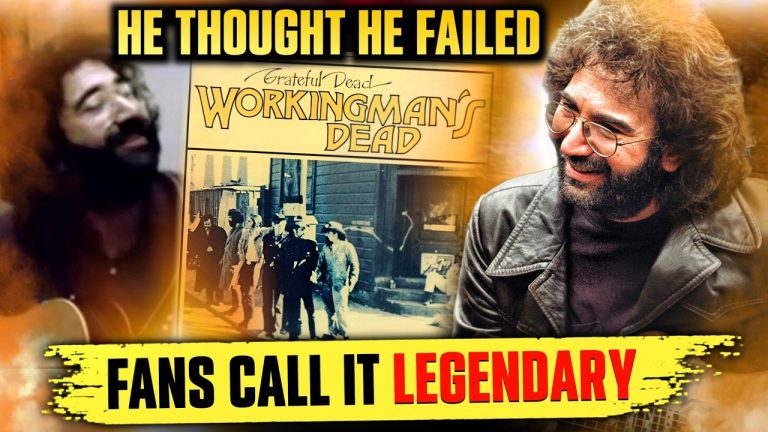
The Dead’s response was scattered across the studio catalog in a way that obscured its shape. “New Speedway Boogie” landed on Workingman’s Dead in June 1970. “Weather Report Suite” closed side one of Wake of the Flood in October 1973. “Estimated Prophet” opened Terrapin Station in July 1977. Three albums, three producers, three entirely different sonic worlds. If you listen to the records in release order, nothing obvious connects them. The connection only appears once you line up the lyrics and ask what question each song was trying to answer.
Robert Hunter wrote the words for “New Speedway Boogie” two weeks after Altamont. He called what he was doing “musical journalism” — not protest, not eulogy, and deliberately not indictment. Hunter refused to name villains. The song’s insistence that “things went down we don’t understand” is doing real philosophical work. It’s rejecting the impulse, everywhere in the music press at the time, to hang the blame on one group — the Angels, the promoters, Mick Jagger, the acid, the crowd. Hunter’s position was that the whole ecosystem had failed, and no single thread could be pulled to explain the tear. For more on how Altamont specifically changed the band’s trajectory, see Why Altamont Changed the Grateful Dead Forever.
From Reporting to Weather
Four years later, John Perry Barlow — Bob Weir‘s childhood friend from boarding school, who had joined the songwriting team in 1971 — wrote the lyrics for “Weather Report Suite.” Where Hunter had written in the voice of a reporter, Barlow wrote in the voice of weather itself. The suite opens as a prelude with no words at all, moves through a pastoral section about seasons, and ends with “Let It Grow,” in which the narrator speaks as the wind, the rain, the crop, the soil.
The move is significant. Hunter asked what had happened at Altamont and refused to assign fault. Barlow, three years further from the event, stopped asking about the event altogether. He zoomed out to a longer timescale — the timescale of agriculture, of cycles, of things that grow and die and grow again without needing an explanation from anyone. The 1960s had imagined themselves as a revolution. “Weather Report Suite” treats the whole decade as a season. Seasons don’t need blame either.
The suite was performed only forty-six times between September 1973 and October 1974. After the hiatus, it was retired in full. “Let It Grow” survived on its own and stayed in rotation for the next twenty years. It’s telling that the part that survived was the part that made the argument — the part that said the world keeps going whether or not you understand what just happened to it.
The Warning That Closed the Loop
“Estimated Prophet” arrived in 1977, eight years almost to the month after Altamont. Weir wrote the music and Barlow wrote the words, and the song is written in 7/4 — a time signature rock music almost never touches. Bill Kreutzmann‘s solution was to play two fast bars of 7/4 at half time, which produced the hypnotic reggae-inflected feel the finished track is known for. The meter sounds casual until you try to count it. That’s the point.
Barlow’s lyric takes the voice of a false prophet — someone convinced he has seen the future, convinced the crowd should follow him, convinced his vision is the one that matters. The song doesn’t condemn him. It lets him speak, and trusts the listener to notice the warning. Weir said in interviews that he’d been watching the guys at shows who’d stand at the edge of the stage pointing at him and explaining that they had “the message.” Those guys were the song’s real subject.
This is the move that closes the arc. Hunter rejected the assignment of blame. Barlow, via Weather Report Suite, rejected the idea that events need explaining at all. And then Barlow again, in “Estimated Prophet,” rejected the prophet — the figure who claims to have the explanation that everyone else missed. Across eight years, the Dead worked their way out of the crisis Altamont had exposed. The crisis wasn’t the violence. The crisis was the temptation, after the violence, to produce a story that would make it mean something.
Why Almost Nobody Connected the Dots
The reason the three-song arc went unnoticed for decades is that it was engineered to go unnoticed. Each song works on its own — “New Speedway Boogie” as a blues-informed working-man’s reflection, “Weather Report Suite” as a pastoral exercise, “Estimated Prophet” as a character study with a great groove. None of them reaches for the reader’s shoulder and announces that it’s part of a sequence. The Dead were a band that trusted their audience to do the work, and the Altamont response was the most demanding work they ever asked for.
For the full chronological breakdown of how the three songs were composed, premiered, and absorbed into the live catalog, see our companion piece: Altamont 1969: How the Grateful Dead Processed America’s Darkest Moment Through Three Apocalyptic Songs. For the lyricists behind the arc, see John Perry Barlow: The Wyoming Rancher Who Bridged Counterculture and Cyberspace and our coverage of Robert Hunter’s relationship with the road.
The Shakedown Archives publishes new research on Grateful Dead history each week. If you enjoyed this essay, you can subscribe to the companion YouTube channel below.
Subscribe on YouTube