December 15, 1986: The Most Important Show in Grateful Dead History
On July 10, 1986, Jerry Garcia collapsed backstage at a show and fell into a diabetic coma. He was forty-three years old, overweight, a heavy smoker, and his drug use had deteriorated from recreational to compulsive over the previous several years. The coma lasted five days. When Garcia regained consciousness, he couldn’t remember how to play guitar. He couldn’t remember chord shapes. He couldn’t remember songs he’d been playing for twenty years. The damage wasn’t psychological. It was neurological — the coma had impaired his motor skills and musical memory in ways that no one knew were reversible.
For five months, Garcia worked to recover. He relearned chord positions. He rebuilt muscle memory in his fingers. He practiced songs he’d played thousands of times as if learning them for the first time. Merl Saunders — the jazz and R&B keyboardist who’d been Garcia’s closest musical collaborator outside the Dead — helped guide the rehabilitation, playing alongside Garcia in informal sessions that gradually restored his confidence and his technique.
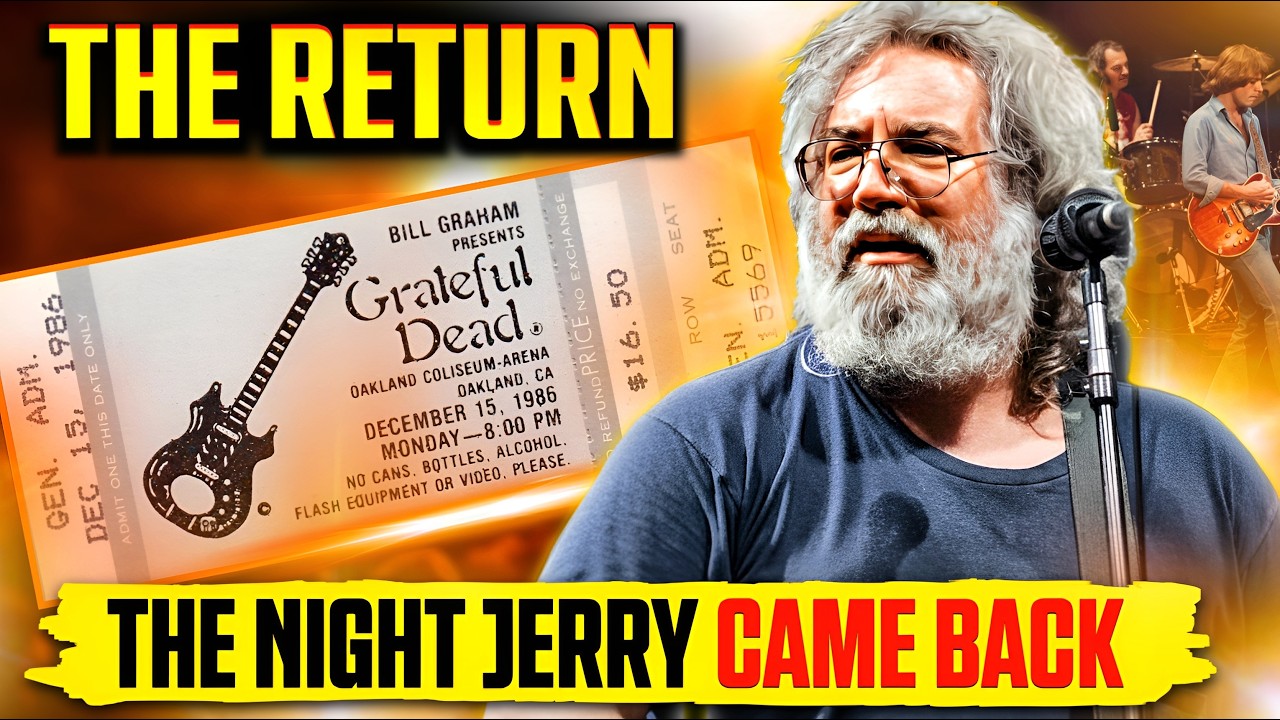
December 15, 1986, at the Oakland-Alameda County Coliseum Arena, was the test. It was the Grateful Dead’s first show since Garcia’s coma — the night that would determine whether Garcia could still perform, whether the band could still function, whether the Grateful Dead were finished or not. Fifteen thousand people packed the arena. The emotional stakes were as high as any show the Dead had ever played.
What happened that night exceeded every reasonable expectation. Garcia didn’t just perform. He played with an intensity and joy that multiple witnesses described as a return to his best years. The coma had, in some paradoxical way, reset something. The lethargy that had crept into Garcia’s playing during the mid-eighties — the phoned-in solos, the disconnected stage presence, the sense that Garcia was going through motions rather than making music — was gone. In its place was a musician who seemed genuinely grateful to be playing, who attacked his guitar with an engagement that the audience hadn’t seen in years.
The setlist itself was significant. The band opened with “Touch of Grey” — a song that would be released as a single in 1987 and become the Dead’s only Top Ten hit. The choice was either prophetic or strategic: a song about survival, about enduring despite everything, about getting through to the other side. “I will survive” isn’t subtext in “Touch of Grey.” It’s the lyric. Playing it as the comeback opener was a statement.
The rest of the show confirmed the statement. “Scarlet Begonias” into “Fire on the Mountain.” “Estimated Prophet.” “Eyes of the World.” “Morning Dew” for the encore. The performances were sharp, emotionally present, and marked by the kind of improvisational daring that the mid-eighties Dead had been lacking. Garcia’s guitar tone was clear and bright. His melodic ideas were fresh — not recycled patterns from old shows, but new explorations that suggested a musician hearing the music differently after nearly losing the ability to hear it at all.
Brent Mydland’s role that night deserves specific attention. Mydland had joined the Dead in 1979 and spent seven years as Garcia’s most responsive musical partner. During Garcia’s decline in the mid-eighties, Mydland had been carrying more of the musical weight — his Hammond organ filling spaces that Garcia’s guitar was leaving empty, his vocals providing energy that Garcia’s performances lacked. On December 15, Mydland didn’t need to compensate. He could play off Garcia the way he’d always wanted to — as an equal, trading phrases, pushing and responding. The interplay between Garcia’s guitar and Mydland’s keys on that night’s recordings is some of the best in the Brent era.
The December 15 show launched what Deadheads call the “comeback era” — a period from late 1986 through 1987 that many fans consider the Dead’s last great creative peak. “Touch of Grey” hit number nine on the Billboard Hot 100 in 1987. In the Dark, the album it appeared on, went platinum. The Dead began selling out stadiums that they’d previously played as arena acts. The commercial success was unprecedented and, for longtime Deadheads, alarming — the influx of new fans drawn by “Touch of Grey” changed the culture of Dead shows in ways that the community is still debating.
But on December 15, 1986, none of that had happened yet. It was just a man who’d nearly died, relearning his instrument and walking back onstage to see if the music was still there. It was.
The full story of the coma, the recovery, and what happened that night at Oakland is in the documentary above.
Subscribe to The Shakedown Archives on YouTube
youtube.com/@theshakedownarchives