Jerry Garcia’s Guitar Tells You What Drug He Was On
Jerry Garcia’s drug eras left a forensic fingerprint on his guitar. Pull up a 1972 tape, then a 1985 tape, then a 1988 tape — you are listening to three different players. The attack changes. The patience changes. The willingness to leave silence in a phrase changes. By the end, even the hands change. This documentary walks through every chemical era of Garcia’s life and shows you exactly what to listen for on the tape.
The thesis is simple. The Grateful Dead were not a band that happened to use drugs. They were a band whose sound was continuously rewritten by whatever Garcia was using, and you can hear the rewrite in real time across the thirty-year catalog. Once you know the markers, you can date a Garcia solo by ear within eighteen months.
The Mount Wilson Acid Trip (1966)
In 1966, Garcia and Phil Lesh dropped acid on Mount Wilson, above Los Angeles. It was not their first acid experience and it was not their last, but it sat at the center of the period in which LSD was rewriting the Grateful Dead’s sense of what a song could do. The band had already been playing house gigs, bar sets, and the Merry Pranksters’ Acid Tests with Ken Kesey. On Mount Wilson they were doing the same thing they had been doing on stage, just with no audience and no instruments — experimenting with how far they could push attention before the music asked for closure.
That experiment is the reason 1966 through 1972 sounds the way it does. Garcia plays through a phrase, pauses inside of it, picks it up again, abandons it, comes back. The band listens instead of answering. Nothing resolves until it is ready. The psychedelic peak was not a genre choice. It was the playing style of a group of men who were using acid as a tool.
Owsley Stanley’s Watts House Experiments
Owsley Stanley was running his own experiments in parallel. At the Watts house in Los Angeles, the Dead’s soundman and in-house chemist measured amplifier output while someone in the room smoked DMT. The output jumped. Voice coils melted. Owsley, who was already building the foundation of what would become the Wall of Sound, treated the incident as a data point about the relationship between consciousness and electricity. It was the kind of thinking the band absorbed without questioning, and it quietly shaped the technology and sound philosophy the Dead’s crew carried for the next two decades.
What Acid Did to the Sound — Europe ’72
The full stretch of the acid-era Dead is on Europe ’72. Twenty-two shows in six weeks, mostly recorded, and the resulting triple-album is the document of what Garcia’s playing sounded like when LSD was still the organizing chemistry of the band. The phrases are long. The pauses are confident. Garcia will leave four bars of open air in the middle of a solo because he is still deciding what the next note should say. You do not hear that confidence again after 1974.
The other tell is how the rest of the band listens on those tapes. Bob Weir does not fill space. Phil Lesh is not soloing underneath the vocalist. Bill Kreutzmann is riding cymbal texture instead of driving time. That kind of collective restraint is what acid bought them. It is also what they lost first.
The Acoustic Pivot — Workingman’s Dead
By 1970, the band had already begun to hedge. Workingman’s Dead and American Beauty were recorded back to back that year, and both records pulled the Dead toward country, toward Robert Hunter’s lyrics, toward tight three-minute songs instead of open jams. The pivot is usually explained as a financial decision after the 710 Ashbury bust and the expense of the San Francisco years. It was that. But it was also a warning: the acid economy of 1966–1969 could not keep producing the same kind of music forever, and the band’s songwriters knew it before the drugs did.
Cocaine Rewrites the Phrasing
By the mid-1970s, cocaine had saturated the entire operation — band, crew, management, the people around the management. Mountain Girl called it “the end of the open heart.” You can hear what she meant. The jams get shorter. The attack gets harder. The space between Garcia’s phrases compresses. What had been a question-and-answer conversation with the rest of the band becomes a series of statements delivered over the top of a tighter rhythm section.
This is not automatically bad playing. Some of the most celebrated shows in the classic era fall inside the cocaine years. But it is different playing, and once you have listened to enough Europe ’72 and then enough 1977, the change is impossible to unhear. The sound is quicker, denser, less patient, and less willing to listen.
Persian Heroin and the Long Decline
Freebase came in next, and then Persian — smokable heroin — arrived and stayed. Garcia’s playing did not collapse immediately. He was still capable of extraordinary nights well into the early 1980s. What disappeared first was the risk-taking. The solos stay inside the expected shape. The unexpected turns get rare. Dennis McNally, who watched the decline in real time as the band’s biographer, described Garcia during this period as simply “impervious to pressure.” The people around him asked him to stop. He did not. Persian had a way of making the asking irrelevant.
The January 1985 Metson Lake Arrest
On January 18, 1985, police found Garcia in his BMW near Metson Lake in Golden Gate Park. He was smoking Persian off a sheet of tin foil. Inside the car was an open briefcase containing twenty-three paper bindles and a single seven of hearts playing card that nobody ever explained. The bail was set at $7,300. It was the first time the decline was on a police blotter instead of a tape, and for Garcia’s family, crew, and the rest of the band, it became the public event that the private ones had not.
The 1986 Diabetic Coma — Learning Guitar Again
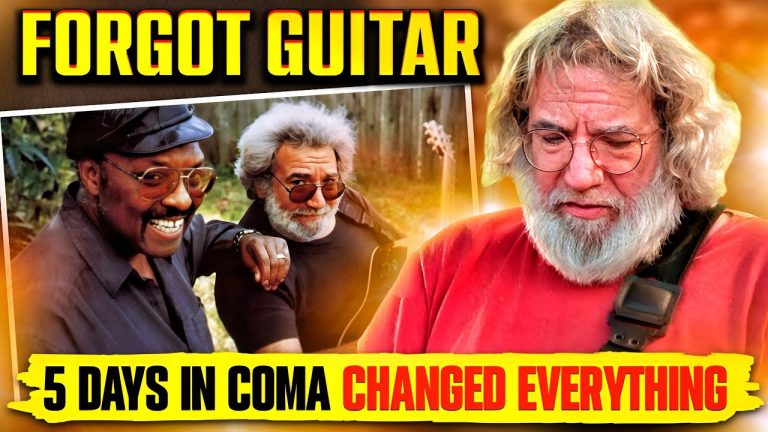
Eighteen months later, Garcia went into a diabetic coma. When he came out, he could not play. Merl Saunders, his old organ foil from the Jerry Garcia Band, came over and started teaching him from scratch — basic chord changes, an hour or two at a stretch, the way you would teach a beginner. The first song Garcia asked to relearn was “My Funny Valentine.”
The post-coma Garcia is a different player, and the return is audible on every tape from late 1986 through the end of the decade. His tone is softer. His attack is less aggressive. Some of the great late-period shows — the ones fans point to when they argue for the 1989 and 1990 bands — are the work of a guitarist who had been taught his own instrument a second time. He was also, briefly, off the hard drugs. The playing reflects it.
Scuba Diving as Oblivion’s Replacement
Bill Kreutzmann certified scuba alongside Garcia at Jack’s Diving Locker in Kona, Hawaii. Garcia described the experience using the same vocabulary he had once used for acid: going somewhere else, weightless, full of new information the surface world did not have. It is a small detail that does more work than it looks like it does. Scuba gave Garcia an approximation of what LSD had given him in 1966 without the chemistry and without the risk to the band. For a window of time in the late 1980s, it was a replacement that worked.
The Forensic Record on Tape
Every chemical era of Garcia’s life is preserved on the live tapes. The acid years sound like long open questions. The cocaine years sound like fast tight answers. The Persian years sound like a man playing the shape he already knows. The post-coma years sound like a guitarist who has remembered what patience was and is using it again with a slightly smaller margin for risk. You do not need the arrest reports or the biographies to hear the arc. You just need a decent soundboard, a good pair of headphones, and the willingness to listen to the same band across thirty years as if you were listening to four different bands, because in every way that mattered to the music, you are.
That is the forensic record. The drugs left a signature on the tape. Once you learn to read it, you can date almost any Garcia solo by ear — and you will never hear the Dead the same way again.
Sources
- Dennis McNally, A Long Strange Trip: The Inside History of the Grateful Dead (Broadway Books, 2002) — Wikipedia
- Bill Kreutzmann, Deal: My Three Decades of Drumming, Dreams, and Drugs with the Grateful Dead (St. Martin’s Press, 2015) — Wikipedia
- Rock Scully, Living with the Dead: Twenty Years on the Bus with Garcia and the Grateful Dead (Little, Brown, 1996) — Wikipedia
- Grateful Dead audio and interview archive — Internet Archive
The Shakedown Archives publishes new research on Grateful Dead history each week. If you enjoyed this essay, you can subscribe to the companion YouTube channel below.
Subscribe on YouTube